Hey trader,
When you place a trade, you assume the prices on your screen are real.
Real buyers. Real sellers. Real money willing to transact at those levels.
That assumption can cost you.
This morning on micro gold, I watched an algorithm fake those prices in real time.
It dangled fake orders above and below the market like bait.
Every time price got close, the bait moved.
Traders who didn’t know what they were looking at walked right into stops they never should have hit.
Here is what I saw, what’s actually going on, and how to spot it before it costs you on the next trade.
A Quick Word On What I’m About To Show You
Every futures contract has a list of pending orders waiting to fill.
Buy orders below the current price. Sell orders above it. The list sits there for any trader to look at while the chart moves.
Professional traders watch that list alongside the chart. It tells you where real money is sitting and where it isn’t.
It’s supposed to show actual demand. Real buyers waiting. Real sellers waiting.
This morning, a chunk of what was sitting there on micro gold was completely fake.
What I Saw On Gold This Morning
Gold gave a clean buy signal off 4690 right out of the gate.
I had the trade typed up and ready. Before I clicked, I glanced at the list of pending orders.
Two things jumped out.
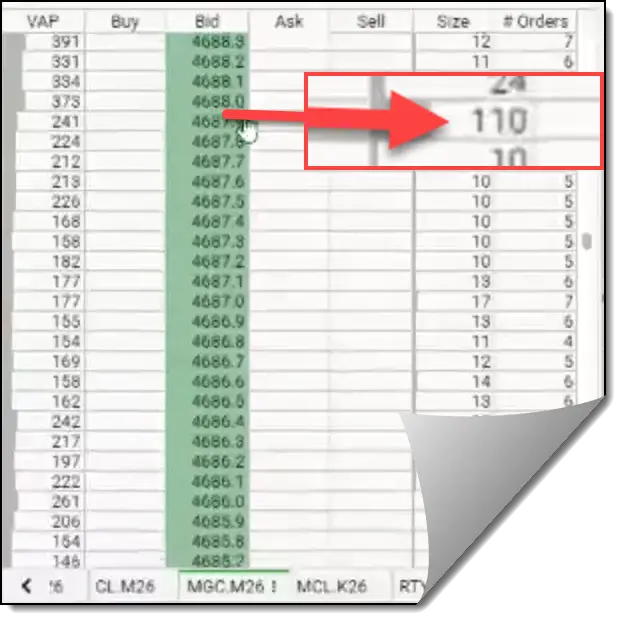
100 contracts sitting above the price. Another 100 contracts sitting below the price. Exact same size. Exact same distance from the market on both sides.
Then I watched.
Every time gold ticked up, the upper block of 100 moved up with it. Every time gold ticked down, the lower block of 100 moved down. They never let price get within five points of them.
Same size. Same distance. Every single tick.
That’s not a person. That’s a machine running a script.
Why It Matters That Those Orders Aren’t Real
The orders aren’t there to fill. They’re there to be seen.
When you see 100 contracts waiting to buy just below the market, you assume there’s heavy support sitting underneath you. That assumption is the whole trap.
You feel safer taking a long. You put your stop just under that “support” because the wall of buyers will protect you.
Then the algorithm moves the bait away. The support vanishes. Price drops through the level. Your stop gets hit.
You just paid the spoofer for the privilege of getting faked out.
This Is Illegal. It Keeps Happening Anyway.
Spoofing has been a federal crime for over a decade.
The CFTC has prosecuted cases. Convictions, fines, even prison sentences are on the books.
None of that has stopped it on micro contracts. Enforcement is slow. The payoffs are fast. The risk to the spoofer is low.
Of every instrument I have personally watched, gold micros are the worst offender by a wide margin.
How To Tell A Fake Order From A Real One
Three signs to watch for.
Real orders sit still. Fake orders chase price.
A real buyer parks an order at a level and waits. They have a reason that level matters to them. A fake order moves with the market because its job is to look like support or resistance wherever price happens to be.
Real orders get filled. Fake orders disappear.
Watch what happens when price moves toward a big block. If the block holds and price bounces off it, that block was real. If the block vanishes just before price reaches it, you just watched a spoof in action.
Real orders show up in messy sizes. Fake orders show up in suspiciously clean numbers.
A real order book has 17 contracts here, 42 there, 8 over there. Fake orders sit in round chunks. Exactly 100. Exactly 50. Exactly 200. That uniformity is the tell.
What This Changed About My Morning
I didn’t take the gold trade.
The signal was clean on the chart. The math worked on paper. The risk-reward was there.
What killed it for me was knowing the order book underneath couldn’t be trusted. If my stop got hit, the fill price was a roll of the dice.
Sometimes the best read on the market is “this isn’t a clean game right now.”
I sat on my hands. The trade ran to target without me. Some traders in the room caught it for $150 per micro. I didn’t count it in my log because I never took it.
That’s a story for another day.
The Bigger Lesson
The chart shows you one version of the market. The order book shows you another.
When those two stories don’t line up, the order book usually tells you what’s actually about to happen next.
A trader who only watches the chart trades blind in markets where this kind of game is being run. You see the price move. You don’t see why.
Learning what sits underneath price action is the difference between getting picked off and seeing the trap coming.
Entry, stop, target, and the gut check on whether the liquidity behind the level is real before any order goes in.
Blake Young
Senior Market Strategist, TheoTRADE