Hey trader,
Think back to the last trade that went green and then slid all the way back to your entry before you closed it.
It makes you start to question yourself…
…was my profit target too far…did I forget to take a profit?
Chances are the stop was tied to the one number that does not matter to anyone but you: the entry price.
That habit quietly turns a good winner into a scratch or even a loss.
Fortunately, there is a better way to manage risk I’m going to show you today.
You see, the market never really sees your entry. It’s buried underneath
It only cares about order flow and what’s on the charts.
That’s how you should set your stop and profit targets.
Now, I’m not saying you should ignore the balance of risk and reward. But that defines whether you take the trade, not HOW you trade it.
It’s a subtle difference, but an important one.
And I’ve got a great example to illustrate this point.
Why Your Entry Price Fails You
Your entry is a fact about you, not about the market. It tells you what you paid, not where buyers or sellers are actually lined up.
When you set a stop a fixed distance below your fill, you are drawing a line the market has no reason to respect.
Price can wander right through it on noise, then turn and go your way without you.
The same trap works on the profit side.
You hold too long because you are “only up a little,” or you bail early because you are “finally green.”
Both of those calls come from your cost, not from the chart.
That is how a good winner slides back to break even. The trade was fine. The reference point was broken.
The Right Way: Anchor to the Chart
The fix is to set your stop and target off the levels the market is actually trading against.
For me, the entry and the target come from my monkey bars.
That is the market-profile map I draw before the open, showing where volume and price have already agreed.
A breakout of a monkey bar gives me a level to enter against and a projected level to target.
The stop is a separate job. It rides the swing structure underneath price, the most recent low on a long or high on a short.
That swing level would prove the trade wrong if it breaks.
Then I only move the stop when price gives me a reason. A fresh higher low on a long lets me trail up. Clearing the halfway mark to target lets me pull to break even.
Every one of those levels exists whether you are in the trade or not.
That’s what I use to make adjustments. Your entry has none of that behind it.
Anchor to structure and your stops line up with where the market is likely to turn.
Plus, reading levels off the chart takes the emotion out of the decision. You stop asking how you feel about the trade. You start asking what price just did.
Now let me show you how all of that held up on a real trade Tuesday morning.
First, a Look at the Tape
Tuesday was a thin one. Volume ran about half of normal into the open.
When liquidity is that light, the market tends to balance in a small range and chop sideways. Not much wants to trend.
One thing was moving with purpose, and that was crude. It climbed most of the session and pulled the dollar up right along with it.
Keep that in the back of your mind. A stronger dollar leans on the Russell, and that pressure was building the whole time I was in this trade.
Deciding Whether to Take It
Here is where risk and reward do their job. They tell me if the trade is worth taking at all.
The Russell broke out above one of my monkey bars, then pulled back and retested it. The retest handed me a long at 3001 with the target up at 3009.7.
Small risk into a clean target meant the reward was there, so I took it.
I went two micros on purpose. This was about showing the room how I manage a position, not swinging for a big number.
Now the Part That Actually Matters
Getting in was the easy decision. Managing it is where the money is made or given back.
Right after I got long, price drifted lower. It printed a couple of lower highs and lower lows.
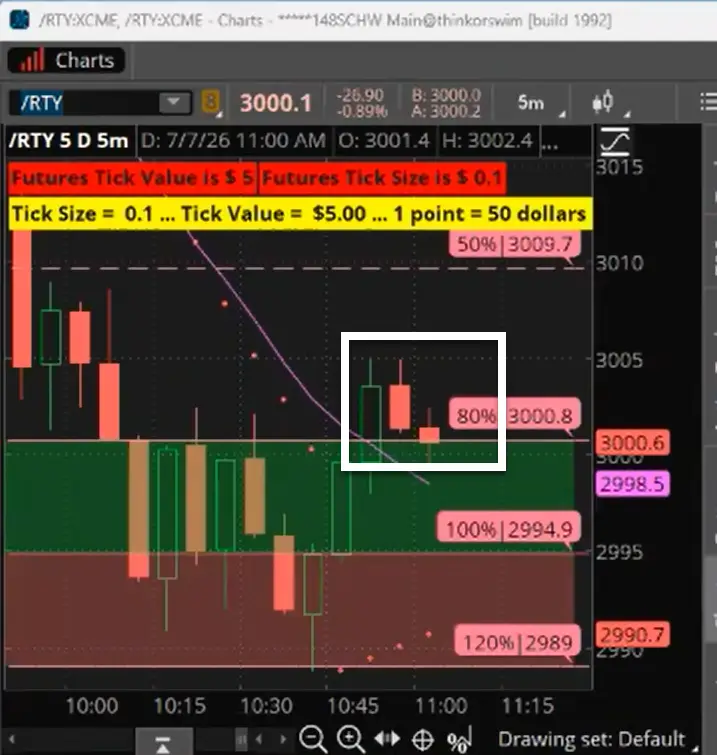
That drift gave me my first level. I pulled the stop up to 2999, the low of that pullback, and my risk dropped to about $25.
Notice what moved the stop. Not my nerves. Not the fact that I was sitting near break even.
A swing low on the chart told me where the trade would be wrong, so that is where the stop went.
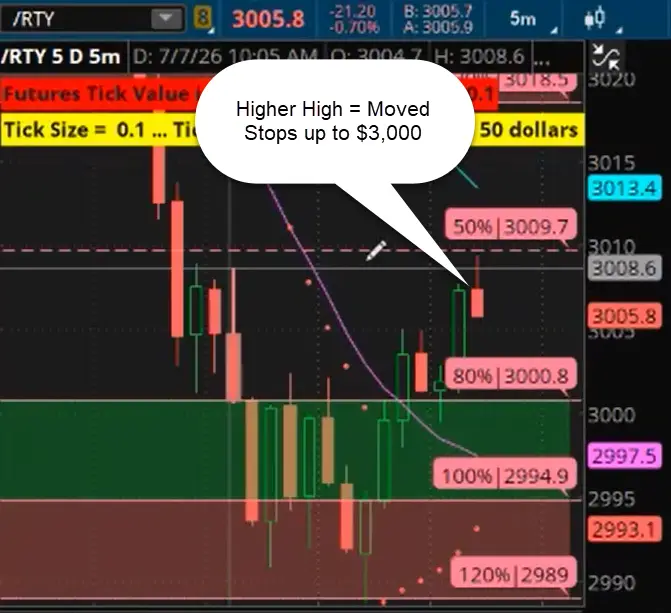
Then price flipped and started working. It made a higher high and a higher low and pushed past the halfway point to my target.
Clearing halfway tells me to stop risking money on the trade. I slid the stop up to 3000.8, right back to the monkey bar.
One more higher low followed. That let me move the stop to 3001, my entry, with nothing left at risk at all.
Every one of those moves came from the same place. The chart earned each adjustment before I made it.
Three Ticks Short
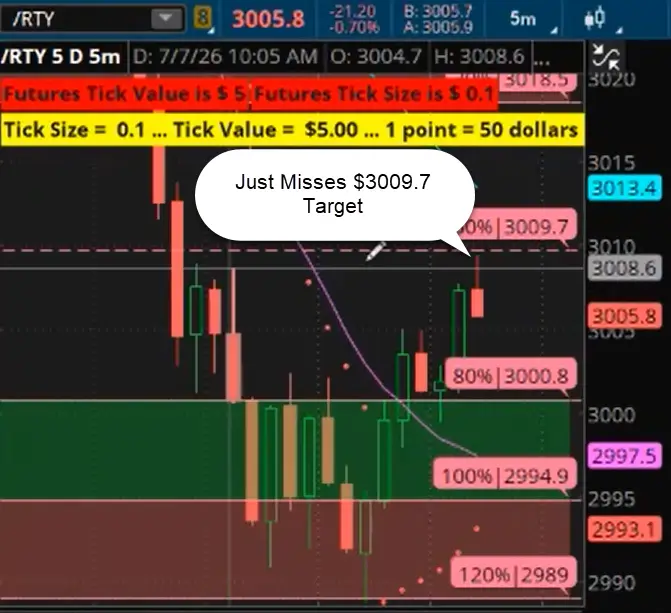
Price climbed toward 3009.7 and ran straight into the prior swing highs. It poked above them but could not close through.
We got a whisker away. The high came up three tenths of a point below the target. Three ticks.
Then the tape turned, right on cue. That crude strength from earlier was still lifting the dollar, and the dollar started dragging the Russell back down.
My open gain had been sitting near $80 a moment before. I took the exit close to my entry for a small profit that paid for the trade.
Why the Miss Did No Damage
A trade that comes up three ticks short can still blow up on you.
It happens when the stop is glued to your entry and you ride the whole move back down, waiting to be proven right.
Mine never carried that risk. By the time it stalled, my worst case was already break even.
The chart had walked my stop all the way up there, one signal at a time.
Run the same routine on your own trades before the next click:
- Set the first stop at the swing low that proves the trade wrong, not a round dollar amount you are willing to lose.
- Trail it only when price gives you a reason, like a fresh higher low on a long or a lower high on a short.
- Once price clears the halfway mark to target, pull the stop to break even so the worst outcome is a scratch.
- Keep one eye on the tape around you. The dollar strength that stalled the Russell was on my screen long before it pulled price back.
Your entry price never makes that list. The market does not know it and does not care about it.
Trade With the Number on the Chart
This is the whole habit behind The 10% Club. Every trade starts with a level, a stop, and a target before the order goes in.
Every adjustment after that comes off the chart.
That structure turned a three-tick miss into a non-event on Tuesday. It also lets you decide on price and structure when your own trade stalls near the line.
I call these live every morning inside The 10AM Bell. Entry, stop, and target before the click, with the reason behind every move I make in the trade.
Every session, no exceptions.
Click here to join us and watch the next one called in real time.
Blake Young
Senior Market Strategist, TheoTRADE