
HMonday’s tape was a mess before the bell even rang. CPI printed a one-minute candle 240 handles wide.
Kevin Warsh was testifying live. Every fresh headline shoved the market another 50 handles in whatever direction it felt like.
I said it to the room plainly. “I think this market’s ultimately just extremely confused.”
I sat on my hands through most of it. I kept asking price to come back to my level. “Maybe we’ll get our 26.”
Then it did. Price rolled down from the 50 into our gold line, with VWAP sitting right underneath.
I bought two contracts. The first one paid.
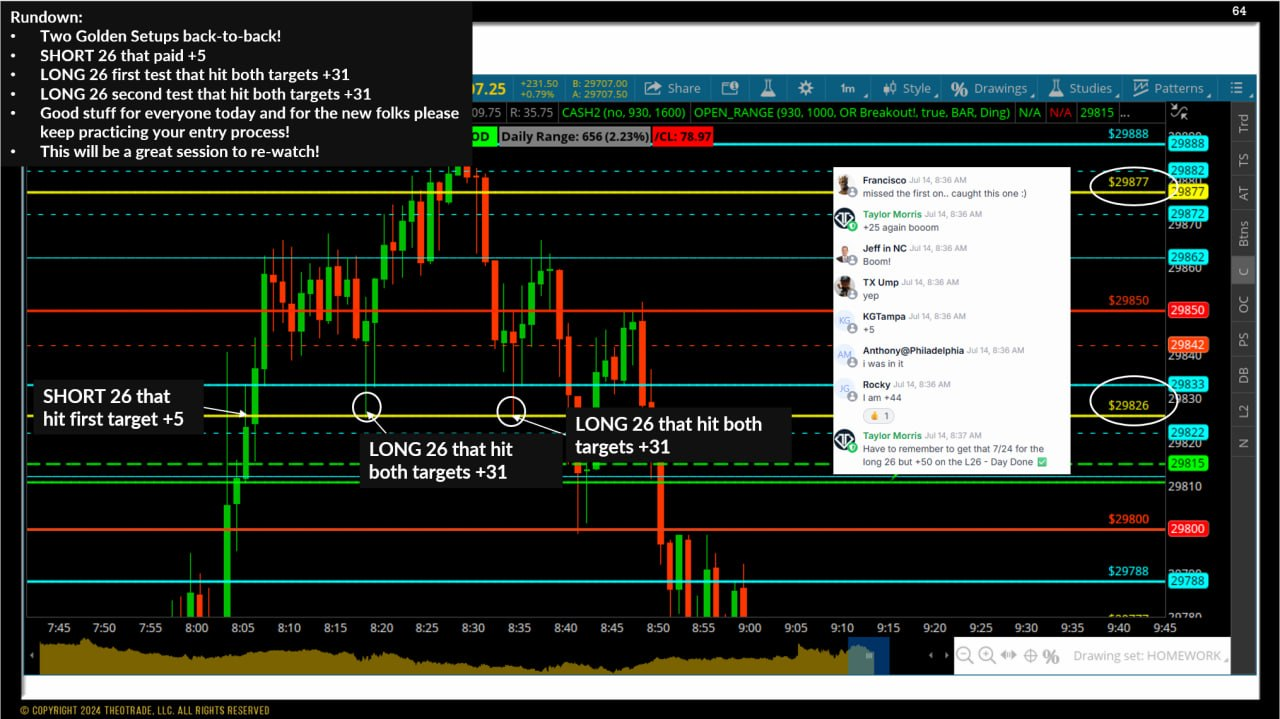
I slid my stop up to my entry. The runner carried all the way to a full +31.
Here is the part I want you to sit with this weekend. That +31 was free the moment my first contract filled.
What “Getting Risk Out” Actually Means
The methodology is not complicated. You buy two contracts at your entry.
You sell one of them when it reaches a plus five or a plus seven. At that exact moment, you place a stop at your entry price.
That stop sits at even. Once the front half books, the math on the whole position changes.
“The definition of getting risk out is once we take profit on that first contract, we cannot lose money after that. We’re in a winning trade. We can’t lose.”
Read that line again. After the front half fills, the worst outcome left is a scratch.
The runner either carries to the full number for a +31, or it drifts back to my entry. If it drifts back, it stops me out at even.
My front-half profit is already in my pocket. There is no version of that trade where I hand money back to the market.
This is what I mean on slide 60 when I tell the room we are in a free trade. “We make money. We get risk out of the trade. We’re in a free trade.”
The front half pays for your peace of mind. The back half rides for nothing.
The Email That Says It All
Paul is newer to the room. He sent me a question this week that a lot of you have quietly wondered about.
“Is there a penalty for putting two targets and not achieving the second?”
I pulled up the slide and walked him through it. You take the first contract for the quick points, then move your stop to your entry.
If price never reaches the second target and comes back, you stop out at even. “There is no penalty.”
That answer is the entire game. A +31 costs you nothing to chase because you removed the risk before the runner had to prove anything.
You are not gambling on the back half. You are letting a house-money contract run while your original risk sits safely behind you at even.
If It Comes Back, I Don’t Want It
There is a mindset welded to this mechanic. It matters as much as the button clicks.
When I buy the 26 off the 50, I am playing a probability. Price came from a red line down into a gold line, so there is a strong chance it works back toward 33.
“If I’m in the right trade, it’s not coming back. If it comes back, I don’t want it.”
That sentence keeps me out of trouble on days like Monday. A winning trade does not drift back to my entry and loiter there.
When price does come back, it is telling me the edge is gone. My stop at even lets it go without a fight.
I will not let a green trade rot into a red one. Getting risk out makes that outcome impossible by design.
It Worked Twice
The best proof that this is a process and not a lucky read is that it repeated. After the first 26 paid its full +31, price set up on the 26 a second time.
It used the same structure, the same entry, the same two contracts. It paid both targets again.
“Boom. Two golden setups right there today.”
The whole room felt it. Rocky, Anthony, KG, Jeff, Taylor, and Francisco all booked pieces of those moves.
The market spent the morning flailing between an inflation print and a Fed governor. The setup never cared about the noise.
It came from the 50. It tagged the 26. It paid.
What This Looks Like Monday
Build your week around one habit. Buy two contracts at your entry every single time.
Take the first one for your quick points to get your risk out. Then move your stop to your entry price and leave it there.
After that, your job is to do nothing. “Getting it done and then not sitting here and trying to take every wiggle on the chart.”
The runner does not need a babysitter. It carries to the full number, or it stops you at even.
Both outcomes are wins. You already won the moment the front half filled.
Skipping that first target is how good traders give money back. They hold both contracts hoping for the whole move in one shot.
When price reverses, they have nothing booked and a full-size loss staring back at them. Taking the front half every time is how you stack winners instead.
“The key is getting the points and keeping them.”
The difference comes down to one mechanical decision. You strip the risk off your first contract so the second one can run with no weight on it.
It is not about a cleaner read or a calmer tape. It is about structure that pays you first and lets the rest ride for free.
Monday’s market was confused all morning. My process was not.
I bought the 26 off the 50. I got risk out on the front half.
I let the back half run to +31. The setup delivered that same result twice.
Do that on your next 26. The confused tape becomes someone else’s problem.
Trade smart,
Tony Rago
Creator of the Golden Setup