
Hey trader,
Your profit target is the reason your winners keep turning back into scratches.
You pick the number you want to earn instead of the number this tape can pay.
The market went into a low volatility shell about three months ago. You’re still pricing your exits off the market that existed before that.
You roll the position and wait for the bigger number. You give back gains you already had in hand.
I set my FITB number out loud before that trade ever went on.
Below, I’ll walk you through the three inputs behind it so you can run them on your next entry.
The Market Sets The Size Of Your Number
Input one is the tape you’re trading in. I run a lot of models and not one of them shows an edge here.
The worst thing you can do in a market like this is force a trade. Money burning a hole in your pocket has never been a reason to enter.
Three months ago this tape would have paid you for a home run. It moved into a low volatility shell instead.
My rule for that runs short. If the market’s low vol, take the gains on the low vol, and if it’s high vol, trade at high vol.
You can’t squeeze blood from a turnip. You don’t have what you used to have, and your target has to shrink to match it.
The Dollar Figure Goes On Before The Trade
Input two is the number itself, and you name it before a dime is at risk. I kept telling the clients at Burn Signal the same line on FITB.
If we could get $3 to $4 out of it, that would be a home run trade. I said it every time the name came up.
I never set my sights at $19 on that stock. A number like that belongs to a different market than the one we’re in.
The clients kept pushing back that the percentage was too small to bother with. That thinking is how traders talk themselves out of the only gains this market is handing out.
Where The Levels Go
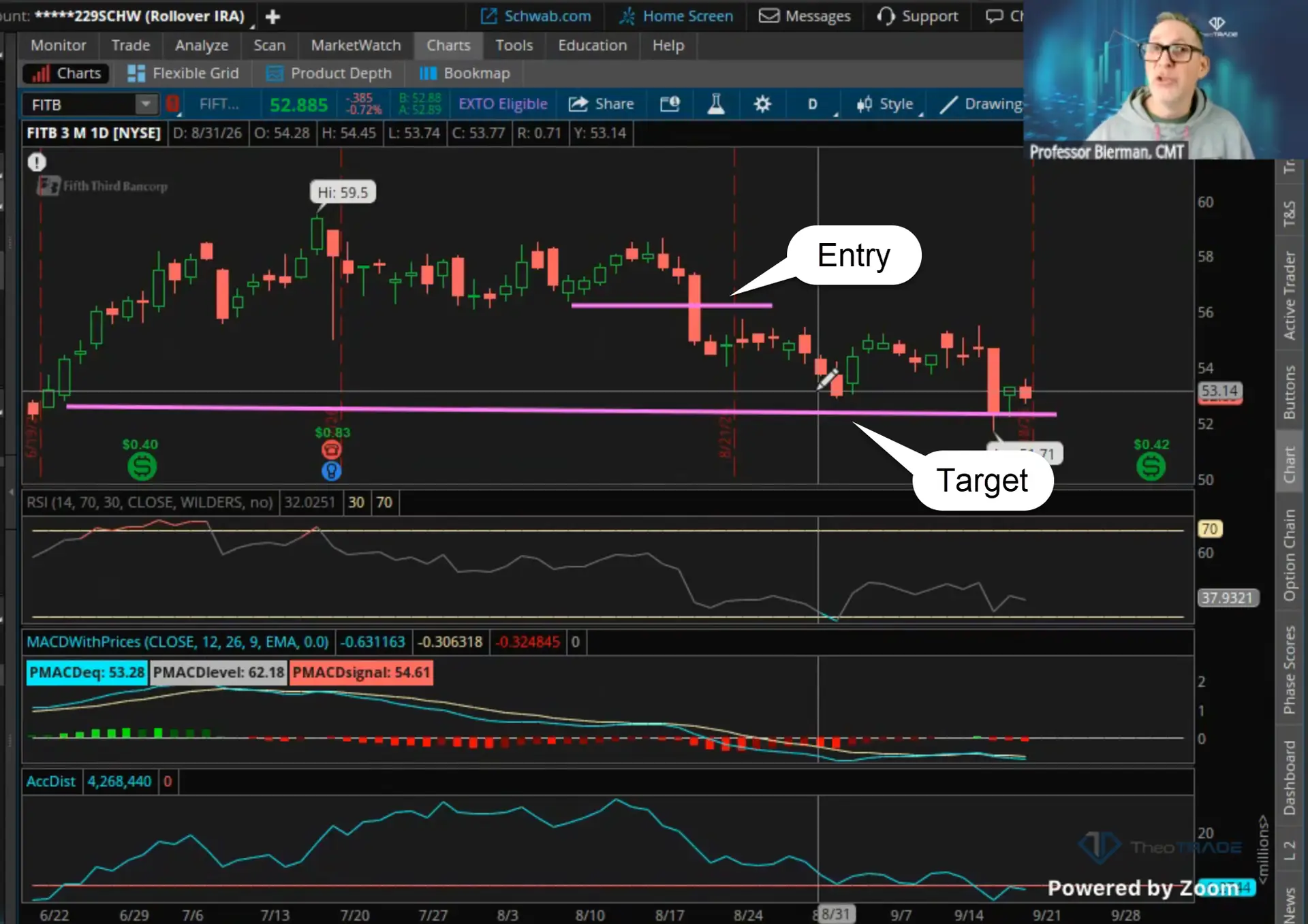
Input three is the level, and FITB had one on both ends. I got short at $56.20 on the breakdown, bought puts and shorted the stock at the same time.
I took the options off at $52.25. That’s $3.95 of movement against a target that called for $3 to $4.
Republic Services Group runs on the same two numbers. A short goes on at 230, and a long is worth considering at 200.
That long comes with a clock attached. One week is all I’d give it, because the institutions defended that stock from January to March and haven’t since.
Clorox got the same treatment when it turned into more grief than I wanted. I decided a move back to the 96 or 97 level would get me out.
The hedge follows that logic every time. When I’m long I’ll buy a put, and when I’m short I’ll buy a call.
Why $3.95 Was The Whole Trade
Those options expired Friday. I closed them rather than roll them into the next expiration.
Clients made about 50% to 60% on the option position. I got what I wanted out of it.
I’m still short the stock. Taking the options off didn’t close the trade, and if it pops again I’ll put the option back on.
You rinse, lather and repeat until the math does the work for you. That habit builds accounts, and swinging for the fences drains them.
We look for singles on these trades. We closed one out on Friday.
This market won’t reward you for home run trades. Not now it won’t.
What This Means For You
Three moves turn all of this into something you can run on your next trade.
- Name your home run number in dollars before you enter, and say it out loud to someone, the way I gave the Burn Signal clients $3 to $4 on FITB
- Size that number to the volatility the market is handing you right now, because a low vol tape will not pay out a high vol target
- Put a level on both ends before you click, the way $56.20 and $52.25 were set on FITB, and close the trade when the second one prints
The first move does the most work. A target you committed to in front of somebody else survives contact with the market, and a target you keep in your head does not.
The third one catches the mistake that costs the most. You had the gain in hand at the level you named, and holding past it hands the money back.
Your Next Step
Pull up the trade you’re closest to entering. Write the dollar target on it before you click anything.
Check that number against what this tape has actually paid over the last month. Cut it if the recent range says the move isn’t there.
Then set the level where you’ll close and hold yourself to it. Low volatility markets pay in singles, and taking them is not a consolation prize.
The Burn Room holds 200 traders, and the 16-trade streak is still running.
CLAIM MY SEAT IN THE BURN ROOM
Take the single, then go take the next one.
Professor Jeffrey Bierman
Creator of the Genesis COG System