Hey trader,
A trade that goes nowhere still costs you.
Your risk stays on the table the whole time you wait for a move that may never show up.
I use a simple candle count to decide when a stalled trade has to go. You can run it on your own chart tomorrow and stop waiting on dead positions.
Holding on feels like patience. On a momentum trade, that patience mostly gives the market time to turn against you.
A Bollinger Band breakout is one of those momentum trades. The signal fires when price closes outside a band built around its normal range.
On Friday, I shorted the Euro off one of those breakouts. I had $62.50 at risk.
I told the room up front that I didn’t love the setup.
Price sat still for several candles. When it finally ticked my way, I got out anyway for one tick.
In the same room, I gave an equally quiet MES long all the time it needed. That one went on to hit its target.
Those two trades ran on two different clocks. Here’s how I decide which clock a trade gets, and exactly when mine runs out.
Two Signals, Two Clocks
Every signal I trade carries a clock. The kind of signal decides how long that clock runs.
A Bollinger Band breakout runs on momentum. When the push behind the breakout dies, my reason for the trade dies with it.
My beacon trades run on time instead.
Beacons are levels I map for each market at 0%, 20%, 50%, 80%, and 100% of a range. Price can take hours to work through them.
My line on momentum trades is four candles. If price hasn’t moved my way by the fourth candle after the signal, I work my way out near breakeven.
A breakout doesn’t have to hit its target in four candles. It just has to move.
I run the same four-candle count on divergence setups. Beacon trades don’t get that clock at all.
Friday’s Euro Short And MES Long
The Euro gave me a bearish Bollinger Band breakout right after the University of Michigan consumer sentiment report. My stop sat at 1.1442 with a target of 1.1431.
On Euro futures, one pip is worth $12.50. One tick is worth $6.25.
My stop sat about five pips away, which put $62.50 at risk on one contract.
A stop that tight can get hit in seconds after an announcement. At one point, a single candle stretched as wide as my entire stop.
I told the room I really didn’t like it.
A trade’s a trade, though. The signal met my rules.
By the fourth candle after the signal, the Euro still hadn’t moved.
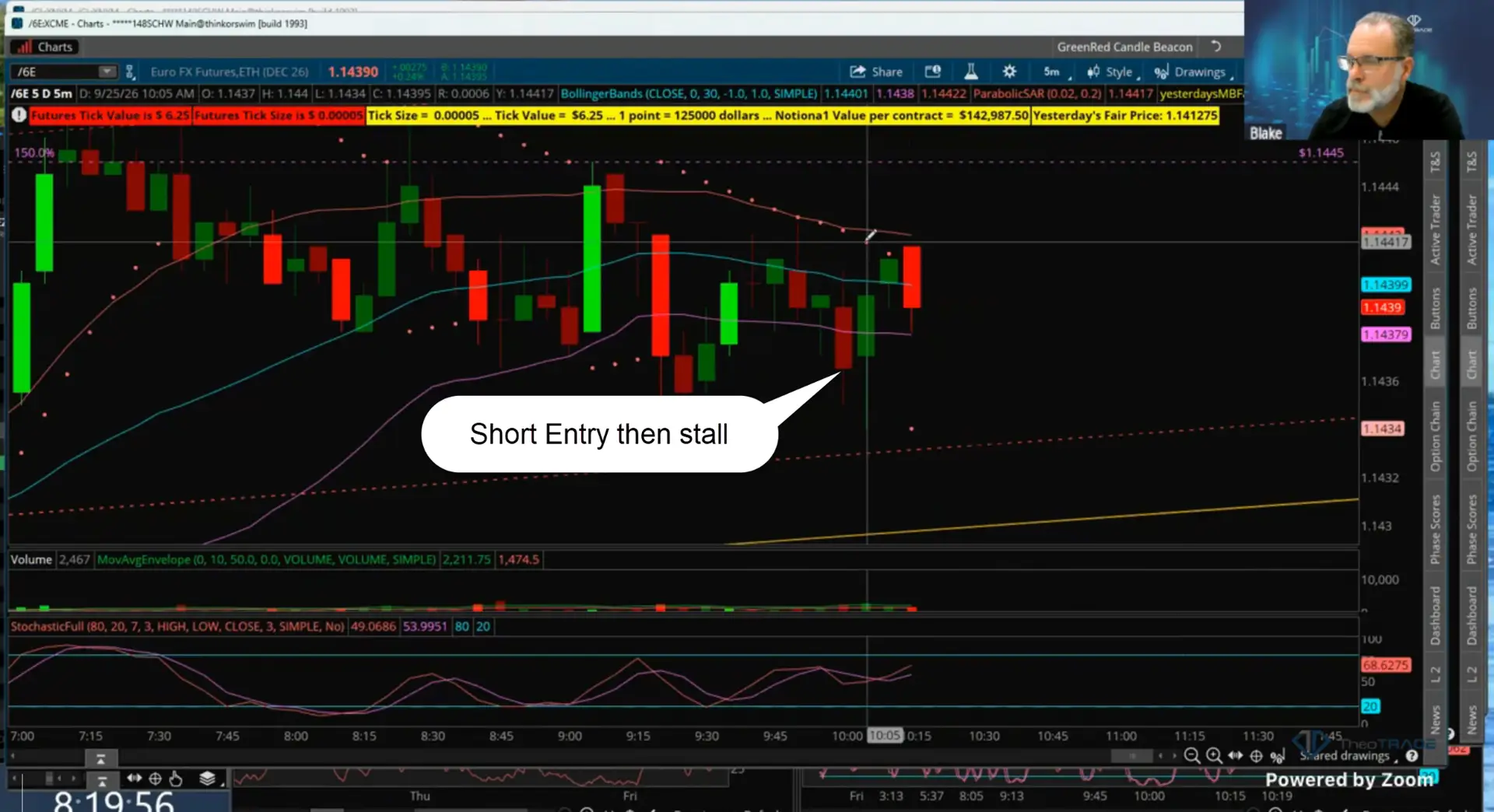
I set a limit to close for one pip of profit. When that sat unfilled, I took one tick instead.
The Euro finally ticked my way while I waited on that fill. I still wanted out, because it had gone sideways for hours with the dot sitting below us.
That dot is the Parabolic SAR, an indicator I use to trail my stop candle by candle.
I told the room the Euro might run lower right after we got out. I’ll accept that outcome before I’ll hold a momentum trade that has stopped moving.
My MES beacon long sat just as quiet in the same room. MES is the micro S&P 500 futures contract.
Twenty points on one MES contract comes to $100.
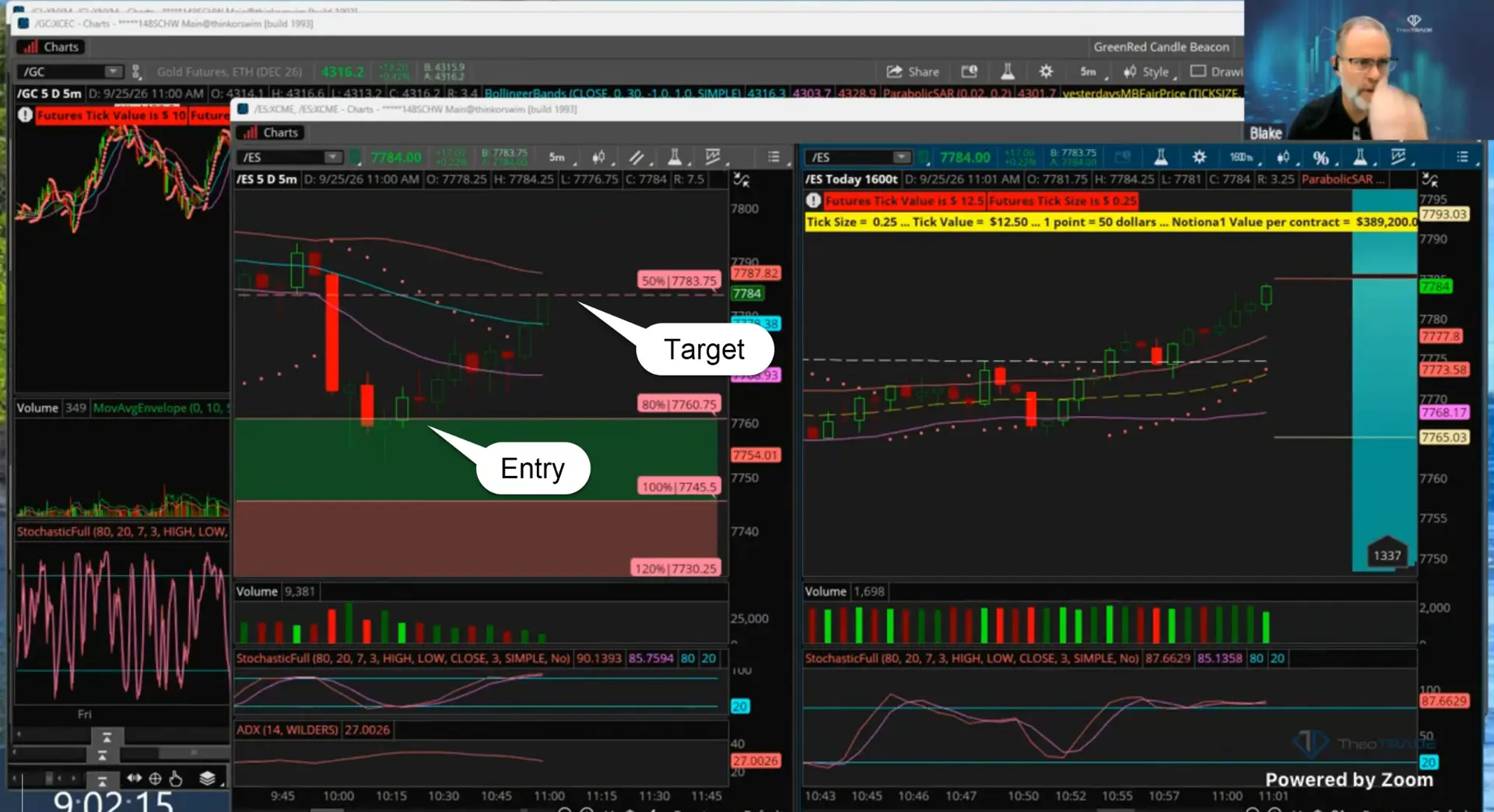
I got long at 7764 after a confirmed close above the beacon, with a target of 7783.75. My stop started at 7745 and moved up to 7752 after a one-candle reversal.
That trade didn’t do much for a while either. I kept it, because a beacon runs on time.
I kept trailing the stop into the futures room, first to 7760 and later to 7768.50. The MES eventually broke higher and hit its target.
Two trades from the same morning got very different amounts of time. Each one got the clock its signal called for.
Running The Count On Your Own Chart
You can put this to work on your next trade with three habits.
- Name the signal type before you enter. Momentum breakouts get the four-candle clock, while beacon setups get room to develop.
- Start counting at the signal candle on the timeframe you traded. If price hasn’t moved your way by the fourth candle, start working an exit.
- Rest a limit a tick or pip in your favor instead of dumping the trade at market. I did that on the Euro to pay for the trade.
That’s my line, and it doesn’t have to be yours. A member asked me about leaving his stop alone and letting the trade play out.
I told him I don’t have a problem with that all-or-nothing approach. Those setups still hit the target before the stop close to 70% of the time.
Inside the 10% Club, I call these clocks out loud while the trades are live. You see the entry, the stop, the target, and every exit call in real time.
You’ll watch me scratch the stalled momentum trades and give the beacon trades the time they need.
Give a breakout four candles to move, and let it go when it won’t.
Blake Young
Senior Market Strategist, TheoTRADE