Hey trader,
Risk management separates the traders who make money from the traders who lose it.
Position sizing sits at the heart of it, and nothing else I teach matters as much.
Setups get far more attention anyway. Charts are fun, and a fresh signal is a lot more exciting than a position-size calculation.
Managing risk doesn’t have to be hard, though. If you only follow one position sizing rule, make it this one: size the trade from the stop.
You place your stop first, wherever your rules say it belongs. That stop then tells you how many contracts you can afford to trade.
On Wednesday, a member in the room said his stop-outs kept hitting his daily loss limit before price came back off his levels. I asked whether he was risking too much on each trade.
Skip this rule and a run of ordinary losses can end your day before your setups get a chance to pay you. A losing streak is part of trading, and your size decides whether you survive it.
Position sizing this way takes two numbers and one division. It works in nearly every situation, and you can run it before your next trade.
I’ll walk you through the math using a Euro trade I broke down for the room Wednesday.
Why Position Sizing Starts With The Stop
Your stop belongs wherever your rules say the trade is wrong. I let the chart set that level before I ever think about size.
I call the distance from entry to that stop the trade risk. I measure it from the initial stop, never from a tighter stop I hope to move to later.
Portfolio risk is the other number. It’s the slice of your account you’re willing to lose on any single trade.
Divide your portfolio risk by your trade risk, and the answer is your size.
When a full stop costs more than my account allows, I don’t drag it closer just to make the number work. I’ll only tighten it if the chart gives me a real barrier, like a recent low.
Position sizing matters most during a losing streak. On a system that wins twice what it loses, I expect six losers and three winners as a normal pattern.
I told the room Wednesday that proper position sizing lets you tolerate a string of losses and still take the next trade.
The Position Sizing Math
Start with your account. Multiply it by the percentage you’re willing to risk, and you have your portfolio risk.
A $5,000 account at 2% gives you $100 per trade. A $50,000 account at 2% gives you $1,000.
Trade risk comes from the chart. Measure the distance from your entry to your initial stop, then multiply by what each point, tick or pip is worth.
You can run that number on a full contract or a micro. The answer comes out the same either way.
Here’s the whole position sizing process in three steps:
- Find your portfolio risk. Multiply your account size by your per-trade percentage.
- Find your trade risk. Multiply the distance to your initial stop by the dollar value of each price step on one contract.
- Divide the first number by the second. The result is how many contracts fit your budget.
If the answer comes out below 1, step down to micros. A micro contract is one-tenth the size of a full contract, so 0.6 of a full contract becomes 6 micros.
Wednesday’s Euro Trade, Sized
Euro futures track the Euro against the U.S. dollar. On a full-size contract, each pip is worth $12.50.
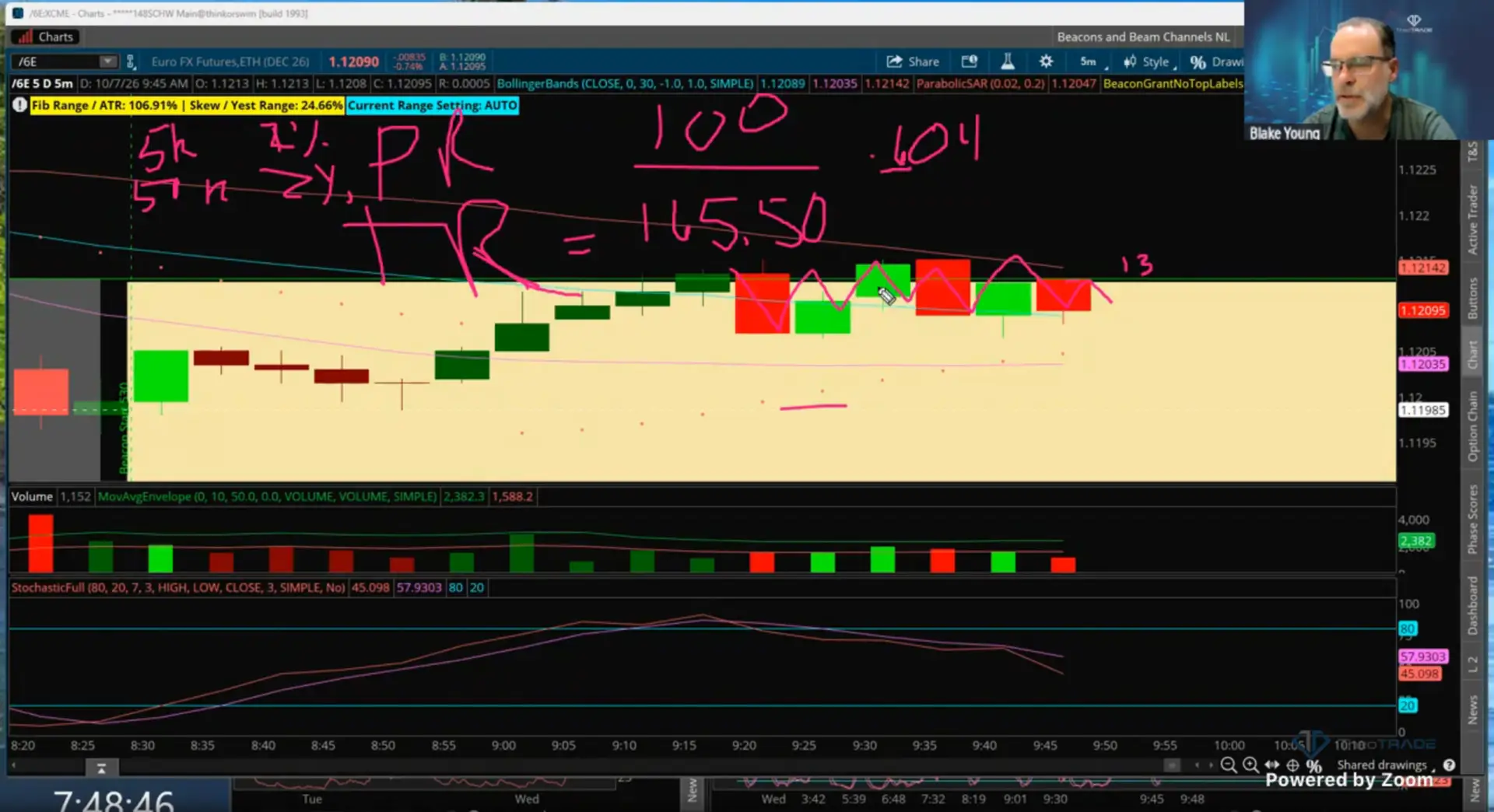
On Wednesday, the Euro gave me a long at 1.1213. I walked the room through the position sizing using the full stop at 1.1200, the zero level on my map of the day’s range.
That’s 13 pips of trade risk. At $12.50 a pip, one full contract puts $162.50 on the line.
A $5,000 account risking 2% has $100 to work with. Divide $100 by $162.50 and you get about 0.6.
That rules out a full contract.
It works out to 6 micros, which keeps the risk just under $100.
Those 6 micros carry the same dollar risk on every trade, because every trade gets built off the same budget.
The trade I called in the room used a tighter stop at 1.1205, with a target of 1.1235. That put $100 at risk on a full contract or $10 on a micro.
Price climbed to 1.12215, then reversed hard on heavy volume. I called for an exit at breakeven, the drop tagged my tightened stop at 1.1210, and I booked a 3-pip loss.
The next Euro signal that morning ran all the way to the 1.1235 target.
Put A Ceiling On The Day
Position sizing protects you on one trade. A daily limit protects you on a string of them.
I risk 2% per trade. I never want you losing more than 5% in a day, and I’d rather you stop at 4%.
I rarely give up the full 2% on a trade, because I move my stop up as the trade works. It usually takes a big reversal candle to hit the original stop.
If 5% feels like too much, back off the risk on each trade. That’s my line, and it doesn’t have to be yours.
You can put this to work before tomorrow’s open:
- Set your budget before the bell. Write down your account size and the percentage you’ll risk per trade.
- Size every trade off the initial stop. Divide your budget by the trade risk, then round down to whole micros.
- Set a daily ceiling. Pick a number between 4% and 5%, and stop trading for the day when you reach it.
On Wednesday, I ran this position sizing math live in the morning room. That afternoon, our coaching session picked the conversation back up with daily loss limits.
We hold those coaching sessions every month inside the 10% Club. Every trade I call in the room comes with an entry, a stop and a target, so you can size it before you take it.
Set the stop first, then let it tell you how many contracts to trade.
Blake Young
Senior Market Strategist, TheoTRADE