
Hey Trader,
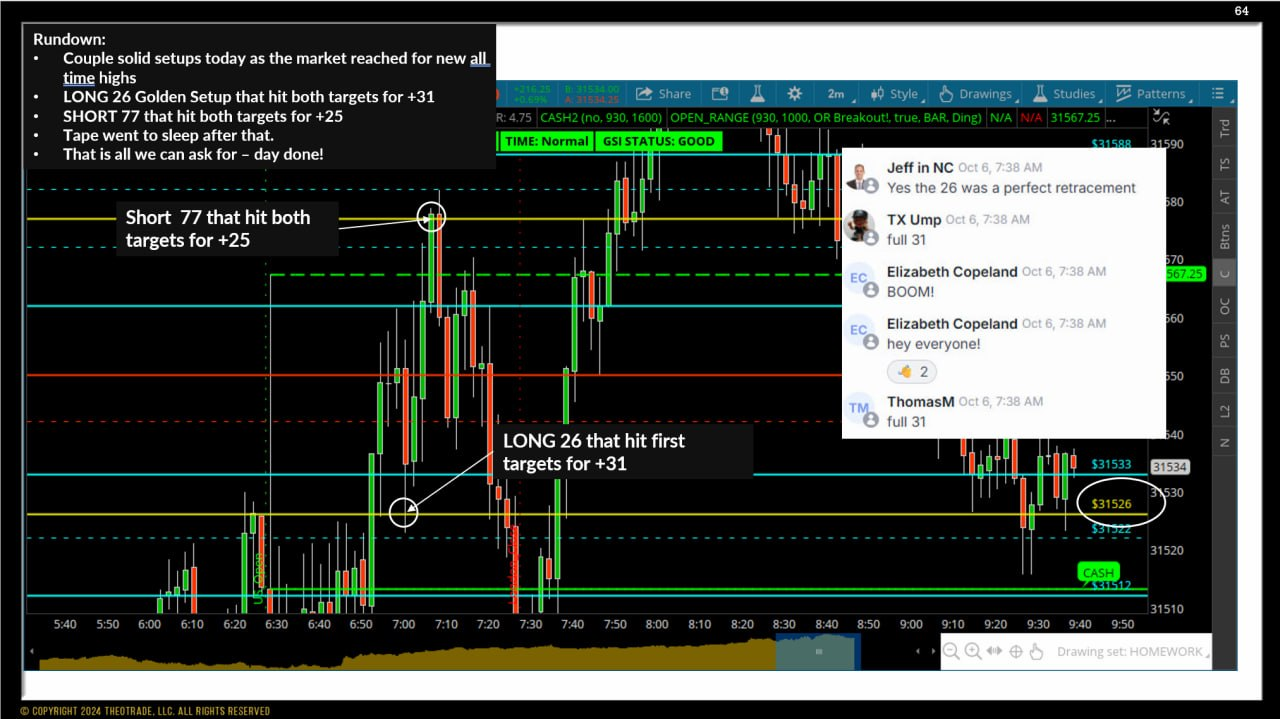
Tuesday morning gave the Golden Setup room two long 26s off the same 50. A break even stop protected both of them.
The first one paid both targets for a full 31. The second one barely went up.
That second trade lifted just far enough to activate the break even stop on our bracket. Then it rolled back to the entry.
We walked away at even. I’m happy with that result.
“We don’t let green trades go red. We’d rather get stopped out at even and have another go at it.”
You ask a stop loss to do two jobs. You want it to give a winner room to run, and you want it to protect you the moment the trade turns.
You’ll never get both jobs done 100% of the time. Nobody can, because those two goals pull against each other on every trade.
I stopped trying a long time ago.
I built my risk management around how people actually trade instead. My stop only moves when a specific condition shows up on the chart.
Everything else stays fixed. Every Golden Setup trade starts with the same 15-point emergency stop.
Once one of those conditions locks in a profit, the trade can’t go bad on me.
You’ll learn when I set a break even stop and the 10-point line that tells me to escape a trade early.
You’ll also see how one homework trade turned a full emergency stop into a minus 3.
A Stop That Only Moves on a Signal
Quick orientation first. My levels repeat inside every 100-point block on the NQ, so a 26 sits 26 points above a round number with the 33 and the 50 above it.
On a long 26, the 33 is my first target. The 50 is my second, and I trade two contracts so each target closes one of them.
Every trade goes on with a 15-point emergency stop. That stop exists for the trade that goes wrong and keeps going.
“You have to have a stop because, let’s say you were late to the party here and you got stopped out right here. When do you want to cover?”
Once I’m in, I manage the trade. My stop only changes when one of three conditions shows up.
Condition One: The First Target Sets My Break Even Stop
Tuesday’s first 26 long trade tagged the 33. That’s plus 7 on the first contract.
When I took off that first contract, I set a break even stop at my entry on the second contract.
“We then have an even stop, which means we can no longer lose.”
Price finished the move to the 50 for the second target. Those 24 points plus the first 7 make the full 31.
The short 77 followed the same logic in the other direction.
We took the first part of the trade and placed a break even stop. Price came back down to the second target for plus 25.
Once the first target pays, the break even stop puts my worst case at even for the rest of the trade.
Condition Two: The Bracket Sets a Break Even Stop on Its Own
Tuesday’s second long entry at 26 worked out differently than the first. It moved just far enough to trigger the break even stop built into our bracket.
You see, once price moves up enough, I move my stop to breakeven, even if I haven’t hit that first profit target.
“This barely went up. It did activate our even stop on the bracket. And we avoided a loss.”
That protection costs something, and I told the room exactly what. A trader who froze on that trade might have gotten paid anyway.
“If you went deer in the headlights here, you might have got your 33. If you didn’t go even, you had a green trade here and you let it go red.”
Holding without the break even stop might have worked on Tuesday. On another day, the same choice turns a green trade into a full 15-point loss.
I’ll give up the occasional 7 to make sure I never hand back a winner. I chose that balance on purpose.
Condition Three: 10 Points of Heat
I use the third condition on trades that never go green.
I don’t want more than 10 points of drawdown on any trade. When price gets there, I start looking for an exit near my entry with a max stop loss of 15 points.
I gave the room an example off the short 77. If price ran to 87, the emergency stop would still be sitting up at 92.
“If this went to 87, I would tell everybody we need to escape at 80.”
Getting out at 80 costs 3 points. I call that exit my escape hatch.
The GSI tells me how likely I am to need it. A yellow or red reading warns me that a trade could get into trouble fast.
What the Homework Showed
After Tuesday’s trades were done, I pulled up September 29th on a tick chart with the room.
“You don’t have to believe me. I don’t want you to believe me. I want you to go look at this stuff for yourself.”
That day was ugly. One short 26 ran straight to the 36, which put it 10 points against us.
Price came back down and let us out at the 29. That’s minus 3 a contract, or minus 6 on two contracts.
“As opposed to if we didn’t take what I call an escape hatch, we got stopped out for the emergency stop.”
A full emergency stop costs 15 points on each of two contracts, or minus 30. The escape hatch saved 24 points on that one trade.
The Golden Setup went 4 for 7 that day. It took one full emergency stop and a couple of escape hatches.
I want new traders to see days like that one before they risk real money.
“It shows you that the emergency stop when it is hit is not the end of the world.”
Put Your Break Even Stop Rules on the Chart
Write your stop conditions down before the open. Mine fit on a sticky note: a break even stop after the first target, the automatic break even stop in the bracket, and an escape at minus 3 after 10 points of heat.
Build the break even stop into your bracket order so the platform moves it for you. Your hands stay off the stop the rest of the time.
Mark your 10-point line the second you’re filled. On a short 77, that line sits at the 87. On a long 26, it’s the 16.
Then do the homework. Open slide 60 of the Masterclass deck, pull a tick chart, and grade every setup between 10 a.m. and 3 p.m.
Count how often the escape hatch kept you away from the emergency stop. That number will tell you more about your risk than any opinion I could give you.
Looking Ahead
Earnings season is close. Netflix is always the first to report, and it’s up on the 20th.
My stop conditions won’t change when the tape picks up. Those three conditions will still be the only reasons my stop moves.
Tuesday’s second 26 didn’t pay me a single point. It didn’t cost me one either, and I’ll take that trade every time.
The bracket, the break even stop, and the escape hatch rules I used this week live inside my Golden Setup.
Trade smart,
Tony Rago
Creator of the Golden Setup