Hey trader,
On Monday, a member named Walter landed in a long Euro futures trade, a bet that price would rise. He never meant to take it, and now he had to decide where to exit a trade he didn’t plan.
I told the room to manage a trade like that with fresh eyes.
Picture your cat walking across the keyboard and opening a position for you. You’d have no story about why you’re in it, only the chart in front of you.
I want that mindset on every trade, including the ones you take on purpose.
Once you’re in a trade, bias creeps in. You start setting your stop at a dollar amount you can stomach instead of where the chart says you’re wrong.
I fix that with one question. It tells me where to exit a trade whether I’m long, short or in a position I never meant to take.
Here’s the question I ask, and how it showed up on two Euro trades Monday.
Why Your Entry Makes It Hard To Exit A Trade
Every trade comes with a story. You remember why you got in, what you hoped for and how much you can stand to lose.
That story makes a poor guide when it’s time to exit a trade. The chart doesn’t know your entry price.
Walter’s mistake stripped the story away. He never meant to get long, so he had nothing to defend.
I told the room to treat every trade that way. If someone else had put you in the position, you’d manage it from the chart alone.
Manage every trade as if someone else put you in it.
The Question That Tells Me Where To Exit A Trade
Here’s the question I ask on every open position. Where would I take the opposite trade?
If I’m long, I ask where my rules would put me short if I were flat. That level becomes my exit on the long.
The same logic works on the downside. If I’m short, I find where I’d buy, and I get out there.
Exit a trade where you’d take the opposite one.
A level that would flip you to the other side marks the spot where your trade has been proven wrong. That makes it the right place to exit a trade, and the question forces you to find it on the chart.
It fixes your stop, too. I told the room not to set a stop based on how much money they’re willing to risk.
Let the chart tell you where the stop goes.
Two Euro Trades From Monday
My own Euro long on Monday shows the idea at work.
I got in near 1.1249 with a target of 1.12655.
I moved my stop to 1.1243, one pip below the low of a reversal candle. Price came back down and stopped me out.
A few minutes later, the Euro gave a short signal on a close at 1.1244, aimed at 1.1235. I talked through it in the room but didn’t take it.
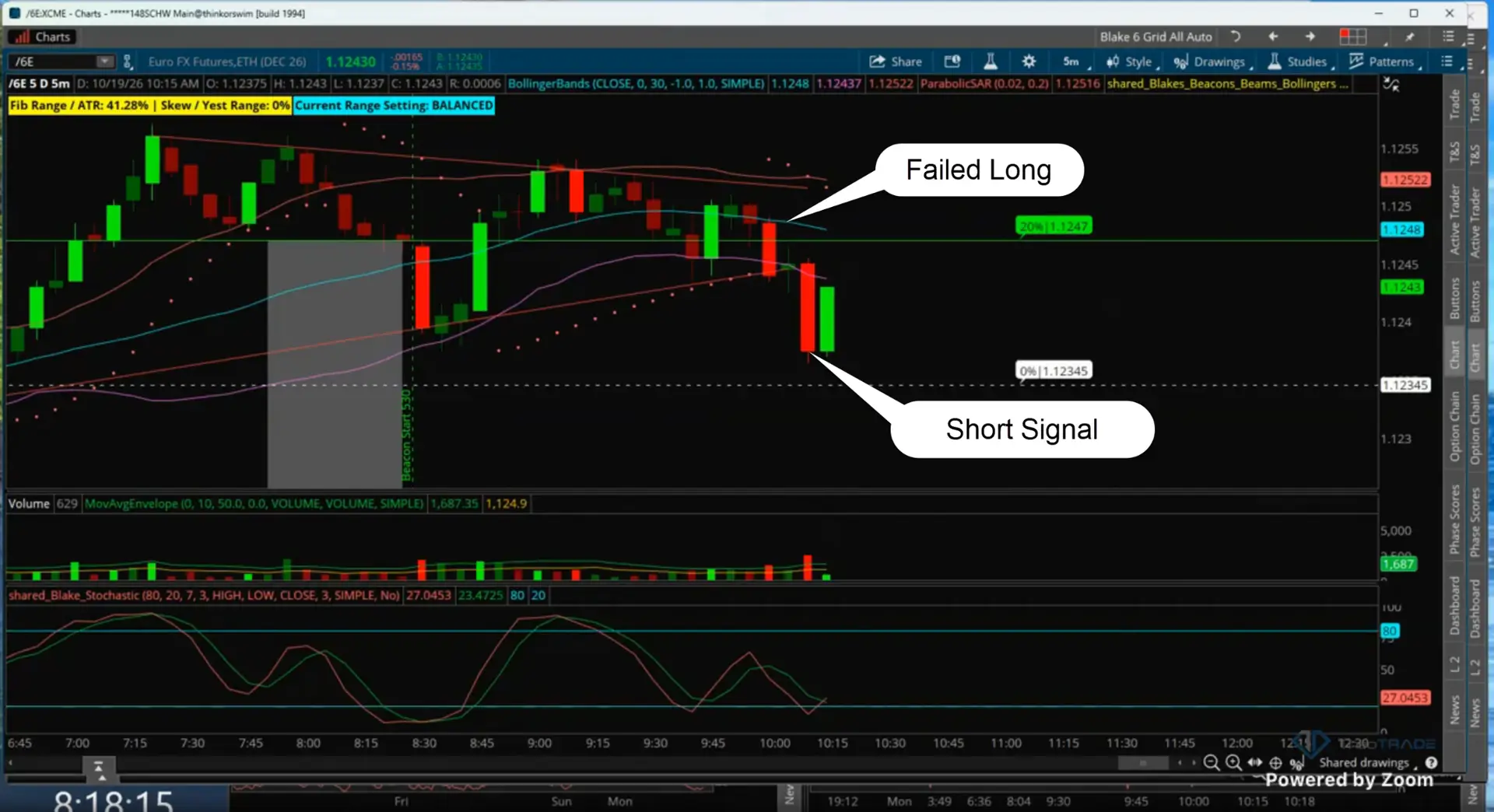
The level that ended my long sat one pip from the level that started a short.
Walter’s trade ran the question in reverse. He was long by mistake, so I asked where a short trader would flip to the buy side.
The chart showed a bullish divergence. That forms when price makes a lower low but momentum doesn’t, a sign sellers are losing their push.
I told the room a close above the close price I marked would be my signal to buy. A short should exit there, and Walter’s accidental long could end up paying him.
I never confirmed whether that signal triggered before the session ended, so I won’t claim a result on Walter’s trade.
If the answer says you’re on the wrong side, sometimes you should bite the bullet and exit a trade right away.
If it says stay, you still need a stop. In Walter’s spot, I’d have put it below a pirate flag, my name for any candle with a higher high and a lower low.
Run The Question On Your Next Trade
You can run this on your next open position in three steps:
- Name the opposite signal. Ask what would make you take the other side if you were flat right now.
- Put your exit there. Plan to exit a trade at that level rather than at a dollar amount that feels comfortable.
- Ask again with fresh eyes. As new candles print, reevaluate where you’d take the opposite trade.
I think traders who manage this way are going to come out ahead. That’s my line, and it doesn’t have to be yours.
Walter got that read in the room while his trade was still open. I answer questions like his live, every morning, inside the 10% Club.
Every trade I call comes with an entry, a stop and a target in the alert. You hear why I move a stop, and when I exit a trade, while it’s still working.
Once a month, usually on the first Wednesday, we hold a coaching session. New members can start with the Start Here section and the masterclass.
Exit a trade where you’d take the opposite one.
Blake Young
Senior Market Strategist, TheoTRADE