Hey trader,
The Fed announces its rate decision tomorrow. If you plan to trade the Fed, the market already dropped a clue on Tuesday.
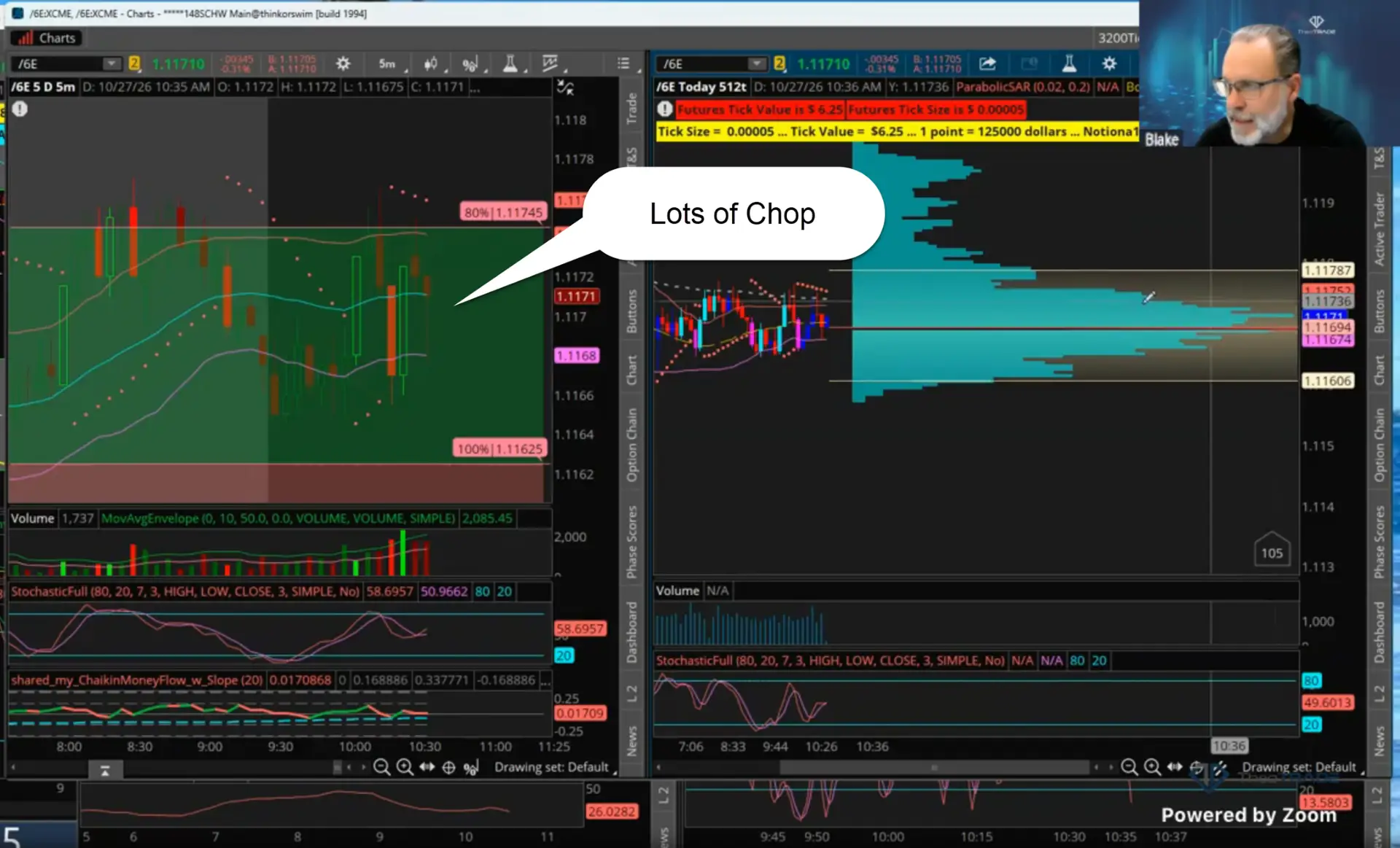
The Euro sat stuck for 4 hours.
I told the room I was surprised to see it coil up ahead of the Fed already. Volume faded candle after candle once the morning’s economic reports passed.
The calendar stays crowded after Wednesday. GDP and PCE, an inflation report I watch more closely than CPI, both land Thursday.
Guessing the Fed’s answer turns a trade into a bet on one headline.
Before I pick a side, I check what options cost. Implied volatility drives that cost, since it measures how much movement the options market is pricing in.
On Tuesday, a member asked how to trade the Fed outcome. I told the room implied volatility might still be low enough to make it a straddle or strangle day.
A straddle buys a call and a put at the same strike. A strangle does the same at two different strikes, and both pay when price moves far enough either way.
I’d only buy one after a quick check.
I also keep a few other rules all week.
Here’s how I plan to trade the Fed, starting with the trades I’m sitting out.
The Trades I Sit Out Before I Trade The Fed
Big scheduled reports change how I trade the Euro. I won’t trade it during GDP, PCE or CPI.
Outside those windows, I don’t put a time limit on it. I’m fine trading the Euro as early as 5 minutes after a report.
I also hold off on fresh signals right before a release.
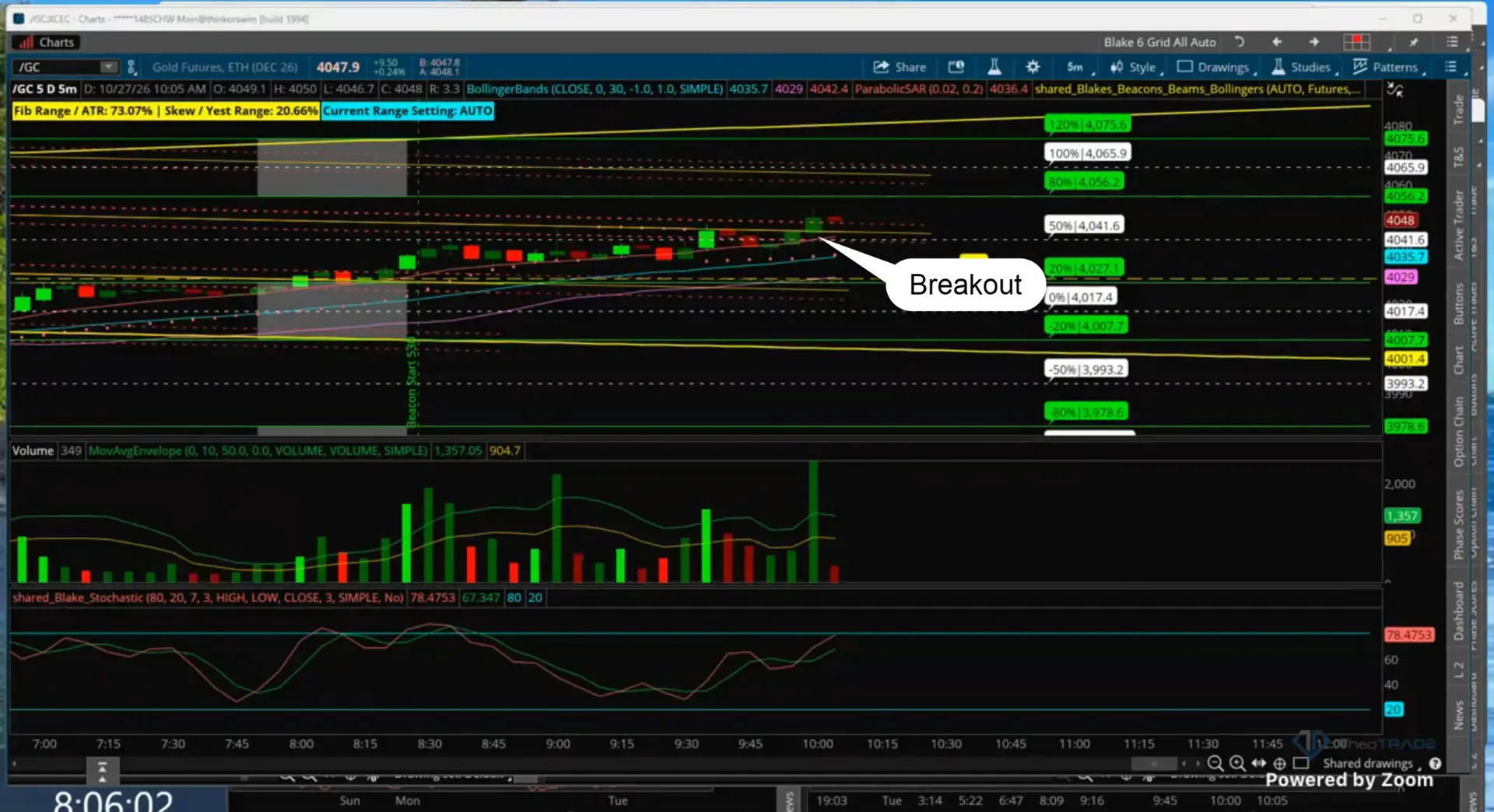
On Tuesday, gold flashed a breakout buy signal with consumer confidence about 3 minutes away. I held off because the report could turn volatile.
I’d rather be out of a trade wishing I’d taken it than in a trade wishing I hadn’t.
The report came in much better than anticipated, and nobody cared. I called it a big nothing burger.
Gold pulled back after the release and gave me a channel breakout at 4047. I closed that long at 4063 for $160 on one micro contract.
What I’m Watching Around The Decision
The expectation is no rate change on Wednesday. I don’t expect much guidance, so I think the statement will matter most.
Generally speaking, Fed Day goes up.
On Tuesday, the S&P 500 futures cleared their overnight highs. I told the room maybe we were getting it all a day early.
The Euro looked like it was already waiting. Its point of control, the price with the most trading, kept shifting between 1.1168 and 1.1171.
I told the room I expected the Euro to stay stuck around the Fed.
Monday gave me a similar warning. The S&P 500 futures rallied on very light volume, and I wondered aloud whether the Fed was the reason.
The Volatility Check Before You Trade The Fed
A market can sit flat for a long stretch and then explode out of it. I told the room exactly that on Monday while the S&P 500 futures chopped back and forth.
A straddle or strangle lets you trade the Fed without guessing which way price breaks by buying a call and a put.
Implied volatility sets the price of both. When options run cheap compared to their own history, the move doesn’t have to be as large to pay you.
That’s why I compare implied volatility and IV rank before I buy either one.
IV rank shows where today’s reading sits between its own high and low. This week, the readings pointed toward cheap.
On Monday, XSP (the mini version of the S&P 500 index) options priced about $2.10 of movement when I started the session and $1.60 later that morning. XSP is the mini S&P 500 index option.
I told the room that was another 20% off the top.
On Tuesday, ahead of consumer confidence, I doubted implied volatility was very high. The options market had about a 20-point move priced in for the S&P 500.
Buying options also caps your risk at what you pay.
A defined-risk XSP trade doesn’t care how wild the spike gets, as long as price reaches the target at some point.
Check what volatility costs before you trade the Fed.
I didn’t place a Fed trade in the 10% Club or the futures room on Tuesday, so there’s no result to report.
Your Checklist To Trade The Fed
You can use three habits to trade the Fed through Thursday:
- Stay out of the release. Skip fresh signals in the minutes before a big report, and wait at least 5 minutes after it before trading the Euro.
- Respect the coil. Treat a market stuck at its point of control as a market waiting on the Fed.
- Price the move first. Compare implied volatility to its own history before you buy a straddle or strangle.
That’s my line, and it doesn’t have to be yours.
The Fed can move price on Wednesday. It can’t redraw a level I marked the night before.
Inside the 10% Club, those levels land in your inbox shortly after 6 PM. Each one comes with the entry, stop and target for the next morning.
Every morning, I call trades live in the room.
On Tuesday, the gold alert hit the chat and the announcements before I took it. Every stop move after that went into the chat too.
When a member asked how to trade the Fed outcome, I answered live with the market still open.
You also hear why I pass on a trade, like Tuesday’s gold breakout with consumer confidence 3 minutes away.
Check what volatility costs, then decide whether to trade the Fed.
Blake Young
Senior Market Strategist, TheoTRADE