Hey trader,
I keep a deep bench of markets, so no single one decides my day. Order book depth tells me which ones to bench.
I respect traders who know one market cold or sit out slow weeks. Yet one market can strand you, forcing trades or watching the day slip by.
I’ll show you my quick chart pass for running one setup on several markets.
A bench only gets you halfway, though.
The Nasdaq’s order book showed one or zero contracts at a price Tuesday.
I benched it all session. The same setup hit its targets in the euro, gold and the Russell.
Let’s start with why volume didn’t save the Nasdaq. Then we’ll build your bench and check its order book depth.
Why Volume Didn’t Save The Nasdaq
Volume counts the contracts that already traded. Liquidity is the stack of orders still waiting at each price.
I said it plainly in the room Tuesday: “Volume just tells you what’s happened.”
Everyone at TheoTrade said this Thanksgiving week would be hard to trade.
The Nasdaq showed why. Its futures kept trading, yet the order book depth showed ones, twos and zeros.
Some prices had no orders at all.
One trader moving 10 contracts could jump price $5. You wouldn’t get a fill, and a stop could skip right past you.
Stop orders take the worst of it. They grab whatever price is available once they’re touched.
A market can keep trading and still leave you without a fill.
I warned the room not to get aggressive in the Nasdaq. I’d only consider a QQQ or NDX trade there.
Build Your Bench Around One Setup
A bench is a short list of markets you can trade with the same rules. Any setup you trust can anchor it.
My quick pass Tuesday ran through six charts. I checked the euro, gold, crude, the S&P 500, the Nasdaq and the Russell 2000.
Each chart got a quick verdict. Crude closed outside its Bollinger Bands, but it was overbought, so I left it alone.
The S&P 500 sat at the floor with no buyers in sight.
My beacon breakout paid in three markets. A candle has to close through the beacon level my charts mark.
Members caught a 20-pip euro long before the session, worth $250 per full-size contract.
Gold fired a short I didn’t catch, see or type into the room. Members took it from the 3606 close and banked $210 per micro at the target.
I told the room that’s the value of learning the system.
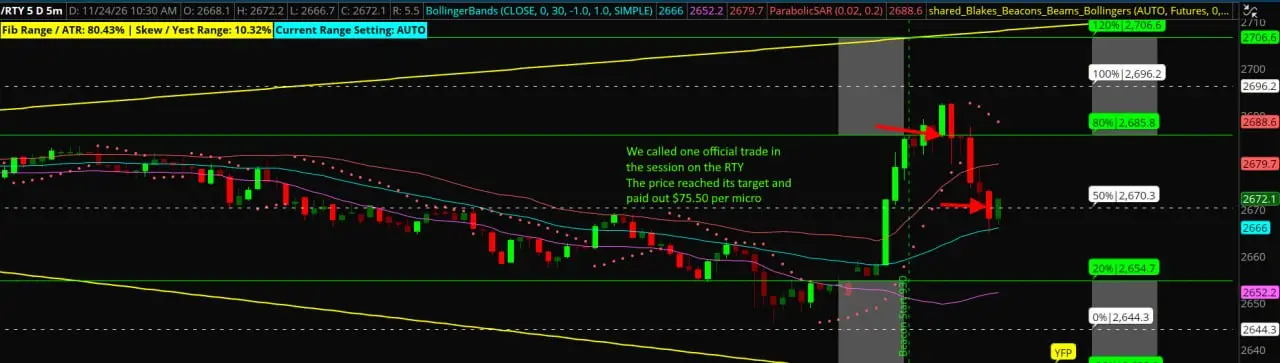
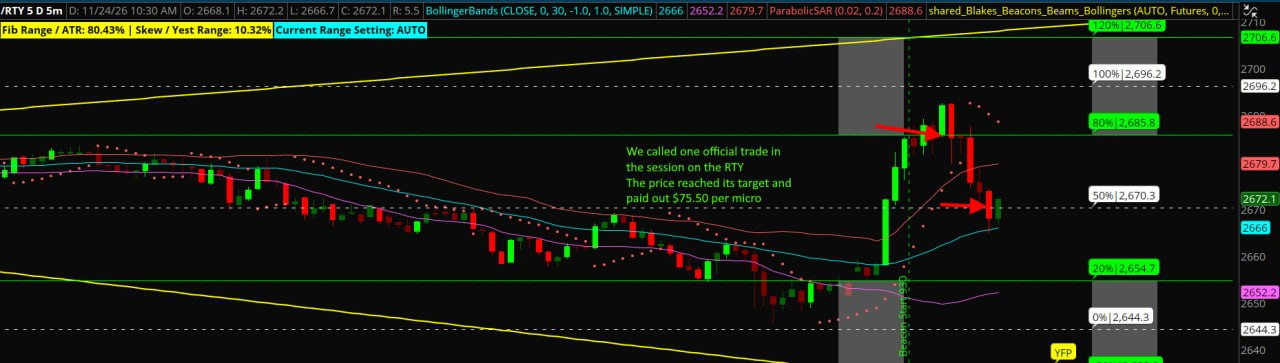
My one call came in the Russell. I sold short with a limit at 2685.80, a 2696 stop and a 2670.30 target.
I didn’t chase it, and the fill came a few minutes later. Price hit my target for 15.5 points, or $77.50 per micro contract.
A micro Russell contract is worth $5 a point.
A later crude short was still working when the session ended. I won’t claim a result on it.
I pointed out that the setup kept working in light holiday volume, without the Nasdaq.
One setup on several markets keeps a broken market from costing you the day.
Check Your Bench’s Order Book Depth
Order book depth is the number of contracts waiting to trade at each price. I read it on the Active Trader tab in thinkorswim.
My check counts how many contracts my order would join at a price.
One order in the euro would have joined 186 contracts Tuesday. A Nasdaq order would have joined one or zero.
The euro had 150 times the Nasdaq’s order book depth. You’d be the order flow there.
Judge order book depth by comparing each market with the others on your list.
Order books change through the day. I called the S&P 500, Nasdaq and Russell thin at the open.
The Russell was trading better than the Nasdaq near the end of my trade.
The Nasdaq’s order book depth still looked thin when the session ended.
I told the room anyone touching the Nasdaq should use a limit order. A limit, as I put it, says “I will only accept this much.”
My Russell entry was a limit order, too.
I’d go further and use QQQ, NDX or another trade where the risk is defined. Defined risk means you know your maximum loss before you enter.
Sit out any market where your order would be the order flow.
Run An Order Book Depth Check Before You Trade
Here’s how I’d set up your bench before your next session:
- Pick a short list of markets. Mine covers the euro, gold, crude and three stock index futures.
- Run one quick pass through every chart. Give each one a verdict before you commit to a trade.
- Compare order book depth across your list. Count the contracts your order would join in each market.
- Sit out the thinnest or define your risk. Use limit orders, and trade a thin market only with a set maximum loss.
That’s my line, and it doesn’t have to be yours.
Keep a deep bench, and check order book depth before you trade.
Blake Young
Senior Market Strategist, TheoTRADE