Hey trader,
Four weeks above the expected move changes the probability math on every position tied to the sector.
That kind of sustained run doesn’t go unnoticed at the institutional level, and protection buying follows.
This morning, the Console showed exactly who moved first.
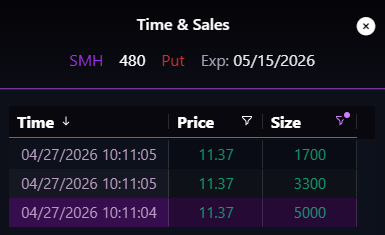
At 10:11:04 AM, three SMH put prints hit in a single second: 5,000 contracts, then 3,300, then 1,700.
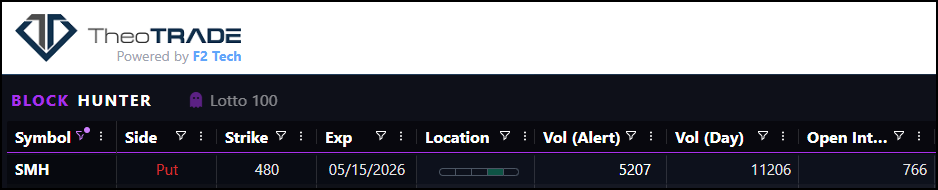
Ten thousand contracts in a single expiration, all pointing the same direction.
That structure is worth understanding because it repeats every time an institution moves size without tipping its hand.
Once you know what coordinated block splitting looks like, the print tells you intent, not just size.
Why the Order Got Split
A 10,000-contract put order placed as a single print moves the market against the buyer.
The act of placing it pushes implied volatility higher and premium up before the fill even completes. Splitting solves that.
Five thousand contracts establish the position and absorb the initial liquidity. The remaining 3,300 and 1,700 fill in the same second, before the market has time to reprice.
The Console logged all three at 10:11:04. Same strike, same expiration, consecutive prints.
Retail put accumulation builds differently. It spreads across a session in different strikes and expirations, with gaps between fills.
Three prints at identical parameters in under a second point to one decision-maker executing one thesis before the tape adjusts.
What Four Weeks Above the Expected Move Actually Means
The expected move is the weekly range options pricing assigns roughly 68% odds of containing the underlying at expiration.
Clearing it once is notable. Four straight weeks shifts the baseline and creates the mechanical conditions for a reset.
SMH has done exactly that, and this setup has a direct precedent. A nearly identical put block appeared on the Console in November. That setup preceded a semiconductor breakdown that never fully recovered.
The current extension going into today’s print is greater than what preceded that move.
The Console is not showing this print in isolation. AMD’s aggregate flow today shows a clear bias toward buying puts and selling calls.
Approximately 4,000 to 5,000 SOXL puts have accumulated at the ask. SOXS calls are building for May 1 and May 15 expirations.
The 10,000-contract SMH print is the largest piece of a pattern developing across the entire sector.
Why Elevated IV Changes the Structure
SMH implied volatility sits at approximately 47%, placing it at the 69th percentile of its 52-week range.
Buying naked puts at those levels creates a compounding problem. Premium decays faster at elevated implied volatility, meaning a correct directional bet can still lose money if the move develops slowly.
The volatility skew in SMH changes the calculus. Implied volatility rises as you move down the put strikes, which means the lower strike sold in a spread fills at a higher IV than the upper strike purchased.
The spread is discounted by the skew before the underlying moves at all. You are buying lower implied volatility and selling higher.
A $5 wide put spread in SMH costs approximately $2.25. At 2% account risk per trade, that requires roughly an $11,000 account to size it correctly.
The $5 increment represents 1% of SMH’s price, keeping the structure proportional to the underlying.
How to Structure the Trade
- Buy the SMH one-month put at the near-money strike
- Sell the SMH one-month put $5 lower
- Spread width: $5
- Cost: approximately $2.25
- Max risk: $2.25 per contract
- Skew edge: buying lower implied volatility, selling higher
- Direction: Bearish on semiconductors
- Catalyst: 10,000-contract coordinated put block at 10:11 AM, four straight weeks above the expected move, AMD put-buying bias confirmed on the Console, SOXL puts and SOXS calls building for May 1 and May 15
If SMH drops toward the short strike and the spread reaches a meaningful gain, close it and roll to the next level lower. Each completed roll locks in the gain from the prior leg and resets exposure for whatever comes next.
The sector-wide confirmation behind today’s print makes the thesis more durable than any single block in isolation.
See exactly how Block Hunter catches institutional positioning before the crowd catches on.
Brandon Chapman, CMT
Creator of Ghost Prints