Hey trader,
You have probably watched a stock rip through resistance and assumed the breakout was the trade itself.
The vol structure underneath tells you when that move is about to roll over…
…and almost nobody reads it.
Intel just hit a vol setup that history says ends in a violent unwind.
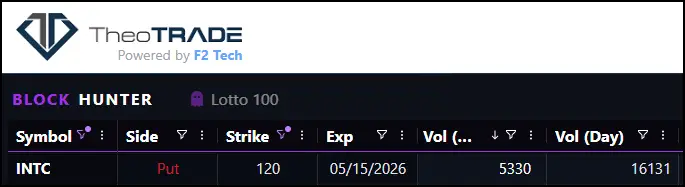
This morning the Block Hunter Console flagged 22,000 put contracts at the Intel $120 strike for May 15.
The stock broke $115 today and is grinding toward $120.
Implied volatility on Intel sits at the 100th percentile of its one-year range.
The IV curve has gone flat right where retail is buying calls, which is the structural signature of institutions selling those same strikes.
The same setup ran on silver three weeks ago and on Avis Budget last year. Both ended in single-session unwinds of 20% or more.
Intel is one broken level away from the same fate. There is a put spread that positions for the rollback for about $2.00 of risk.
Here’s how to read it before the unwind hits.
Why The 100th Percentile Matters
Implied volatility at the 100th percentile means the options market is pricing Intel as more volatile right now than at any point in the last twelve months.
The reading is not actionable on its own. Vol can stay elevated for weeks during a real fundamental move.
The number turns into a warning when it stacks with two other conditions. A flat IV curve near the money and heavy retail call buying that institutions are not matching on the same strikes.
Both are in place on Intel today.
The Flat Skew Tell
A normal IV curve slopes upward as you move away from the at-the-money strike. Out-of-the-money options cost more in volatility terms because hedging demand sits beyond the current price.
Intel’s curve is flat through the at-the-money region.
The $117.50 calls price around $4.40 and the $113 puts price around $3.60 for the same expiration, with strikes equidistant from current price.
Flat near the money means institutions are absorbing retail call buying at those strikes with size. That selling compresses implied vol exactly where retail is most active.
The Console showed the pattern this morning. 32% of today’s call volume sat in the 41-60 delta range and most of it was closing trades rather than opening positions.
Where The Institutions Are Buying
The IV curve steepens hard once you move above $135. Block call trades cluster in the $135 and $150 strikes, well above current price.
Those positions function as the long leg of vertical spreads paired with the short calls near the money.
The spread costs less than a naked long call because positive skew far out of the money keeps the further-out strikes structurally cheap to own.
The structural read is what matters here. Institutions are selling at the strikes retail is chasing and buying only where the slope of the curve compresses premium.
The Silver And Avis Budget Comparison
Silver ran the same vol setup three weeks ago. Vol at extreme percentiles, flat skew near the money, retail driving the bid.
The unwind took the metal through several levels in two sessions.
Avis Budget ran a more extreme version last year. The cornered float and untenable vol structure held until the company itself put out a statement about speculation in the shares.
The fever broke that session.
These unwinds tend to happen in one sitting. Dealer hedging that supports a positive gamma structure flips to negative gamma the moment a put wall breaks below current price.
Selling then accelerates because dealers have to sell into weakness to stay neutral.
How To Structure The Trade
Buying naked calls at the 100th percentile of IV pays the worst risk-reward on the chain. The premium bleeds even on a correct directional read.
A put debit spread positions for the rollback through $115 with defined risk paid upfront.
- Buy the Intel May 22 $115 put
- Sell the Intel May 22 $110 put
- Spread width: $5
- Cost: approximately $2.00 per spread
- Max risk: $2.00 per spread
- Direction: Bearish on the vol structure resolving lower
- Catalyst: IV at the 100th percentile, flat skew near the money, retail call buying not matched by institutional positioning
- Skew edge: positive skew on the downside makes the long put leg cheaper relative to the short leg
The trigger is a break back below $115 after Intel tags $120 or stalls at the wall.
Below $115, dealer gamma flips negative and the move down compresses time decay against the spread.
Any day at this vol percentile can produce a 20% to 30% drop. The Console caught the warning signs in the chain before any chart confirms them.
See exactly how Block Hunter catches institutional positioning before the crowd catches on.
Brandon Chapman, CMT
Creator of Ghost Prints