Hey trader,
Three financial names just caught downside put prints inside three weeks.
Individually, these are easy to dismiss. The contract sits too far from current price to matter on the day it prints.
That read is correct for one print in isolation. It falls apart once three related names stack the same kind of position inside the same window.
XLF caught 7,500 puts at $42 this morning. Bank of America caught 40,000 puts at $48.50 in a single block lifted at the ask. Wells Fargo caught a similar stack at $70 last week.
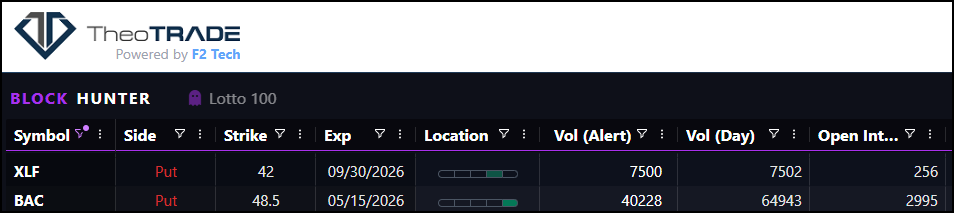
The Block Hunter Console flagged all three as they landed.
None of them moved the chart on their print day. The math behind the build only switches on once price starts drifting toward the strikes.
That drift is what puts dealers on the wrong side of a sector-wide hedging requirement.
BAC is the cleanest place to express the trade because the print sat closest to current price. The vertical at $50 costs about 91 cents of risk.
Here’s how the stack pays.
Why The Buyer Starts At 10 Delta
A 10-delta put costs almost nothing per contract because no realistic short-term path to the strike exists.
Each contract carries only ten share equivalents of immediate dealer exposure.
The 7,500 XLF contracts translate to roughly 75,000 shares of dealer hedging at current pricing. That figure does not move the ETF.
The position is being assembled for what happens when delta climbs.
A drift from $45 to $43 in XLF lifts the same contracts from a 10 delta to roughly a 25 delta.
Dealer hedging requirements jump from 75,000 to about 187,500 share equivalents without a single new contract added to the chain.
Every additional $1 lower compounds the math.
The institution locks in the position now while contracts are cheap, then lets time and price convert it into a real hedging force.
The Cross-Name Pattern
A single bank hedging far out of the money reads as portfolio defense.
Three coordinated builds across XLF, BAC, and WFC inside three weeks signals a positioning thesis at the sector level.
This morning’s 40,000-put BAC block printed at $48.50 at a 6 delta. Last week’s WFC stack landed at $70 for June at a similar delta profile.
The cross-name coordination is what surfaces the build as something larger than a single hedge.
VIX expiration sits tomorrow at the morning settlement.
The May 1 and May 5 readings already triggered the 5 to 10 percent correction regime in the volatility models.
Any session this week can deliver the move the positioning is sized for.
Where The Retail Trade Sits
XLF does not produce a clean retail structure today.
The $42 strike sits too far out, the 10 delta too low, and the June expiration too long for a vertical to capture much of the early move.
BAC gives the cleanest expression of the same theme.
The 40,000-put print landed close enough to the money that a vertical works at a real cost.
- Buy the BAC June $50 put
- Sell the BAC June $47 put
- Spread width: $3
- Cost: approximately $0.91 per spread
- Max risk: $0.91 per spread
- Direction: Bearish on a break of $50
- Catalyst: 40,000-put block at $48.50 this morning, three weeks of stacking across XLF, BAC, and WFC at far-OTM downside strikes, VIX expiration tomorrow
- Skew edge: negative skew on the downside keeps the long put leg structurally favored
The trade pays roughly 70 percent on a move to $48.
The $50 break is the trigger, and $48.50 is the magnet underneath with about 4 million shares of dealer hedging requirement waiting at that strike.
What The Console Catches That Charts Cannot
A 10-delta print does not produce a candle on the chart, and a 6-delta print does not either.
The accumulation stays invisible until the cumulative position forces dealer behavior to change at a strike closer to the money.
The volume-to-open-interest filter does the work of surfacing these prints.
The Console reads relative size against existing OI rather than dollar value, which is why a $300,000 trade at a 10 delta clears the threshold even when a much larger closing trade does not.
By the time the chart confirms a move in financials, the contracts doing the work have been sitting in someone’s account for three weeks.
See exactly how Block Hunter catches institutional positioning before the crowd catches on.
Brandon Chapman, CMT
Creator of Ghost Prints