
Hey trader,
You want to lean bullish here.
However, the S&P 500 sits at the edge of its gamma flip, where one slip turns calm into fast selling.
Gold is usually the easy answer. Buyers normally get friendly pricing on upside bets.
That edge just vanished.
My read on gold’s option structure shows it reshaped to look like the S&P 500 itself.
What do I mean?
The cheap upside is gone, and a defensive, crash-braced setup took its place.
And I think I may have a crafty way to play it.
Because of the dollar rolls over the way the Federal Reserve is signaling, that reshaped structure becomes my opening to buy gold’s upside cheap.
Using options, I can craft a trade with a defined-risk spread that caps my loss and targets a clean gain.
Here’s how I’d go about it.
Gold Took On The S&P 500’s Shape
Before we get into the trade details, I want to explain how this situation works.
Start with how gold usually behaves.
Call volatility rises a little above the current price, so upside bets normally get friendly pricing.
That tilt is gone.
In GLD, the large gold ETF, call volatility now falls as I read higher strikes.
The put side fills in the other half.
Volatility rises as I move below the market, and I count roughly 24,000 put options down there that read as bought.
Put those together and you get negative skew – traders now pay up more for downside protection than for upside, exactly how the S&P 500 trades.
Stocks (and gold) typically are the opposite.
Now, with gold, there is a line holding all of it up.
The heaviest open interest sits at the 370 strike, and GLD has been gliding right along it.
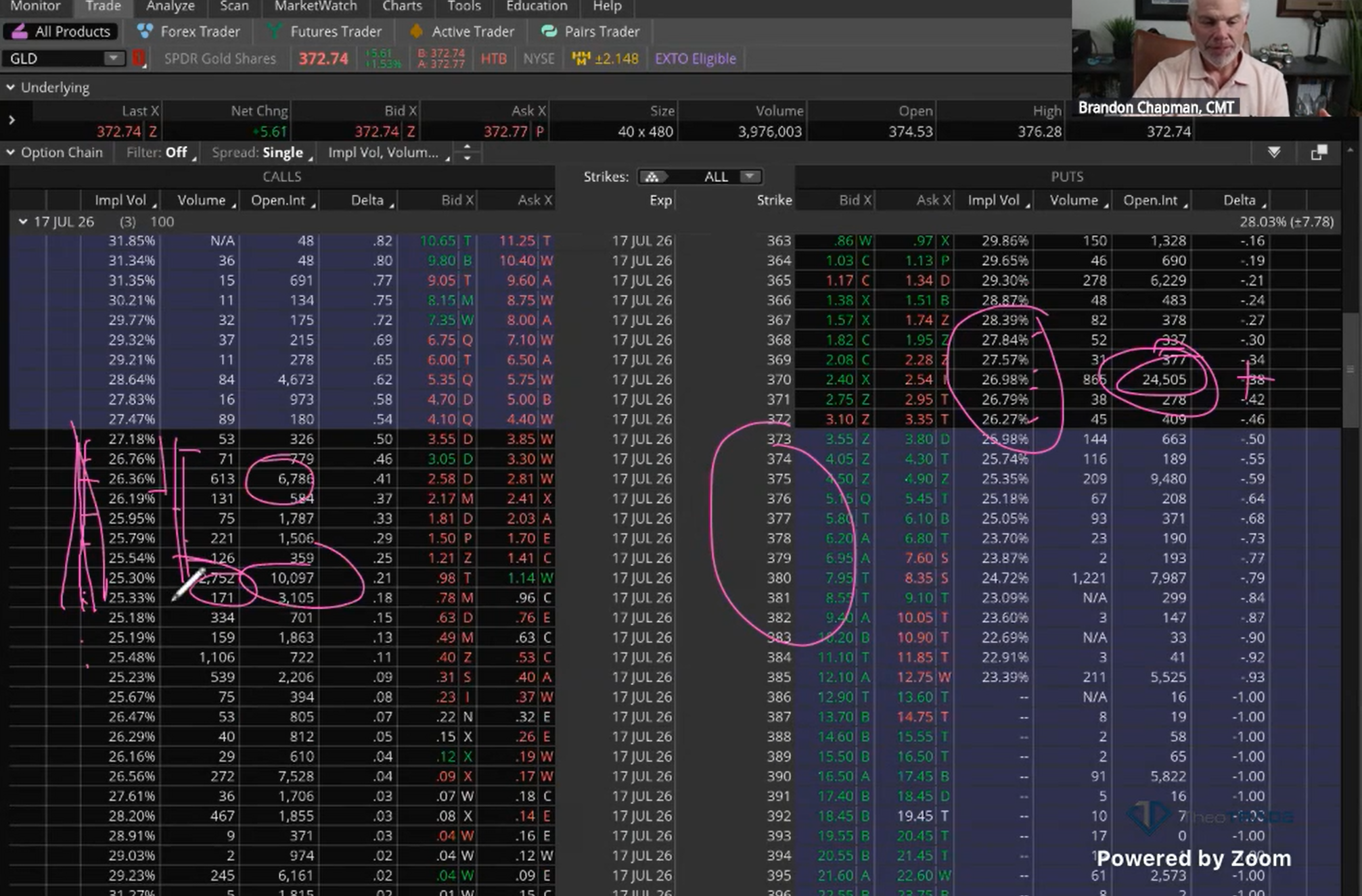
Below 370 the structure thins out fast. That is where a defensive setup could let selling accelerate if price ever loses the level.
Why Big Money Reshaped It
The change did not happen by accident.
On my Console, institutions have been selling calls above the market in GLD, in size.

The counts step up as I climb the strikes, roughly 2,700, then 10,000, then 6,000 contracts. Selling that many calls pushes call volatility down.
That single flow flattened gold’s normal upside tilt. At the same time, those firms bought puts below the market, which lifts put volatility and completes the negative skew.
So the structure looks defensive on its face. My read of the reason behind it points the other way.
The dollar looks set to weaken as the Federal Reserve tilts from raising rates toward cutting them. A softer inflation print and a stalling economy push the same direction.
Gold is built for exactly that mix. Stagnant growth with a falling dollar is the setup where gold tends to outperform the S&P 500.
The defensive option structure shows hedgers bracing for risk. It does not require gold to fall.
I read it as protection being bought around a metal that can still climb.
How I Would Lean On It
I do not need the S&P 500 for bullish exposure here. Gold gives me a cleaner way to lean long into a weaker dollar.
The reshaped structure raises the cost, so I buy the call spread a little further out. I would build it around the 382 strike in GLD, at roughly a 40 delta on the long leg.
That spread runs about 75 cents, and that debit is the most I can lose. Implied volatility sits near 25%, middling at about the 34th percentile.
I have 38 days for GLD to reach 384. If it gets there, the spread is worth well over a 70% gain on that cost.
Here is the structure in plain terms.
- Setup: GLD carrying negative skew, heavy open interest at 370, walls near 375 and 380, and a weaker-dollar backdrop
- Structure: a GLD call spread built around the 382 strike, roughly 40 delta, for about 75 cents (as of the time I write this)
- Trigger: the dollar softening as the Federal Reserve leans toward rate cuts, lifting gold
- Target: GLD at 384 within 38 days, where the spread is worth better than a 70% gain
- Invalidation: GLD losing 370, where the thin structure below opens the door to faster downside
- Max risk: the roughly 75-cent debit, known going in
- Edge: a bullish macro read paired with a defined-risk vehicle, priced around the walls at 375 and 380
What I Am Watching
None of this fires on its own. 370 is the number that counts.
Hold 370 and gold has room to grind and outperform the S&P 500. That is the level I want to see defended.
Above there, 375 and 380 act like brakes. The firms that sold those calls hedge into strength and slow the climb, which is normal friction on the way up.
Lose 370 and the thin structure below takes over. Dealers sell into the slide, and the move can stretch further than the drop that started it.
The order of events is the whole lesson. The structure changed first, quietly, while gold still looked sleepy.
The move, if it comes, arrives second. I built my read while the tilt still looked defensive, and that is exactly when the tape tells you the most.
Brandon Chapman, CMT
Creator of Ghost Prints