Hey trader,
Something lit up in FCX today.
It happened the day before the company reports earnings.
Institutions bought roughly 5,000 of the 67 calls in a straight purchase.
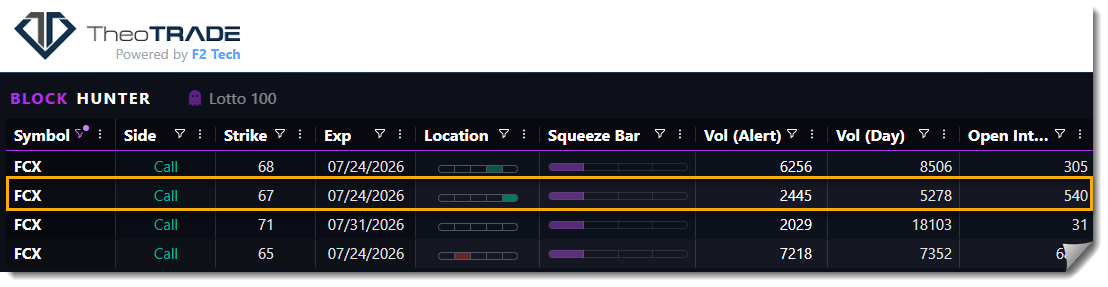
They also rolled their 65 calls up to the 68 strike.
The easy read is that somebody is betting the stock rips on the print. That read skips over the mechanic doing the real work.
Those calls do more than express a direction. They mark a spot the dealers now have to defend, and that spot lines up almost exactly with the market maker move.
FCX is trading around 65…
…The buying clusters at 67 and 68…
…The math keeps pointing to the same place.
I keep asking myself what that desk sees in the 68 strike that the tape has not shown yet.
Let me walk you through how I’d take a cheap shot at it.
What those calls force the dealers to do
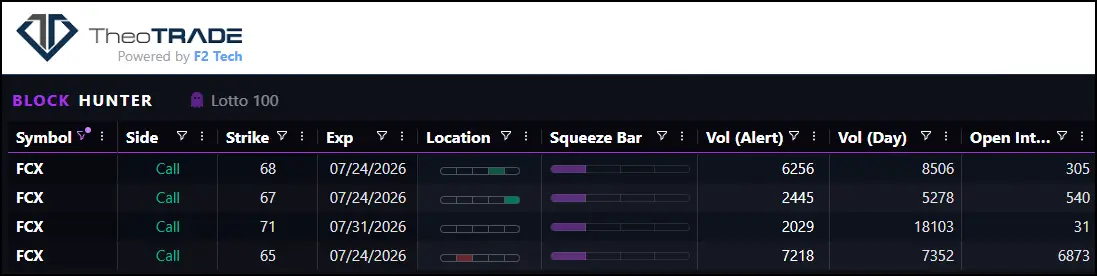
The 68 strike started as a roll. The 65 calls got closed and moved up to it.
The 67 line was a straight purchase, around 5,000 contracts, mostly bought.
When a dealer sells those calls, it takes on short call exposure. Essentially, it loses ground as the stock climbs. It keeps buying shares to stay hedged.
That forced buying turns a cluster of strikes into a magnet.
The old accelerator at 65 is gone. The pull now lives at 67 and 68.
Why 68 is the number
The desk is not guessing at 68. FCX trades around 65 right now.
The market maker move works out to about $3. That figure comes from the volatility priced into the options, not from a hunch.
Add $3 to 65 and you land at 68. The expected move backs it up at roughly 3.73.
The call buying at 67 and 68 sits right on top of that number.
There is a counterweight below. A put wall sits near 60, with an accelerator beneath it.
The skew leans slightly negative. That means the downside carries a touch more implied volatility, so the market is paying up for protection down there.
I respect that downside. The fresh buying today is stacked at 67 and 68. With only two days to expiration, that upside is where the near-term draw is strongest.
The cheap shot: how I’m structuring it
Years ago a former market maker showed me a trade we called a cheap shot.
It is a butterfly built over earnings, centered on the market maker move.
A butterfly buys one strike, sells two of a higher strike, and buys one more above that. Basically, your cost is small and your payout peaks at the middle strike.
Here is the idea I came up with for FCX. I center the butterfly on 68, about $2 wide, on this week’s expiration. It prices around 32 cents.
The edge is the volatility crush. Earnings pump a lot of implied volatility into these options, and once the report is out, that premium collapses. I’m modeling a drop of about 47% by tomorrow.
Run it forward. If FCX pins 68 into Friday’s expiration, the butterfly reaches its max, a gain near a buck-68 on that roughly 32-cent cost. That is about five times.
Land anywhere in the 67 to 69 range tomorrow and I’m looking at 100% to 150%. By Friday, the realistic band runs from about one and a half times to five times the debit.
Here is how I’m framing it, using only what the setup gives me:
- Setup: long call butterfly centered on 68, about $2 wide, this week’s expiration.
- Target: a pin near 68, with the profitable zone running 67 to 69.
- Edge: the post-earnings volatility crush, roughly a 47% drop in implied volatility, plus the 67-68 magnet from today’s call buying.
- Cost: around 32 cents.
- Max risk: the debit paid, near 32 cents, since a butterfly can only lose what it costs.
What I’m watching into the open
A butterfly gets opened and closed as one piece. I don’t leg out of it.
The plan is to work the exit tomorrow morning, once earnings are out. If FCX sits in that 67 to 69 zone and I’m profitable, I take it.
The volatility does not always bleed off at the bell. It can take the first half hour to come out.
Even so, I’m not chasing the last drop. Price can drift out of the range while I wait for the theta to work, and a profitable trade turns into a loss.
The discipline is the whole trade. Get a print, confirm the earnings and the market maker move, price the butterfly, and only then decide. If any step breaks down, I don’t force it.
The 67 and 68 calls never announced themselves. The Console pulled that block out of the noise and handed me a target three dollars above the stock before the earnings even hit.
If you want to read those prints as they land instead of hearing about the move after it happens, this is where you do it. You get the Console, my alerts, and the training to turn a block into a plan.
Click here to get inside Block Hunter.
Brandon Chapman, CMT
Creator of Ghost Prints