Hey trader,
Selling puts for income looks easy until assignment shows up. The fattest premium on the chain usually carries the thinnest cushion.
Plenty of traders scan for yield and stop there. They never measure how far price has to fall before the trade costs real money.
That gap turns an income plan into a stack of underwater positions.
I ran the number out loud on Wednesday before selling a contract.
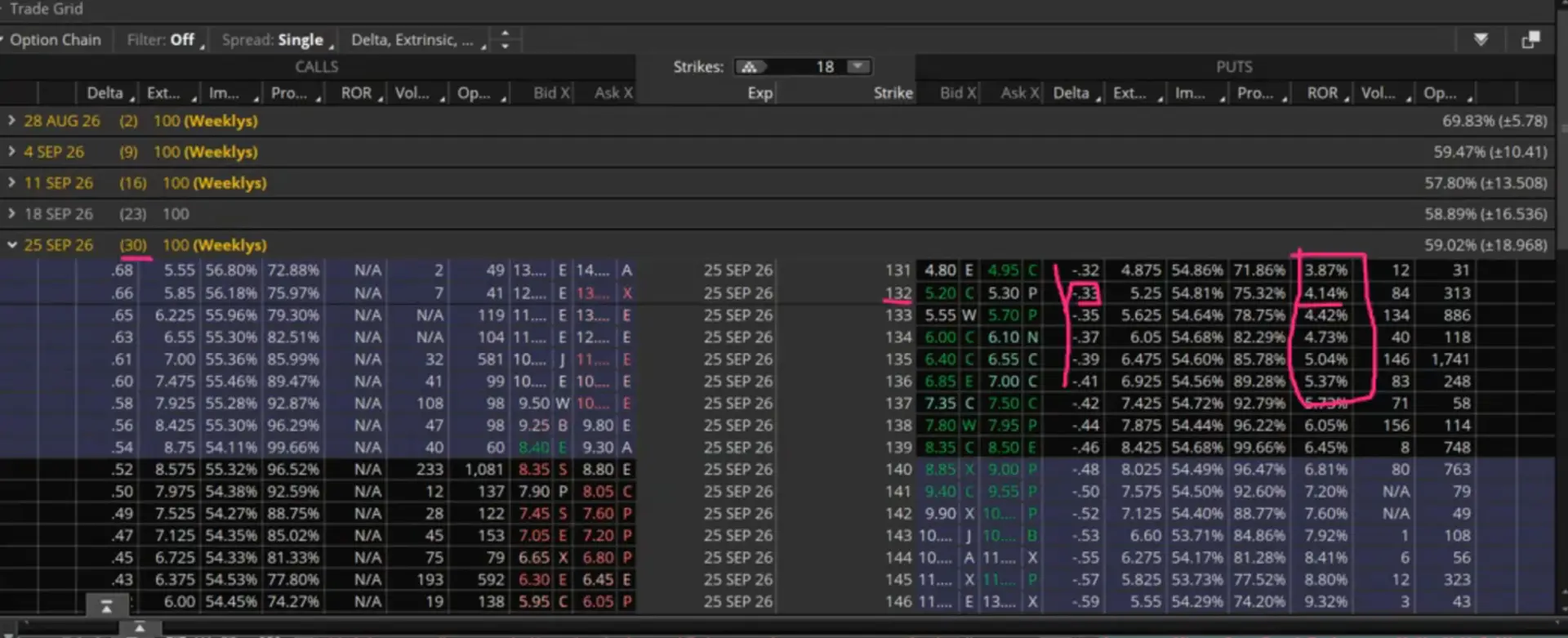
The premium paid 4.14%. Price had to fall 8.8% before I lost a dollar.
Below I’ll cover the filter I use, the setup it told me to skip, and when to take profit early.
That way you can price the risk before you accept it.
Willingness To Own Comes Before The Premium
A short put is an agreement to buy stock at a set price. Someone pays you to keep that agreement open.
I sold a SpaceX put on Wednesday. I said on the session that I do not love the stock.
That reads as a contradiction until you separate two different questions. Liking a chart and accepting a price are not the same decision.
SpaceX traded near $139 and sat below its IPO price. It bounced off that level and closed under it three straight times.
The stock had gone nowhere for a month. Nothing in that picture told me to buy shares.
Nothing in it stopped me from naming a lower price I would happily accept.
The Filter Runs Before The Chain Does
I never scan for the biggest number on the chain. Three conditions get set before I open it.
- Thirty days to expiration. That put me in the September 25th cycle.
- A delta between 30 and 40. That band keeps the strike far enough below price to mean something.
- A minimum return of 2.5% on the capital at risk. Anything thinner does not pay for the obligation.
The September 25th chain cleared all three conditions. Every strike inside that delta band returned between 3.8% and 5.37%.
I moved down to the 132 strike at a 33 delta. It paid 4.14%, which sits below the top of that range.
Taking a smaller return on purpose sounds backwards. The arithmetic below shows what the extra distance bought me.
Walking The Cushion Math Step By Step
The premium is not the protection. The distance between the stock and your breakeven is the protection.
Here is the math I ran live, in order.
- Start with the stock. SpaceX sat at $139.06.
- Measure down to the strike. The 132 put sat $7.06 below the market.
- Add the premium collected. That contract came in around $5.25.
- Total the two figures. $7.06 of strike distance plus $5.25 of premium gives $12.31 of room before the trade costs a dollar.
- Convert that into a percentage. $12.31 against a $139.06 stock works out to an 8.8% decline.
The return was 4.14%. The required drop was 8.8%.
That ratio is the entire test. My cushion came in at more than double my payout.
Price can drift, chop, or fall almost 9% and the trade still pays. The stock never has to rise a penny.
Another month of the same sideways action collects the full premium.
Four percent over 30 days annualizes past 50% once you compound it. The number matters less than the reason it exists.
I got paid for accepting an obligation, not for making a forecast.
The Setup Where The Test Said No
The same session handed me a thesis I actually believe in.
Water demand climbs if the AI data center buildout arrives the way it is being sold.
I walked four water funds live. PHO, CGW, AQWA, and FIW.
PHO bottomed at 64 and rallied to 72. That move ran roughly 15% in a quarter.
CGW set up a similar breakout from about 61 toward 67. Risking $1 to make $6 gives you a six to one payout.
The thesis passed easily. The put sale failed on mechanics.
- At the money markets ran $1.45 to $2 wide against $1 wide strikes. A spread that size eats your premium before the trade opens.
- Dividends sat near 0.68% on PHO and on FIW. Income is not the reason anyone holds these.
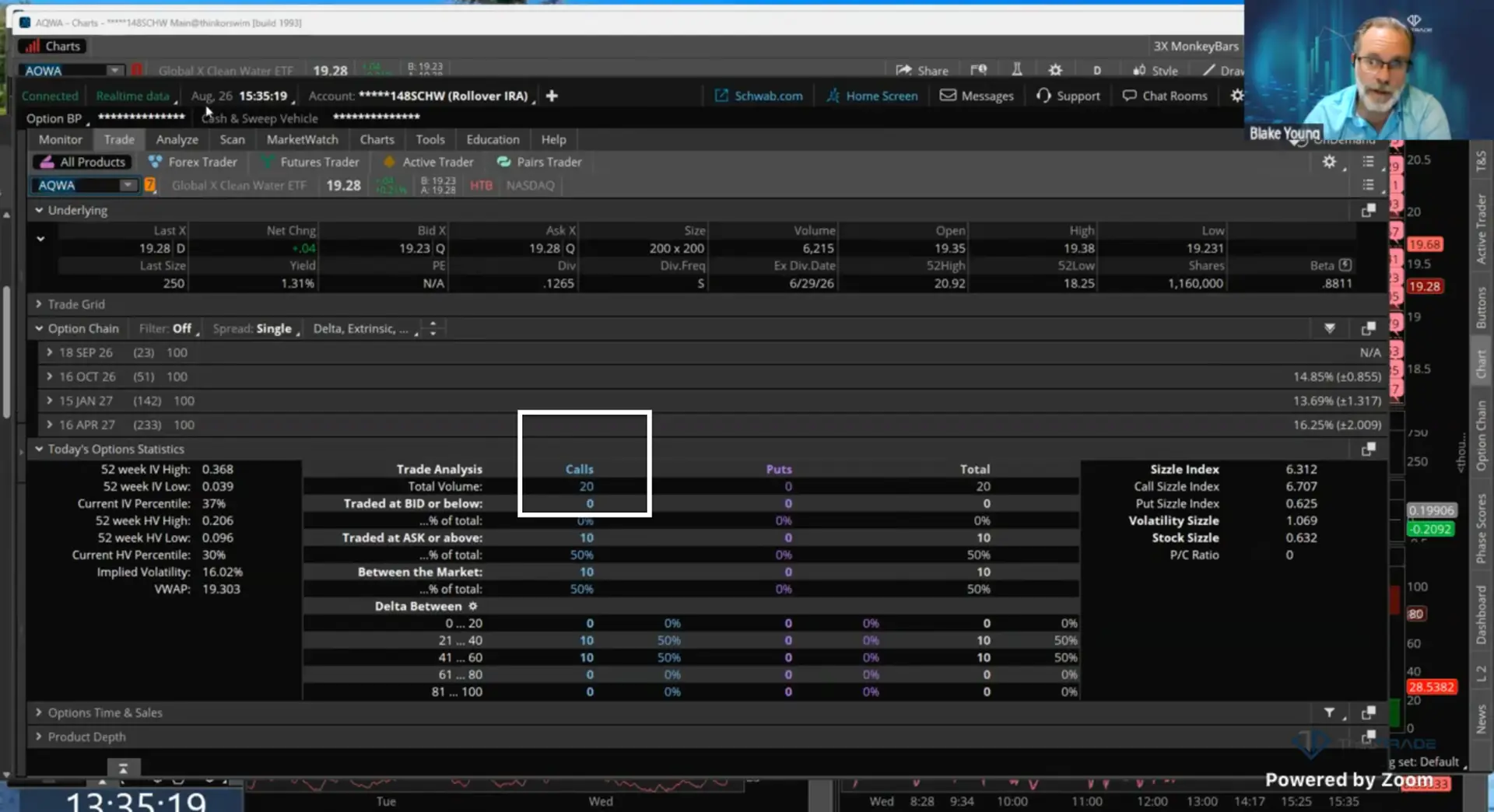
- AQWA traded 20 option contracts that day. Zero of them were puts.
SpaceX traded 533,000 contracts on the same day.
That gap in total options contracts traded (liquidity) explains why one name pays you to sell puts and the other one cannot.
A cushion you are unable to measure protects nothing. The fix was to change the vehicle instead of changing the opinion.
Buying the shares outright works on all four funds. An in the money call also works if you are patient with the order.
AQWA at the 18 strike out to October might fill near $1.80. That runs about 10% of the $1,900 needed for 100 shares.
A $2 move in the underlying lifts that position roughly 80%.
Take The Money Before The Surprise
The cushion protects your entry. Managing the exit protects everything after it.
My rule is to consider closing once I have collected roughly 85% of the premium. That last 15% takes the most time and carries the same risk as the first 85%.
Sitting in a trade for a few remaining cents leaves you exposed to a surprise. Step aside and move the capital into a fresh setup with a full cushion.
What This Means For You
Three moves you can run on your next put sale.
- Write down the price you would accept before you open the chain. No acceptable price on the board means the trade does not exist.
- Add strike distance to premium, then divide by the stock price. Pass on anything where that number fails to double your expected return.
- Check option volume and the bid ask spread before you check the premium. A $2 wide market on $1 strikes tells you to buy the underlying instead.
Run the second one on a position you already hold tonight. Discomfort in short puts usually traces back to a cushion nobody measured.
Your Next Step
You just watched one put sale get filtered, measured, and priced. That same process runs every morning in the private trading room.
Year one produced 453 winning trades and eleven winning months out of twelve. A $5,000 account grew into $14,459 in net profit.
The full intensive is available on demand the moment you join. Watch me trade for 30 days before you risk a single dollar.
JOIN THE 10% PER MONTH CLUB TODAY
Measured cushion, priced risk.
Blake Young
Senior Market Strategist, TheoTRADE