
Hey Trader,
Last week I told you to build the sheet. This week the sheet had something to say.
And it’s these tiny lessons that can turn you from a so-so trader into a great one.
Like what happens when you haven’t stopped out…yet the trade is obviously not working?
Earlier this week, when markets were doing a whole lot of nothing, I pulled up August 18 in the Golden Setup room.
I walked every setup the method offered, one bar at a time.
Somewhere in that walk, I hit a long from the 77 that dropped to the 66. It never stopped me out. It just sat there underwater, doing nothing.
Here’s how I described it to the room while it sat on the screen:
“This is like the market tapping you on the shoulder saying, ‘Hey, do you still want that? I have violated risk. I haven’t stopped you out. You’re still alive. Do you want it?’”
“You say, ‘No, I don’t. It has violated risk. It’s not going to pay me.'”
That’s the escape hatch.
It’s a concept I developed after years of logging trades and reviewing the results.
I don’t ever WANT to use the escape hatch.
But it can save you some serious money when you deploy it correctly over time.
Here’s how it works.
A Stop and a Backstop Do Two Different Jobs
Your stop is a hard number. Your broker enforces it whether you agree with it or not.
Your backstop is different.
It tells you the reason you took the trade no longer exists.
This isn’t unique to day trading. Investors use it as well. When the reason you invest in a company disappears, why would you hold it?
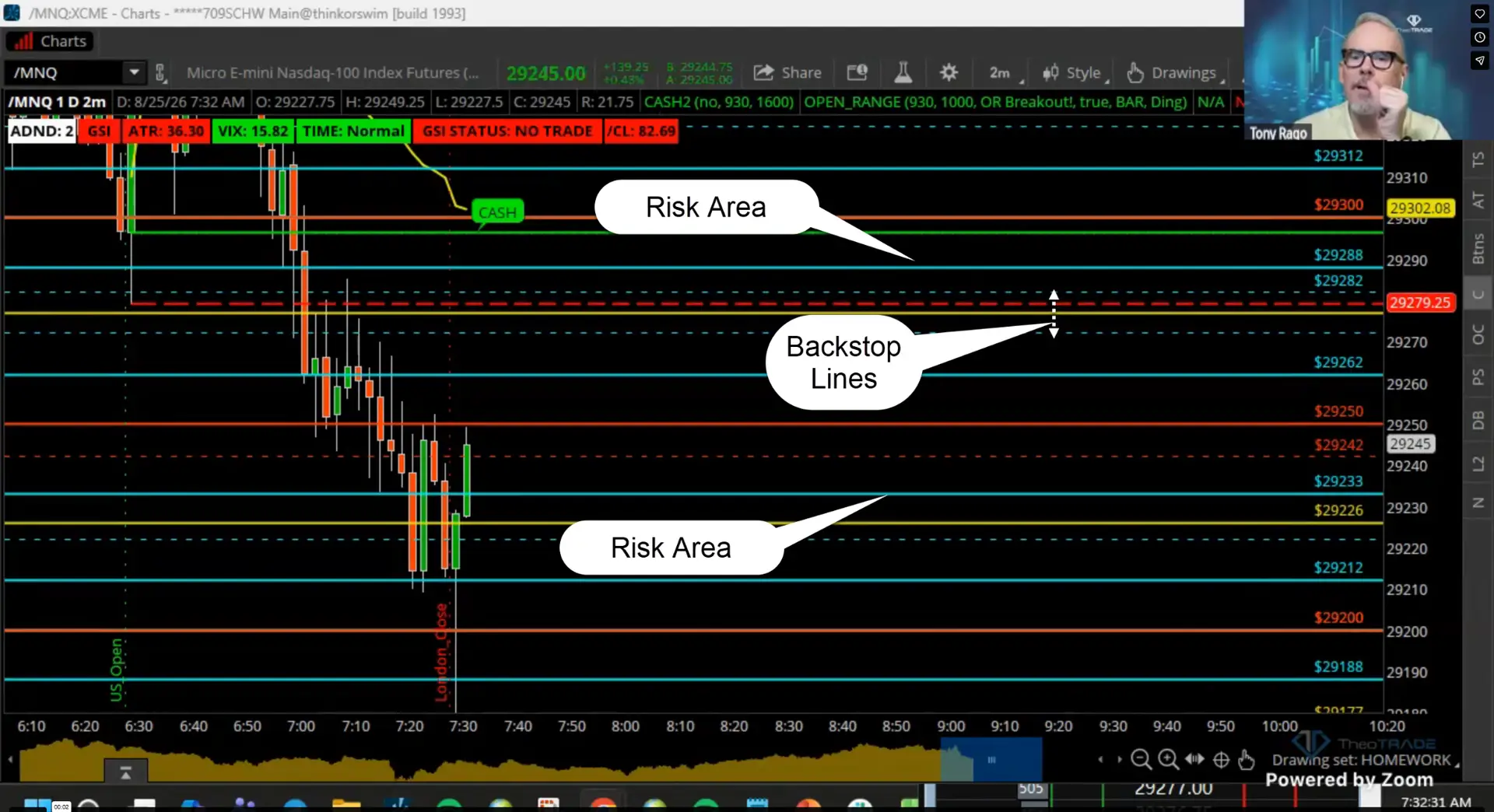
I went through this with Mary when she asked about the dashed lines on her chart.
The blue solid lines, the 33 and the 88, are risk areas.
The blue dashed lines around your entry are your backstops.
The rule fits in one breath.
Long 77 stays alive as long as 72 holds. Short 77 stays alive as long as 82 holds. Five points on either side of the entry
When the backstop gives up and your stop hasn’t fired, you’re in the window.
The trade is invalidated. Your account hasn’t paid full price for it yet.
That window is where the escape hatch lives.
What August 18 Actually Looked Like
The final tally was 18 setups, 14 winners, and 4 losers. Only one of those four was a full loser.
I called it a solid 80% success rate across 18 setups.
I’ll take that number every week of the year.
Look at how those four losers got there. That’s the whole story.
The long 77 that dropped to the 66 let me out before my stop. I logged it as a minus three.
A full stop on that same trade would have cost multiples of that.
Another was a 26 that had, in my words, “just too much action there, too many tests.”
It never stopped me out. It tried to come back and let me out, and it didn’t quite get there.
There was another that went down to the 67 and let us out cleanly. No stop-out there either.
Four losers on the sheet. One cost full freight.
Getting Out Before You’re Proven Wrong
The hardest part has nothing to do with the chart.
You’re closing a trade the market hasn’t officially killed yet.
I made that call live in the futures room this week.
Traders were sitting long the 26 while price hovered just underneath it.
“Look, if you’re long 26, I would scratch that trade. I’d just scratch it here at 24. Just scratch it and be wrong. It could rip, but it’s more likely that it’s going to do this here. So, don’t sit there.”
Right after that, price went down and tagged the 12.
Scratch it and be wrong. That’s the mindset.
You’re not defending your read. You’re defending the number in your account so the next setup gets a clear head.
Some of these will rip the second you flatten. That’s the cost of a rule that saves you far more than it takes.
The Homework Proves the Hatch Is Real
I told the room something during that walk that I want to repeat here.
“This process is so important. I can’t tell you enough how important this is. Very important, because it reminds you about escape hatches, how they work, when you need to take them. Is it even a reality? Can you actually even do that? The answer is yes.”
That last part is why the sheet exists.
A rule that only lives in your head is a suggestion. A rule you’ve watched fire a dozen times on a chart you logged yourself becomes executable at 9:47 in the morning.
When you’re new, you show up skeptical. You should.
The more you see the probabilities play out, the more you start leaning into them. You can’t lean into something you’ve never counted.
Your Weekend Assignment
Open last week’s tab. Find every trade where price violated your backstop and your stop never fired.
Mark two numbers on each one. Mark where the hatch would have fired, then mark where you actually got out.
Add up the difference. That number is what waiting cost you last week.
Now find the trades where you took the hatch and price came right back. Count those too.
You need both sides of the ledger to trust the rule when it matters.
My guess is your math lands close to where mine did. One full loss instead of four.
Looking Ahead
Volatility went to sleep on us. We’ve had a lack of volume, a lack of participation, and a tape spending most of its energy fighting itself.
Summer is officially over after Labor Day. That’s a market holiday, so we get it out of the way and we might start moving around again.
When the range opens back up, the gap between your backstop and your stop widens in dollar terms.
Bigger bars mean a slow exit costs more. Traders who build the habit now won’t hand it all back when the tape wakes up.
The market tapped me on the shoulder on August 18. I paid three points for the lesson.
Take the hint.
The levels, the backstops, and the bracket math I logged all week live inside my Golden Setup.
Trade smart,
Tony Rago
Creator of the Golden Setup