Hey Trader,
You pull up a position and the stock is down. The chart shows nothing wrong with the company.
So you guess at the cause. That guess costs you twice.
You either sell a good company at the low, or you add to a broken one.
Novartis did this to people yesterday. It gapped down hard, and nothing had changed at Novartis.
Amgen reported a disappointing trial result. Amgen fell about 10 percent, and Novartis got dragged down as collateral damage.
Anyone holding Novartis and watching only Novartis never saw it coming. The cause was sitting on a ticker they weren’t tracking.
That’s what makes it dangerous. You can’t pick the right response until you know why the stock is down.
A stock goes down for four reasons, and I found all four on my screen this morning. Each one has a different correct move behind it.
Two of them mean you sit still and stop blaming your chart. One means you avoid the name entirely. One means you buy a put underneath what you already own.
I’ll walk you through all four below, with the stock living each one right now. Then you’ll be able to run the same read on anything red in your account tomorrow.
I call this step the diagnosis. You find out what’s actually wrong before you decide what to do about it.
Reason One: The Event Happened on Another Ticker
A stock can fall on news that never mentions the company. Nothing changes in the business, and the stock is down anyway.
Novartis showed you the honest version yesterday. Amgen reported a disappointing trial on a new drug therapy, and Amgen dropped roughly 10 percent.
Novartis was working on the same class of therapy. It went down as collateral damage.
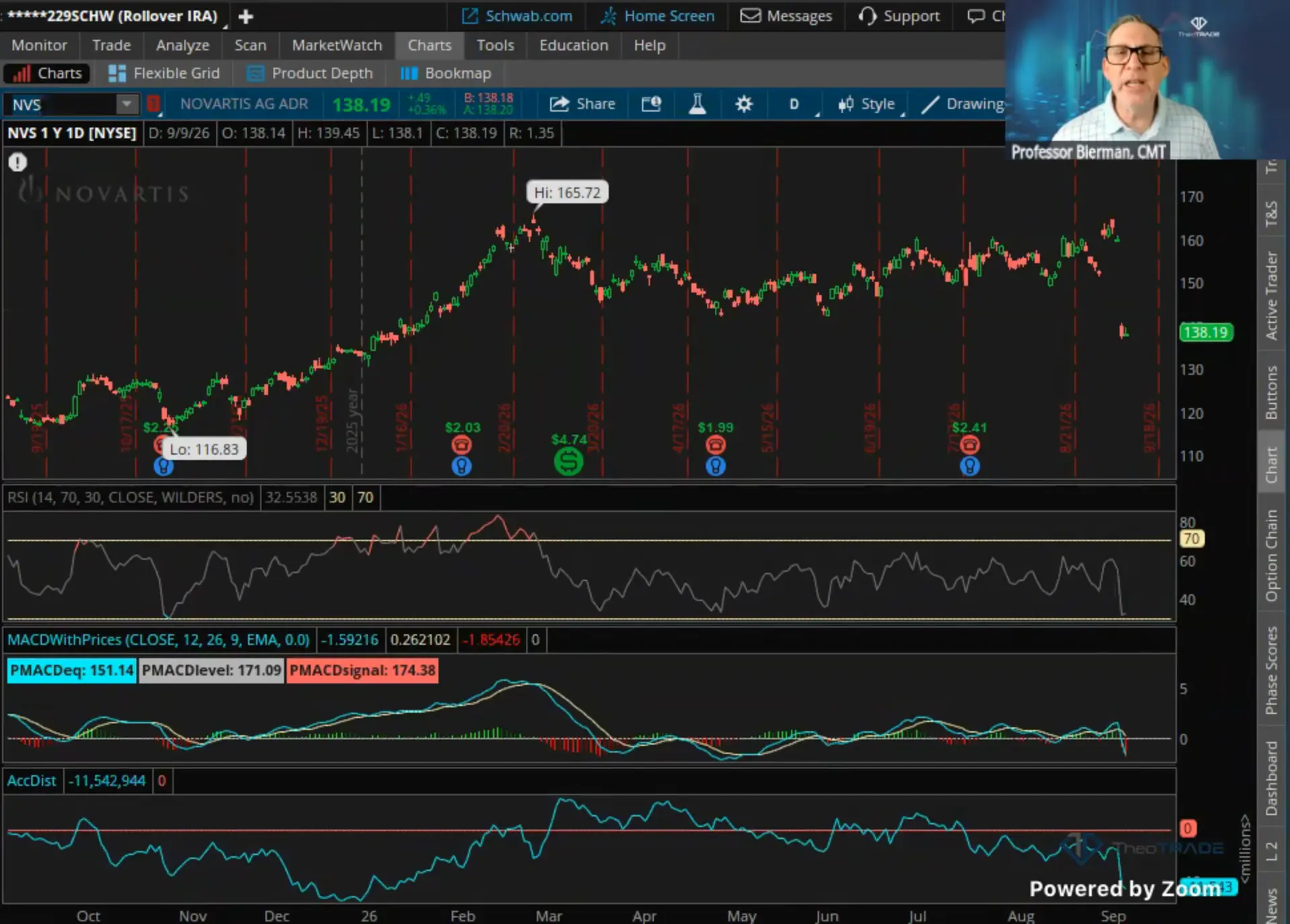
Pharma trades as a group on results like that. All ships rise and fall together on the same tide.
At 20 times earnings, Novartis was never a bubble. That price was opportunistic, and the short trade up at the highs is already gone.
Your response here is to sit still. You didn’t buy a broken company, and you can’t fix an event that happened somewhere else by selling into it.
Reason Two: The Whole Sector Is Getting Flushed
Sometimes the company is fine and the sector is being liquidated. Money managers have made up their minds and window dressing has started early.
Lululemon and Nike are living that today. Anything in retail is getting thrown out, and Walmart and Costco are going with it.
The 90 percent of consumers are pulling back hard. Retail names I track sit at about a six times multiple, and buyers still won’t touch them.
Seven of the 11 sectors I follow are already in a bear market. Money runs to tech and financials every morning with reckless abandon.
A six multiple that nobody will buy tells you the selling has nothing to do with the company.
Your response is patience. Wait for the flush to finish, because a cheap stock in a sector under liquidation gets cheaper before it turns.
Reason Three: A Competitor Just Arrived
New competition reprices a stock immediately. The earnings haven’t moved yet, and the future revenue just got divided.
Amazon and AT&T signed a deal yesterday. AT&T becomes the first US telecom provider running Amazon’s Leo low-earth orbit satellite network.
They’re going straight at Starlink. Every analyst was raging bullish on SpaceX, and Amazon and AT&T were never in that discussion.
More competition should push Starlink’s service pricing down. That helps consumers and dilutes SpaceX’s market share.
This is social Darwinism at work, and it’s coming for other names. Sienna or Corning could sign the next one.
Your response is to reprice the position yourself. Ask what the stock is worth with a second competitor in the market, then decide whether you still want it at today’s price.
Reason Four: The Company Did It to Itself
Service Titan took a massive hit yesterday, and the company caused it. Management made a buyout as a cash deal rather than a stock deal, which diluted the shares.
Look at what earnings did on the same name. They were on $0.40, they beat by $0.30, and the stock still blew up.
Morgan Stanley called it a buying opportunity. Any time you hear about a buyout, get away from that stock.
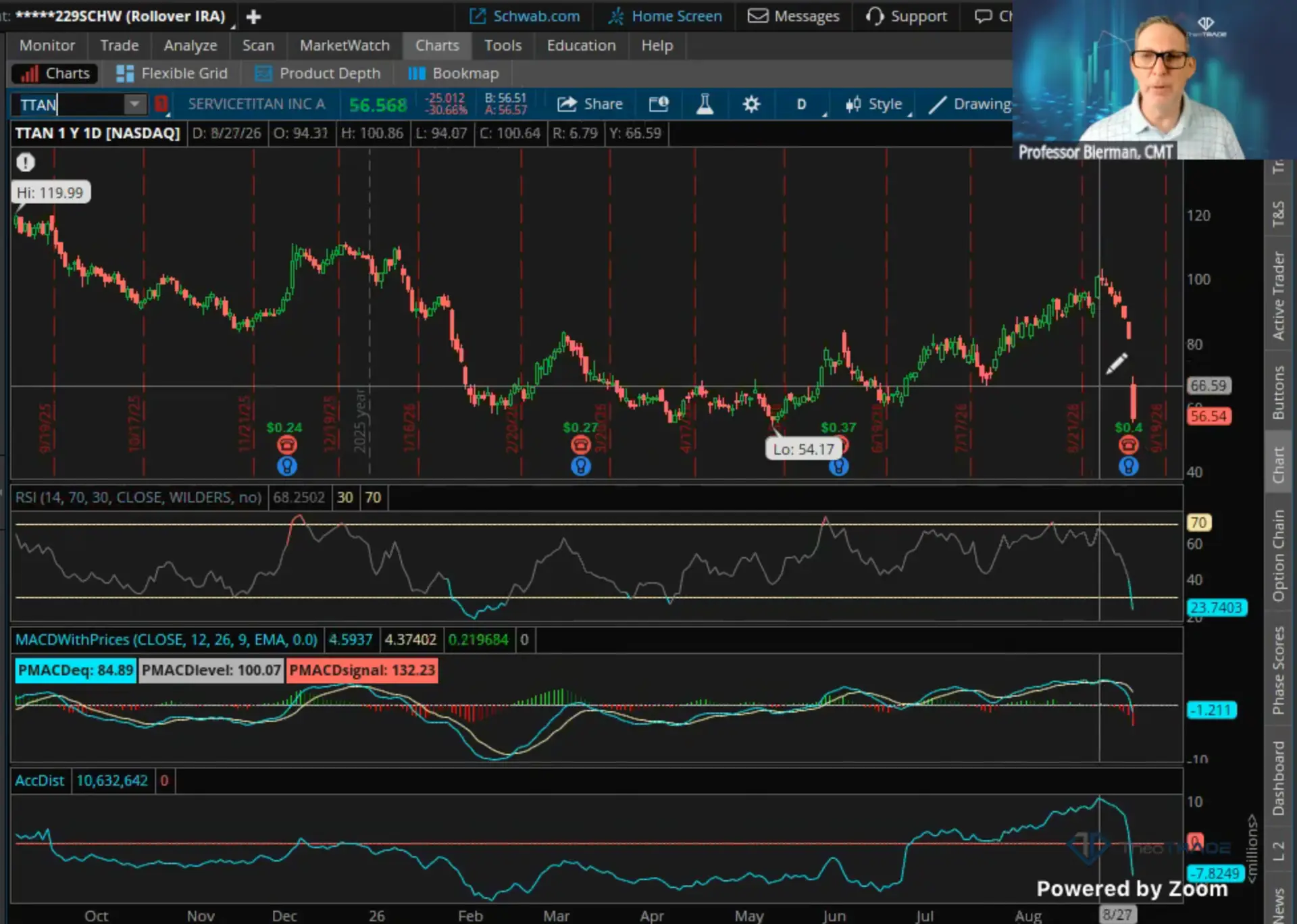
You aren’t an arbitrager and neither am I. These names run on a formulaic play that reprices and gaps automatically once it kicks in.
Your response depends on which side you own. Two positions handle it:
- Hold the target and you need a hedge so a squeeze can’t take you out
- Hold the acquirer and you need a put sitting underneath the position
How to Diagnose Why Your Stock Is Down
Start with the cause and work toward the response. The chart shows you that the stock is down without ever naming the source.
Three checks separate the four buckets on any red position:
- Pull the sector and find out whether a peer reported or released a result
- Check whether the company itself announced a deal, a buyout, or new competition
- Compare the name against its own sector, because a group falling together is liquidation
Then wait a half hour before you act on any of it. The first five minutes catch the people buying pre-market, and they end the morning down 15 percent.
Give me a fundamental reason for the trade or I’m not interested. If you worked for me and bought a dip today without knowing the cause, I’d fire you.
A red position isn’t a signal. It’s a question, and the answer decides whether you sit still, wait, reprice or hedge.
Running that check on one holding takes a few minutes. Running it across a 200 name watchlist before the open is the job I do 12 hours a day.
The diagnosis protects what you already own. It doesn’t tell you where the next move starts.
Go back to reason two for a second. Retail sits at six times earnings with no buyers, and every dollar runs to tech and financials instead.
That money comes back. It shows up first in quiet names with no headlines, before the chart makes it obvious to anyone.
I built four criteria to catch that moment. When two or more align on the same stock, something is about to move.
Etsy fired one in April while the whole country chased Nvidia’s ten day winning streak. The options paid 151% in three days.
I send two alerts a week, each with the ticker, a stock trade and an options play. Twenty of the last 28 closed trades won.
The Burn Room holds 200 traders and no more. You get 30 days and a full refund if it isn’t right for you.
Professor Jeffrey Bierman
Creator of the Genesis COG System