
Hey trader,
Traders love to talk about option blocks and sweeps. They come up in almost every conversation about institutional order flow.
You’ve probably nodded along to both words without ever pinning down what separates them.
But with options dominating market moves, they’re not just nice to knows…but a necessity.
So I’m going to show you both order types.
We’ll dive into what they mean, what they look like on my console, and then how to use this information to trade better.
What option blocks and sweeps actually are
A block is one large order filled in one place, at one price, at one moment. It arrives assembled.
A sweep is one order broken into smaller trades and spread across different exchanges. It arrives in pieces.
Both come from the same kind of buyer. The difference sits in how that buyer chose to get filled.
Size runs into a wall in the options market. No single exchange holds enough contracts at the offer to complete a large order at one price.
A block solves that by getting the whole thing done in one place, in one print.
A sweep solves it by hitting every venue at once and taking all of that liquidity before the market has time to react.
That choice tells you something.
A buyer who accepts a sweep is telling you speed matters more to him than price does. They need to get that order flilled NOW.
Blocks are willing to wait until they can get the right price on their large orer.
I read the fill location next. My alert requires 25 contracts minimum, greater than or equal to 25, filled at or near the ask.
Near the ask means the buyer reached up and paid the offer rather than waiting around for a better one.
What option blocks and sweeps look like on my console
Blocks get their own tab in the Console, because there’s nothing for me to piece together.
I can filter for them at the top using the Block Trades button.

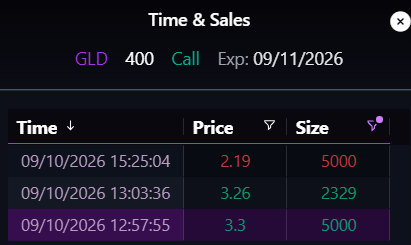
That morning the tab showed a gold spread carrying 17,000 contracts that might be a long put vertical.
You can dig into the details of it by clicking on the location and then filtering for large option prints:
Celanese arrived a different way. It never appeared on the block tab, so high sizzle became the thing that found it.
The alert fired at 2,000 contracts. By the time I looked, that name had 5,000.
So I filtered the chain for fills of 100 contracts and up. Every one of those trades hit at the exact same time, at the exact same price.

You can dig into the details again to see what it looked like.
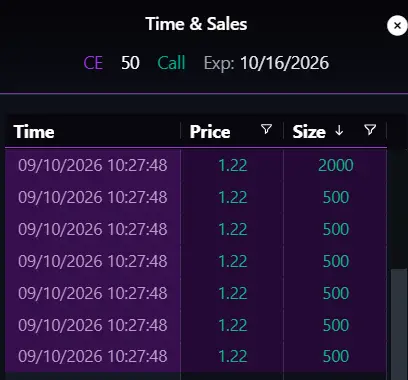
The purple shading is the tell. Purple means a single timestamp across the whole group, and that group produced my alert.
Sitting inside that cluster was a 2,000 contract block.
Take it alone and you’d call it a block and move on. Set it beside the rest of the purple, and it becomes one leg of something far bigger.
So the honest answer on CE is both. There’s a block in there, and in totality, it’s a sweep.
Using it to trade better
That distinction protects you from double counting. One buyer with one thesis looks like four buyers agreeing when you read the rows separately.
Option blocks and sweeps also earn their keep as a timing tool. Once I’ve named the order type, I check whether it actually did anything to price.
The CE sweep filled at or near the ask at 10:27 Eastern. So I went to the one-minute chart and looked at that exact minute.
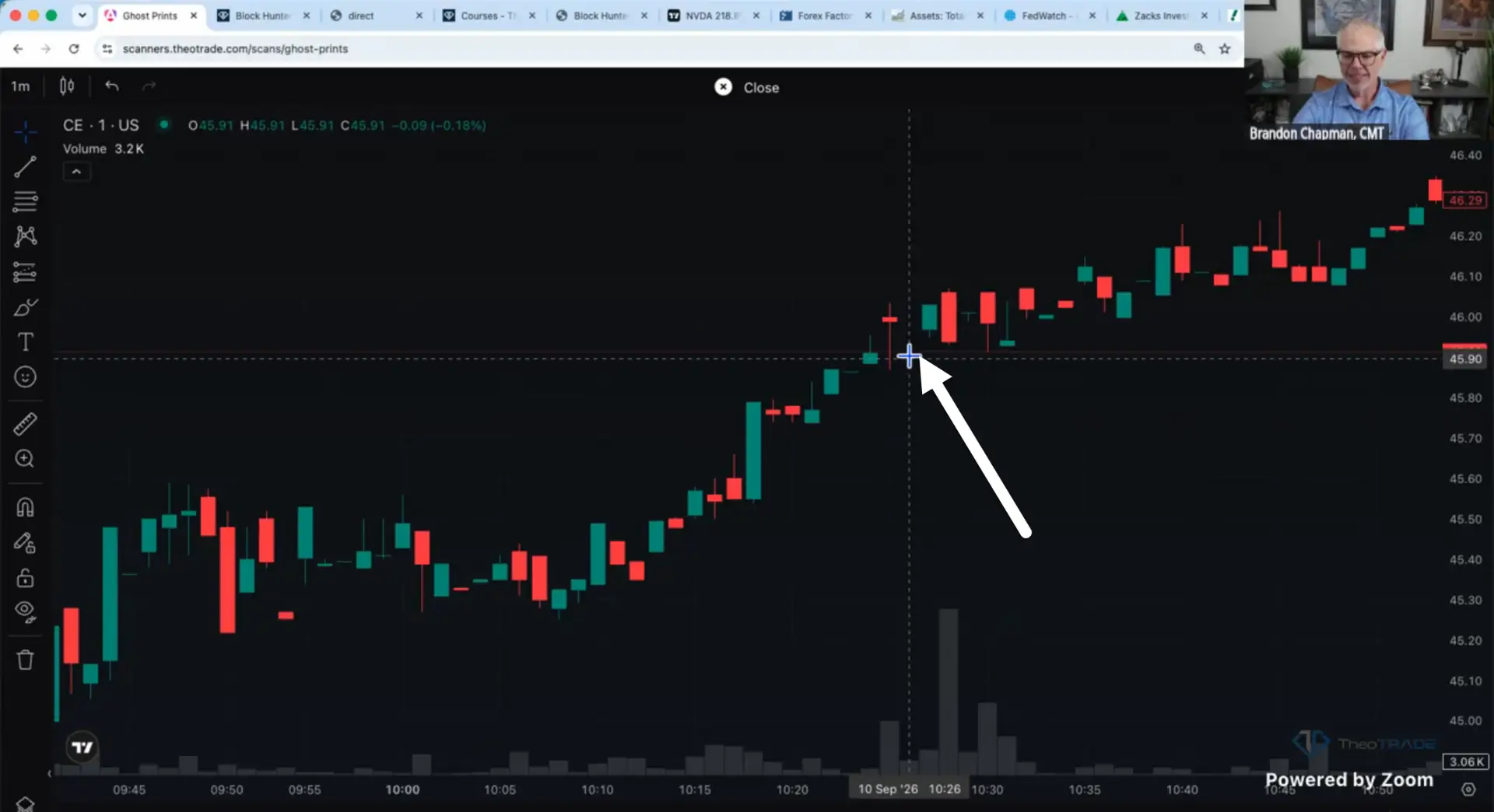
Price gapped from 10:27 to 10:28 on some of the highest volume of the day, pushed up, then faded back.
Gaps on a one-minute chart aren’t easy to produce. That told me the order moved the stock rather than getting quietly absorbed.
The option volume backed it up. Celanese ran 112 times its average, with 49% trading at the ask and zero at the bid.
A print that moves price on that kind of volume gives me something to build on. A print that gets absorbed with no reaction tells me the market didn’t care.
Put it on your own screen
You can dig into Think or Swim if you want the venue-by-venue detail. I built the Console read to stay simple.
On a morning with a dozen names sizzling, you need the answer before the move is gone.
This skill gets faster with repetition, and I’d like you to prove that to yourself.
Take the 90-Day Block Hunter Challenge with me. Ninety days on the same tape I scan, calling option blocks and sweeps as they land, until a purple cluster stops looking like a puzzle.
[Join the 90-Day Block Hunter Challenge]
Brandon Chapman, CMT
Creator of Ghost Prints