
Hey trader,
On Monday, my gut told me to get out of an ES long. ES is the S&P 500 futures contract, and my trading plan said to stay in.
I listened to my gut and closed the trade near breakeven. It’s hard to follow your trading plan when your gut disagrees.
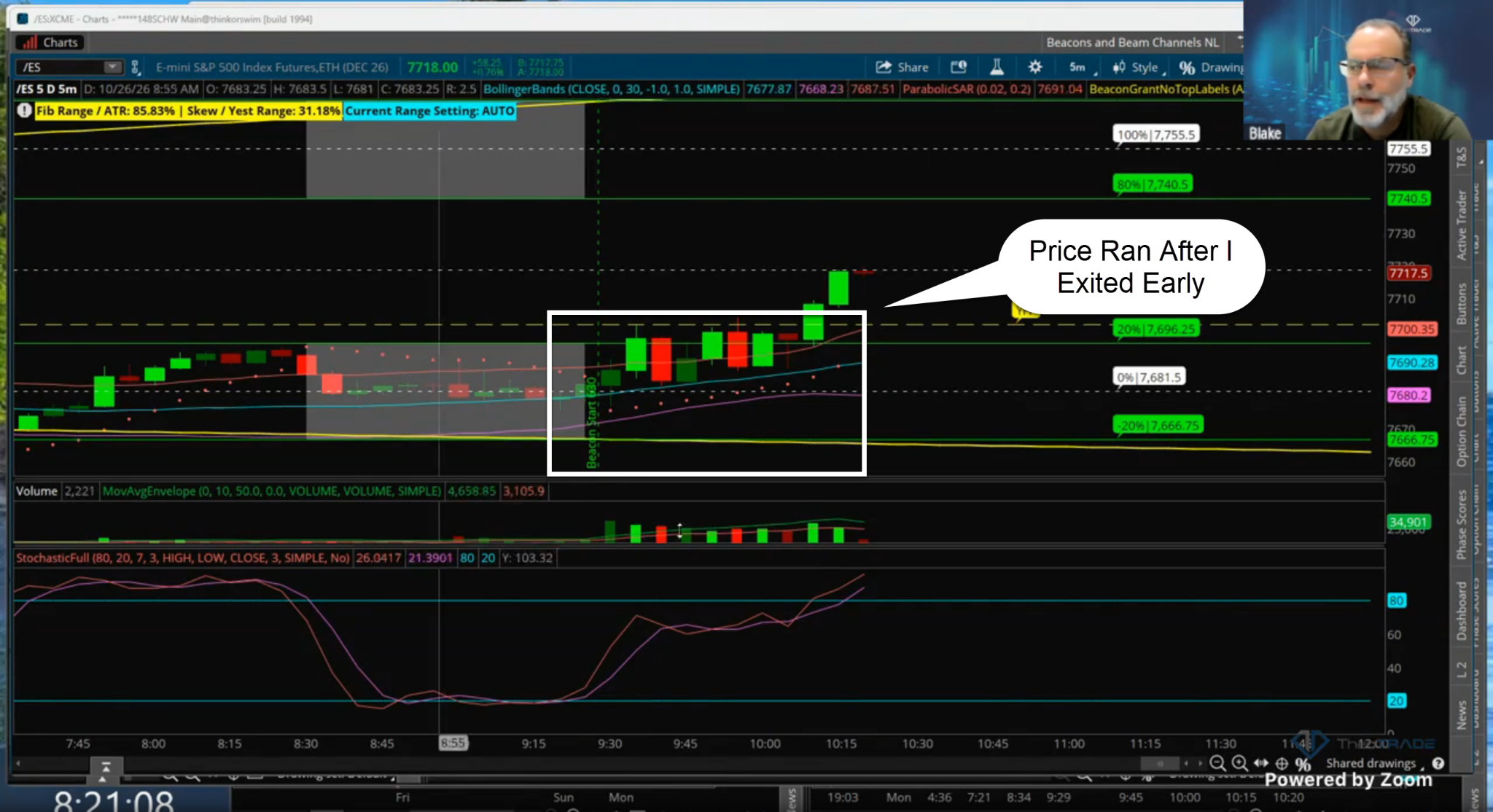
Price ran to my full target anyway. On my two micro contracts, that was $265 I didn’t collect.
I apologized to the room for pulling members out with me.
I’ve traded these signals for almost 20 years, and that feeling still gets me. A chart can look wrong without a single rule telling you so.
My rules come with a record I can check. Across more than 1,300 trades called live, we’re right about 45% of the time.
Our winners average twice the size of our losers. That edge only holds when I take the exits my rules give me.
A gut call skips the record entirely, even when it happens to work.
Monday’s call didn’t work. I said at the time that the breakout was a coin flip in either direction.
Here’s what my gut saw and the 3-step fix to follow your trading plan.
What My Gut Saw Monday Morning
Monday’s ES trade started clean. A Bollinger Band breakout set up a beacon trade aimed at 7718.50.
A Bollinger Band breakout is a close outside the band, signaling momentum.
A beacon is a price zone I calculate from the last few trading days. A close past it is my signal that price is heading for the next level.
I filled at 7691.50 on a pullback, with my stop at 7681. That put about $55 at risk on each of my two micro contracts.
As price climbed, I stair-stepped the stop up to 7687. That level sat three ticks below a pirate flag.
I call a candle with a higher high and lower low a pirate flag.
Then the tape turned ugly. Every candle reversed the one before it, and nobody seemed willing to commit.
Trade volume was light, too. I told the room we should’ve seen triple digits and were only seeing double.
Price also couldn’t hold above the prior day’s fair price. That’s the level where the most contracts traded the day before.
I told the room something didn’t look right. I suggested getting out at breakeven, set a limit at 7692 and took it.
“I paid for my commission,” I said. “That’s it.”
What My Rules Said Instead
None of what bothered me was a rule. My stop at 7687 already marked the spot where I’d be wrong.
Price never touched it. I admitted as much later in the session.
My rules also had a next step waiting. Once a beacon trade moves past halfway, I move the stop to the beacon level.
Here that meant 7696, which locks in profit while leaving the target in play. ES pushed through halfway and kept going.
Price reached the full 7718.50 target, 26.5 points past my exit. On my two micros, that was $265.
Members who held on collected the whole move. That’s the payoff when you follow your trading plan through an ugly stretch.
At the time, I called the breakout a coin flip. A coin flip doesn’t justify overriding a stop that hasn’t been hit.
Why The Record Says Follow Your Trading Plan
Within a minute of my exit, price cleared the low and rallied. I congratulated anyone still in the trade.
In the same breath, I congratulated those who’d exited with me for carrying no risk. Looking back, I was still defending the feeling.
My rules don’t need defending, because they carry a record from thousands of live trades.
Across everything I call, I’m right about 45% of the time. Managing the stops turns that into close to a 2-to-1 payoff.
That payoff only shows up when you follow your trading plan on every trade.
After that management, beacon trades hit about 50% of the time. Bollinger Band trades hit about 62%.
I’ve told members you could enter at random and still profit with well-managed exits. That shows how much weight the exits carry.
A gut exit throws that management away and trades a measured edge for a feeling.
Sometimes the feeling will be right. I’d argue that’s riskier, because one lucky call teaches you to trust the next.
Every lucky gut call makes it harder to follow your trading plan the next time.
When your gut and your plan disagree, follow your trading plan.
How To Follow Your Trading Plan When Your Gut Disagrees
About 15 minutes before I bailed, I quoted Alice in Wonderland to the room. She often gave herself very good advice but seldom followed it.
Later that morning, I gave myself the advice I should’ve followed. “I should have just moved the stop.”
A tighter stop respects the feeling without overriding the plan. Here’s the 3-step fix to follow your trading plan when the two disagree:
- Name what’s bothering you. Light volume, choppy candles and failed levels are warnings until a rule says otherwise.
- Find the next stop your rules allow. Use a reversal candle’s low, the pirate flag, or the beacon once you’re past halfway.
- Tighten to it and let the trade decide. You exit at a smaller loss or locked profit while you follow your trading plan.
That’s my line, and it doesn’t have to be yours.
I made Monday’s mistake live, in front of the room. I apologized that morning and told members I always try to focus on risk first.
On Tuesday, I opened the session by owning it again. We got out too early and missed that runner.
Members who stayed in had my alert, with the entry, stop and target spelled out.
It’s easier to follow your trading plan when you watch someone manage theirs live.
Inside the 10% Club, you watch me manage every stop as it happens. You also hear why, including the times my gut gets loud.
I’d rather you learn this lesson from my $265 miss than from your own.
When your gut and your plan disagree, tighten the stop and follow your trading plan.
Blake Young
Senior Market Strategist, TheoTRADE