
Hey Trader,
A buddy of mine used to work on a trading desk in the pit. He’d show me the messages big traders sent him.
One read, “Sell 300 at the bid and make him feel it.”
The order filler did just that, and the whole pit erupted.
An order that size can’t fill at one price. The seller keeps hitting the bid until price drops hard and leaves a gap on the chart…
…and some of those orders are still sitting there, and price tends to come back to them.
That gap is called a fair value gap.
On Thursday, one gave me plus 50 on the NQ when the tape was moving too fast for my usual setups.
Some gaps are worth trading, and plenty aren’t.
I’ll walk you through how I tell them apart and where I put my order inside the ones I like. That’s how I traded Thursday when my usual setups were off the table.
How Fair Value Gaps Form
A quick refresher on my levels first.
- They repeat inside every 100-point block on the NQ.
- The 26 sits 26 points above a round number I call the roundy (Like 27,500)
- The 33 and the 50 sit above it, and the 77 sits near the top of the block.
It takes three candles to make a fair value gap.
The middle candle makes a big impulse move. The gap is the space between the first candle’s wick and the third candle’s wick.
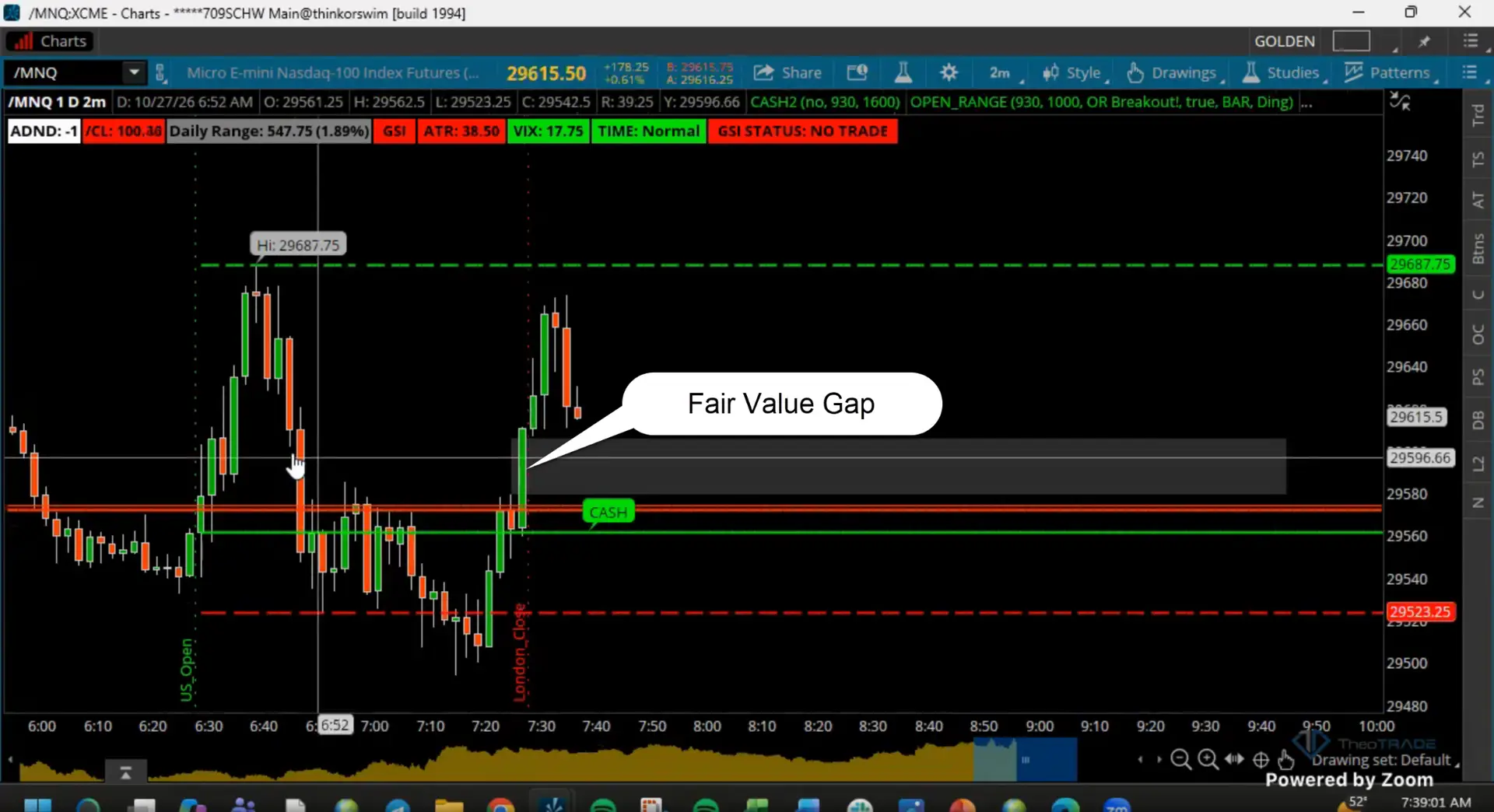
On Monday, I told the room why those gaps show up so often on the NQ. Nobody fills a giant order at one price in that market.
“This is a onesie-toozy market at best.”
A big seller has to work the order in pieces. I described it the way a broker on the phone would.
“You’re going to sell, sell, sell, stop. And then price is going to relax. Come back up, sell, sell, sell, stop.”
When that selling gets heavy enough, price moves so fast that it skips right over a stretch of the chart. I call that displacement. Displacement is what leaves a fair value gap behind, and it tells me someone big was in a hurry.
Big buyers leave the same kind of mark going the other way. Their gap forms below price, and their unfilled buy orders tend to defend it when price comes back down.
Which Fair Value Gaps I Trust
“Not all of them are created equal.”
Before I trade a fair value gap, I run it through three checks.
The first check is displacement. A slow drift doesn’t count. I want a real impulse move that clearly pushed price out of the area.
The second check is the timeframe. A 1-minute gap can work, but I give more weight to gaps on the 5-minute, 15-minute and hourly charts. On Wednesday, I pointed the room to a 4-hour gap on the NQ and told them, “Those are pretty darn good, by the way.”
Gaps on higher timeframes can stay in play for days. On Tuesday, price came down to fill a gap that had formed around 3:30 in the morning my time.
The third check is how candles close around the gap. Wicks can poke into it, and it stays intact as long as candles close back inside it. A close all the way through the other side inverts the fair value gap.
Mary asked about inverted gaps during Thursday’s Golden Setup session. An inverted bullish gap stops acting like support and starts acting like resistance. I told the room the NQ respects them really well.
Where I Enter Inside a Wide Fair Value Gap
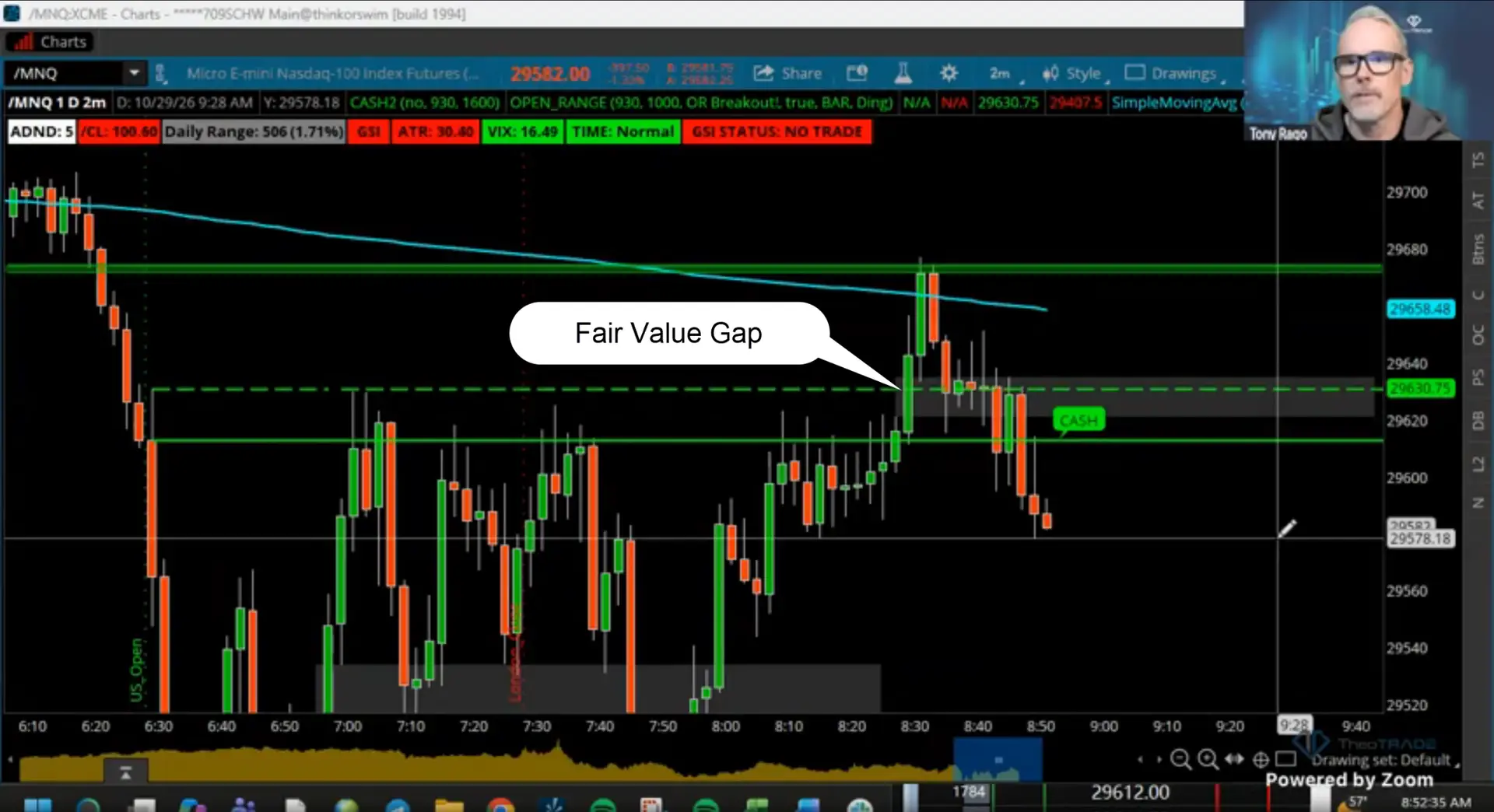
Gaps on the NQ can be 40 handles wide. If you wait for price to reach the far edge, the trade can leave without you.
“Split the damn thing, split it. Try to find your way into the middle of it.”
My Golden Setup levels do that splitting for me. The middle of Thursday’s bullish gap sat right on our 526.
The gap also showed me where I’d be wrong. I put my stop below the 500, under the gap. If price fell through there, the buyers I was counting on weren’t defending it.
My target was the 76, up near VWAP. In the first hour, I only take a trade if it has room for 50 points, and this one did.
My first long risked 20 points, and it stopped out. Then I bought the 26 with a 30-point stop. Price closed back above the gap, ran to the 76 and paid plus 50 on three contracts.
“We lost 60 points here. We just made 150 points there.”
I told the room it was a little messy. The trade worked because I was willing to take a second entry at the same spot.
“We have to have the gumption to go again.”
Later that session, another gap formed after a clean close below the pre-market low. I shorted the 36 and took it off at the 06, just above the 500 roundy, for plus 30 on three contracts.
Those two trades came to a little under 200 handles on micros. My levels didn’t change at all.
“We still use the 26 as our entry. We still use the 77 as our exit. We’re adapting to our current environment.”
In the Golden Setup room, a red GSI still means we stand aside. Fair value gaps are how I trade a high-ATR tape in the main room.
How to Start Using Fair Value Gaps
Start with homework after the close. “It would probably behoove you to go through your chart in the after hours and see kind of where your gaps are.”
Your prep can follow this routine:
- Mark every fair value gap on your 5-minute, 15-minute, hourly and 4-hour charts. Note which ones had real displacement behind them.
- Find any Golden Setup level, like a 26 or a 77, that sits inside a gap.
- Put your stop on the far side of the gap, where the orders you’re counting on should be defending it.
- Drop to a 5-minute or 2-minute chart for your entry once price comes back.
- Treat a candle close through the gap as a warning that it may invert.
Practice all of this on your simulator first. I told the Golden Setup room the same thing on Thursday.
Keep a log of how each fair value gap plays out. A few weeks of notes will show you which timeframes your gaps respect most.
My buddy’s traders could make a whole pit feel a single order. You won’t hear that roar on the NQ, but the gap on your chart shows you where it happened.
Apple reports next week, and earnings bars tend to bring the kind of impulse moves that leave gaps. Mark them before the open and watch which ones price comes back to fill.
The levels, the GSI and the live room where I traded Thursday’s gap all come with the Golden Setup.
Trade smart,
Tony Rago
Creator of the Golden Setup