
Hey Trader,
The S&P 500 slid again on Friday. I watched plenty of you start buying the dip.
I get the urge. I’m long a few names myself, and they’re working.
Even so, I can’t tell you whether this dip holds. The market could break either way from here.
I don’t try to call it. I size the punishment instead, which is how much I lose if I’m wrong.
Every trader carries some losers, including me. I just never take a trade that can wipe out 80% of an account.
If you miscalculate your risk, you won’t survive this business.
My risk check doesn’t stay fixed, though. It changes with the setup in front of me.
Heading into next week, the S&P 500 sits on what I call a razor’s edge. That’s a spot where the outcome could go either way.
A break higher could bring a rally of 400 to 450 points. A break lower could punish anyone buying the dip by 1,500.
I’d love to make 400 points. I’m not risking 1,500 to get it.
That’s why most of my Burn Signal options plays come with a defined maximum loss. You know the punishment before you ever enter.
I’ll show you how I size the punishment before buying the dip in a market like this.
I go into every trade expecting to be right. I also know I’ll lose some of them.
Where The S&P 500’s Razor’s Edge Sits
I track the S&P 500 through the E-mini futures chart. It’s been grinding lower inside a slow channel.
A channel is a pair of parallel lines that hold price between them. This one slopes down at about 10 to 20 degrees.
That’s a gentle slope, far from a 60- or 90-degree plunge. Price broke out of the channel, then slipped back inside it.
That’s where things get tricky. The razor’s edge sits at the apex between the two edges.
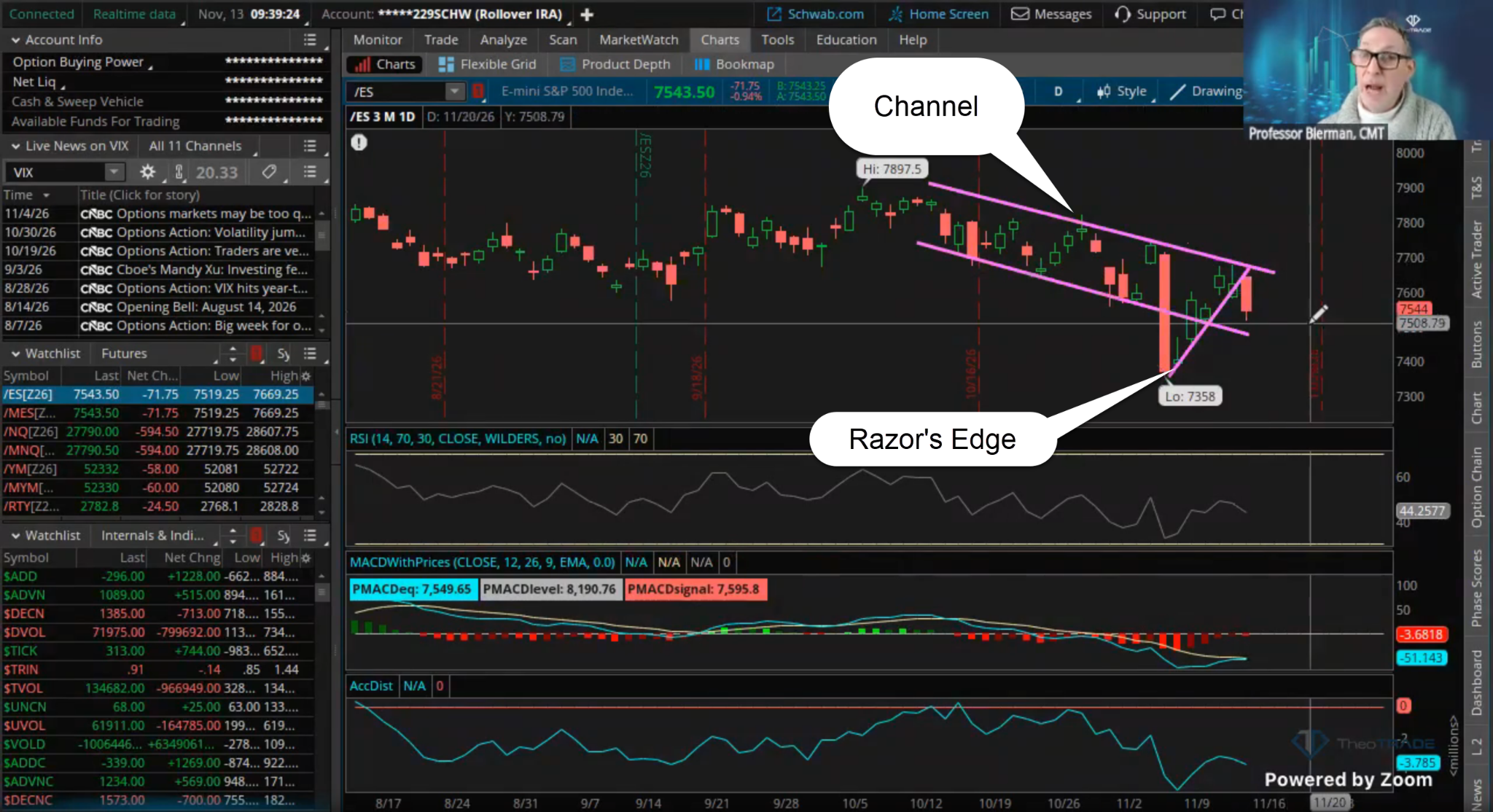
If the market pushes through, I could see a rip toward 8,000. That would mean a year-end rally of 400 to 450 points.
A squeeze that forces short sellers to buy back in could fuel it. That’s the bullish side of the edge.
The other side looks far worse. If the market fails and takes out the lower edge of the channel, the damage gets serious.
I wouldn’t treat this as an easy day for buying the dip.
How I Size The Punishment Before Buying The Dip
The punishment is what you lose if you’re wrong. I measure it before I think about the reward.
Here’s how the two sides line up for anyone buying the dip heading into next week:
- The reward. A break higher could deliver 400 to 450 points.
- The punishment. A break lower could cost a long trader 1,500 points or more.
Buying the dip here could make me 400 points. I’d be risking 1,500 or more to do it.
That’s not a trade I want to take.
Put simple numbers on it. Risking 1,500 points to make 400 puts nearly 4x the risk on the losing side.
At those odds, you’d need to be right about 4 times out of 5 just to break even. Nobody calls an either-way market that well, including me.
I didn’t treat Friday as a run-of-the-mill day. A pivot this important deserves the math first.
Size the punishment first. The reward only matters after that.
Why The Weekly Chart Gets The Final Say
The daily chart can fool you when you’re buying the dip near a razor’s edge. The weekly chart and the weekly MACD far outweigh it.
MACD is a momentum indicator. It shows whether a trend is gaining or losing steam.
The weekly slopes down at about 20 degrees right now. If it pivots to 45 degrees, I think this market crashes.
It won’t fall in a straight line. We could drop 300, bounce 100, drop 500 and then bounce 300.
The steeper that slope gets, the more savings and retirement accounts get blown out. You can watch the punishment grow in real time.
The news adds weight to that side. Friday’s PPI report put U.S. wholesale inflation at a four-year high.
That raises the odds of a Fed hike. I expect one in December and another in March.
In my experience, every rate hike gets met with a 300- to 400-point drop. So far, the market has given back barely 100.
I think we’ve got another 200 points down just to price in that hike.
Watch 7,350 on the S&P 500. A break under it with a falling weekly punishes anyone buying the dip.
How I Take A Long Trade Instead Of Buying The Dip
Sizing the punishment doesn’t keep me out of the market. I’m long right now, and those trades are working.
They’re moving slowly. They keep making progress, and that’s all I ask.
Buying the dip in the S&P 500 carries 1,500 points of punishment right now. I look for stocks where the punishment is already small.
Cheap stocks give me that. Whatever you buy cheap will eventually go up.
I bought United Airlines at 101 when it traded at 8x earnings. I sold it at 120.
I bought Constellation Brands at 9x earnings, around $110. I sold it at $140.
Before buying the dip or taking any long trade, run these three checks:
- Find the edge. Mark the level that decides the trade, like 7,350 on the S&P 500.
- Measure both sides. Write down the reward and the punishment in points or dollars.
- Check the weekly before the daily. A falling weekly can override a pretty daily chart.
If the punishment dwarfs the reward, pass on the trade. If you already own it, buy a put or get out.
I’ll take a smaller win before I’ll risk a loss that can bury me.
That same idea sits behind my Burn Signal alerts. Most of the options plays are defined-risk debit spreads.
You know your maximum loss before you enter. That means you’ve sized the punishment before the trade even starts.
Burn Signals also fire in both directions. That matters in a market sitting on a razor’s edge.
Each alert gives you the ticker and the signs that triggered it. You also get a stock play and an options play.
Alerts come about twice a week. You decide how to trade each one.
You’re covered by a 30-day money-back guarantee. You also get a 90-day, 10-trade guarantee.
Professor Jeffrey Bierman
Creator of the Genesis COG System