Hey Trader,
I need to know if a selloff is a correction or a crash. I call a crash a sudden impact.
I love buying corrections. A sudden impact is a different animal.
Mix them up, and you’ll make your worst decisions in a panic.
You probably judge a correction or a crash by how far the market falls. That’s fair, since I use the 10% and 20% lines myself.
However, a crash comes down to speed more than a fixed percentage. I’ll show you how I tell the two apart with a simple summary table.
That label only gets me halfway. I also check the cause to see if a stock’s tailwinds became headwinds.
CNBC and Bloomberg are calling this drop a crash. The S&P 500 slid from 7,900 to 7,300, which isn’t even 10%.
That’s not a crash. I don’t see one coming this time around.
Let’s start with the summary table. Then we’ll get to the cause, and what it’s telling me to do now.
How I Tell If It’s A Correction Or A Crash
My summary table sizes up a drop on three counts:
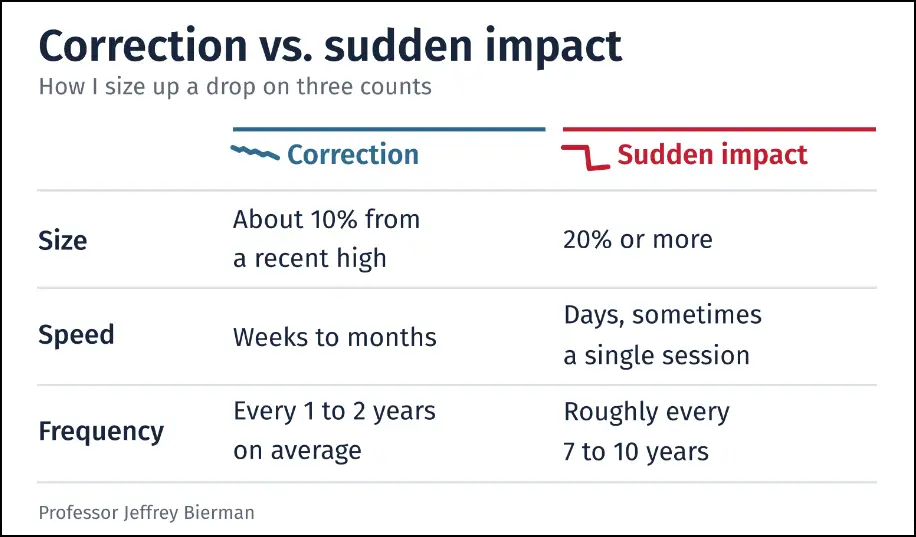
A sudden impact tends to be fast and furious. I named it for that speed.
A correction tends to be protracted, strung out and slow.
Either way, a correction or a crash reprices risk. The crash just does it a lot faster.
A sudden impact also sends volatility way up. That spike reflects psychological instability.
Why A Correction Or A Crash Changes Your Decisions
A correction is a normal part of the market cycle. I see it as a healthy reset, like an exhale.
Wall Street doesn’t like corrections anyway. It wants the market up all the time.
I feel the opposite, because a correction tilts the risk-reward my way. The valuation can turn compelling too.
A crash is panic selling. People sell anything at any price, no matter how cheap or sound it is.
A crash feels like the market is never coming back. You can’t get out once you’re in it.
Nobody makes smart, sober decisions in a panic.
Money managers are making terrible decisions in this correction right now. They’re buying bubbles like Coca-Cola and Procter & Gamble.
They won’t touch tech that’s down 70%, because they bought it 70% higher.
Don’t let a headline decide if it’s a correction or a crash. I laid out this table to keep you from losing your mind.
I’m not calling for a crash. I think the odds have roughly doubled, from 2% to about 4%.
That’s still low. The last full-fledged crash came with COVID in 2020, almost 7 years ago.
We’re getting into that window. Rates are going higher, while earnings beats are starting to slow down.
The ingredients are there.
What The Cause Says About A Correction Or A Crash
I add one more row before I label a drop a correction or a crash. That row is the typical cause, the last piece of the puzzle.
A correction usually comes from overvaluation. The sentiment just shifts.
That’s why I wait so long to buy. I’m looking for the right price.
A stock that works off its overvaluation hands me the advantage. I’d fire you for chasing the high if you worked for me.
Whatever goes up must come down. You just have to wait for it.
A sudden impact starts with a major shock to the system. It goes beyond overvaluation.
The catalysts that drove your stocks up may not be there anymore. Worse, those catalysts may have turned into headwinds.
That’s a complete macro shift. It could come from rates, inflation, the Fed, liquidity or bonds.
COVID was a demand and supply shock.
Where I Stand In This Correction
I called for 7,350 about 8 weeks ago. It took all 8 weeks to get there.
I’m calling this market a correction. Now we’ll see if it can hold the line.
Everybody’s bearish right now. I expect any further decline to bleed out one day at a time.
I don’t see a 900-point gap coming.
I’m sitting on the sidelines with 55% cash. I’m calm, letting the storm go past me.
I won’t buy the first dip in a correction or a crash. I buy when the charts flatten out.
The S&P 500 is getting there. It isn’t flat yet on an hourly basis.
I live for corrections in individual stocks.
Semiconductors are a different story. They’ve worked off their overvaluation.
I’ve tracked them every day for 10 years. They once traded at 40x earnings and now sit at 9x.
I bought a little yesterday and a little more today. Each buy was 50 shares, just a toe in the water.
Their charts have flattened out. The worst of the sentiment is behind them.
My largest position is 3.8%. I trade small to survive a correction or a crash.
You can become a millionaire buying a crash. You have to time it right, which is hard.
I’d do nothing in a sudden impact until the panic clears. It will clear.
Corrections let me use other people’s poor sentiment to get the price I want.
Professor Jeffrey Bierman
Creator of the Genesis COG System