
Hey Trader,
On Tuesday, a short 26 on the Nasdaq got stopped out inside a single bar. The very next candle came right back to the entry and paid.
The trade was right. Anyone holding it still took a full stop, and a quick ATR stop loss check would’ve warned them before they clicked.
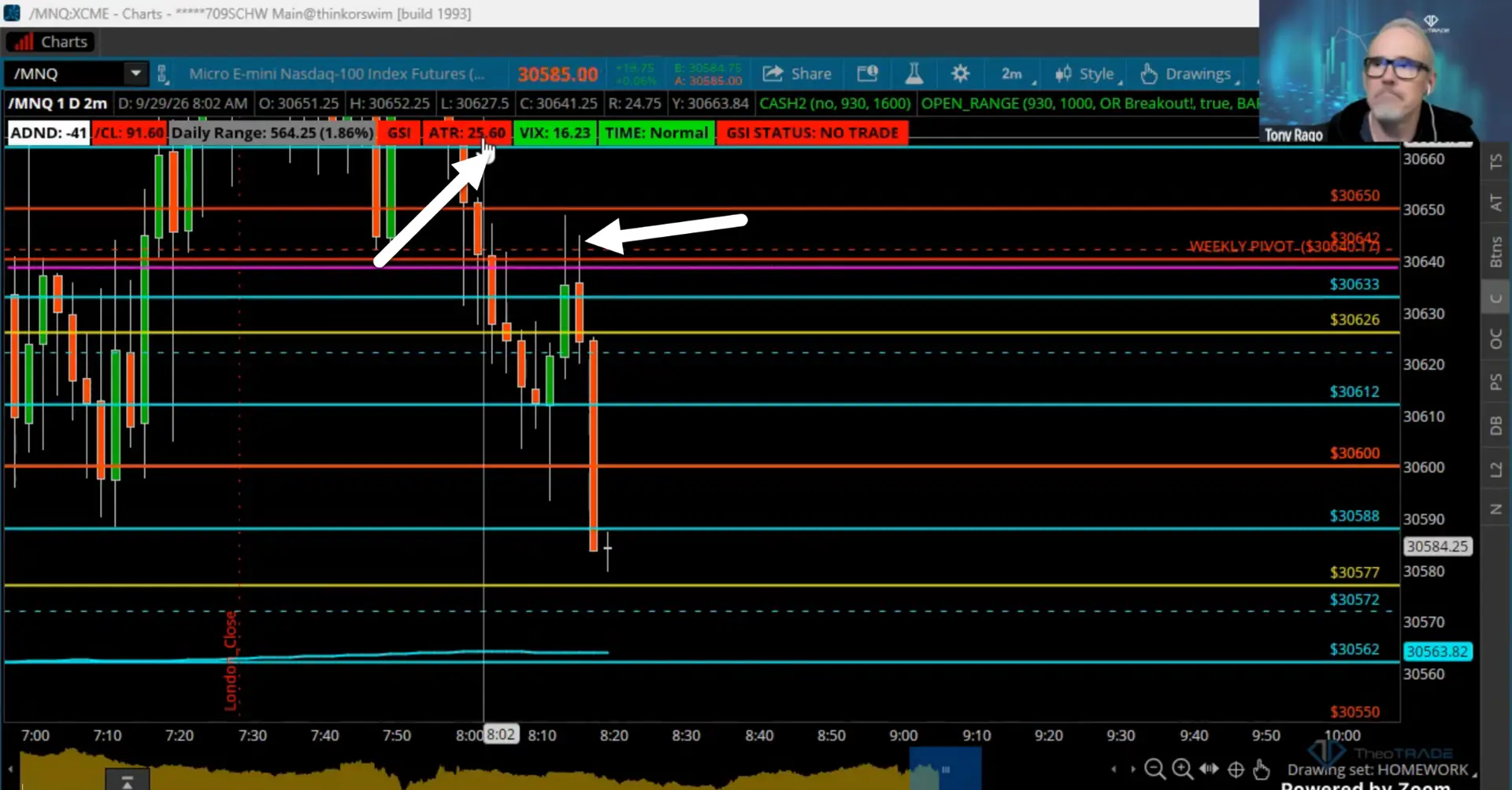
ATR, or average true range, measures how far price normally travels inside one candle. That morning it sat in the mid-20s, and I trade the Golden Setup with a 15-point stop.
When ordinary bars are bigger than your stop, noise can knock you out of good trades again and again. Four of those in one morning on a 15-point stop adds up to 60 points lost on trades that worked.
I wasn’t in that short. My ATR stop loss check had already put me on the sidelines.
“You’re going to say, ‘I was right. I was just early.'”
You’ll learn the check I run, why I won’t widen my Golden Setup stop to pass it, and the two ways I handle a tape that’s too wide. One of them paid us a plus 20 on Wednesday.
What an ATR Stop Loss Measures
Quick orientation first. My levels repeat inside every 100-point block on the NQ, so a 26 sits 26 points above a round number, with the 33 above it and the 12 below.
Price covers the ATR on an ordinary bar whether the setup is good or bad. A stop that sits inside that range can get hit by noise alone.
The textbook ATR stop loss is 1.5x ATR. On Tuesday, that came to roughly 40 handles.
My 15-point stop sits inside normal noise by design. I accept that because my setups are built on tested probabilities.
“It is something that’s been back-tested to the nth degree. Thousands and thousands of trades have been tracked.”
That testing absorbs the occasional noisy stop on a normal tape. It doesn’t protect me when the ATR stop loss runs more than 2.5x my stop.
So I read the ATR stop loss as a gauge of how far out of bounds the tape has gotten. My working line for a 15-point stop is an ATR around 25.
The GSI is the volatility gauge on our Golden Setup charts. It turns red when ATR climbs too high for the strategy.
“We don’t want it at 30. We don’t want it over 25, really.”
Widening my stop to 40 sounds like the obvious fix. My targets stay where the levels are, though, so I’d be risking more than I could make.
“Is that a deal killer? Yep, it is. We’re not going to risk 35 to make 25.”
When ATR runs past my line, I leave the stop alone. I either stand aside or change how I enter.
Two Ways I Handle a Wide Tape
On Tuesday, I stood aside. Marion asked in the Golden Setup room why I watch ATR so closely, and I gave her the math straight.
“Each one of these bars is twice the size of our stop. That means you could still be right on the trade and it could stop you out.”
“Are we going to use a 40-handle stop? I’m not.”
Our GSI was red, so I kept my hands off the mouse. Then the short 26 stopped out in one bar and came right back to work.
“Look, even the short would have stopped us out. That’s the point of the ATR right there.”
On Wednesday, I changed my entry instead. ATR read 31, which sits above my line.
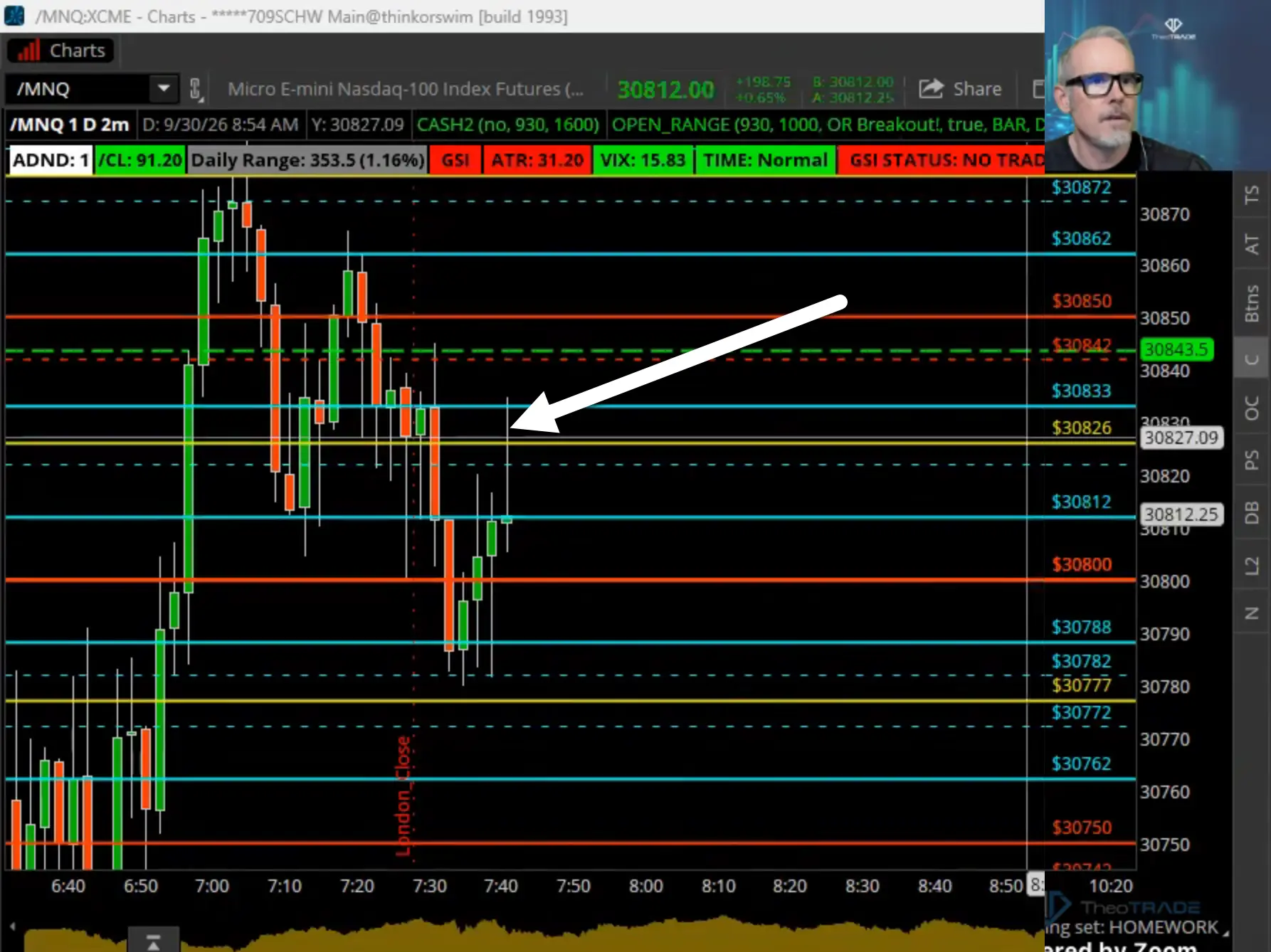
I used the back-through entry. Instead of resting an order at the 26, I let price push up to the 33 first, because the 33 is where my risk sits on a 26 short.
Once the 33 printed, I placed the order. I planned to cancel it if price hit the 36, 10 points past my entry.
That sequence lets the noisy push happen before I’m in the trade. Price came back down, picked us up, and ran to the 12 for a plus 20.
“That is a perfect example of a back through trade right there.”
The same technique had already earned its keep on Tuesday. It kept us out of two trades that would’ve hit full stops.
“That entry technique saved us. It saved us here, and it saved us here.”
Run the ATR Stop Loss Check Before You Click
Read ATR on the timeframe you actually trade, and multiply it by 1.5 to get your ATR stop loss. Compare that number to your stop before the open.
Know your tolerance ahead of time. Mine is an ATR around 25 for a 15-point stop, and yours depends on your stop and your own homework.
When ATR runs past your line, you’ve got two moves. You can stand aside, or you can switch to a back-through entry.
A quiet-looking chart can still fail this check. Tuesday’s futures room crept along on a 33 ATR, which puts the ATR stop loss near 50, and I got stopped out at break-even six times in a row after moving my stop to my entry at plus 20.
Cutting size buys you room when you still want to trade. On Thursday, the ATR stop loss ran over 60 on a 42 ATR, so I switched to micros, which are one-tenth the size of the full contract.
Check ATR on the timeframe you trade. A 1-minute chart shrinks the reading and makes your risk look smaller than it is.
Write your ATR stop loss in your journal every morning. After a month, you’ll see which readings paid you and which ones only charged you commission.
We’re about 30 days from the midterms, and I told the room on Thursday that I expect volatility to increase from here. Expect more mornings like Tuesday.
Check your ATR stop loss before your first trade on Monday. When it runs too far past your stop, you already know what that tape can do to a right trade.
The level map, the GSI, and the back-through entry I used this week live inside my Golden Setup.
Trade smart,
Tony Rago
Creator of the Golden Setup