
Hey trader,
Earnings tonight on Devon Energy just turned into a setup most traders are reading wrong.
You have probably looked at a stock with a clean call print above the current price and assumed the strike is the target.
That read is incomplete. The strike is the destination, but the path matters more, and the path on Devon runs through one specific level that has to break first.
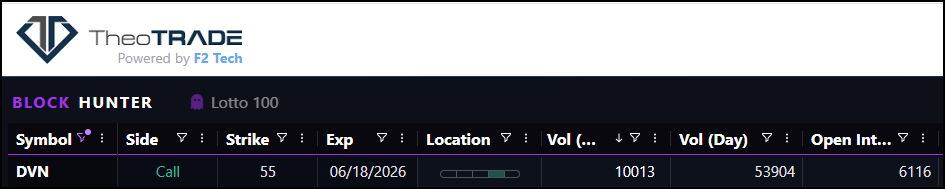
The Block Hunter Console caught 50,000+ contracts traded at the DVN $55 strike for June 18 this morning.
One print of 10,000 contracts led the flow, with the rest filling at or near the ask.
Devon sits near $52. Earnings drop after the close tonight.
The volume-to-open-interest ratio on the print was 1.64, which is what surfaced it on the Console. A standard 5,000-contract block scan missed it entirely.
Here is the part most traders skip. There are two strikes in play, not one. $52.50 is a wall, $55 is a magnet, and the order they break in determines whether the trade pays $1.10 or zero.
Here’s how it works.
Why The Print Reframes The $55 Strike
A $55 call buy is easy to read as a price target. The mechanics behind a print of this size go further than that.
When an institution buys 10,000+ calls, the dealer on the other side ends up short those calls. Short calls carry negative gamma and negative delta on the dealer’s book.
The dealer has to neutralize that delta by buying stock as the price moves toward the strike. The closer DVN gets to $55, the more stock the dealer has to buy.
Each share of dealer buying lifts the price further toward $55. That feedback loop converts a price target into a gravity well.
$52.50 Is The Gate
The option chain shows around 22,000 contracts of open interest at the $52.50 strike. That cluster acts as the nearer wall.
The composition at $52.50 is not fully visible from the print data, which means the gamma effect there could cut either way. What is visible is that the level has been holding the price for several sessions.
Until DVN clears $52.50, the gamma feedback from the $55 print stays muted. The stock has to grind through the closer level on its own catalyst before the dealer’s hedging requirement at $55 starts pulling in earnest.
Earnings tonight is the catalyst designed to deliver that move. Once $52.50 breaks, the morning’s print does the rest of the work between $52.50 and $55.
The Oil Backdrop Behind The Print
Devon does not trade in a vacuum. The macro setup behind this position matters.
Tanker incidents in the Strait of Hormuz pulled the geopolitical risk premium back into the energy market over the last 24 hours.
apan continues intervening in the dollar-yen pair because oil purchases priced in dollars are pressuring the economy at current crude levels.
The supply side for natural gas liquids has tightened. Production facilities in the Persian Gulf have been impaired. Taiwan is a heavy NGL consumer with limited near-term substitutes.
Devon produces oil, natural gas, and natural gas liquids. The institution behind the $55 print is positioning around a story where production economics for U.S. operators are improving while global supply stays constrained.
How To Structure The Trade
The retail version uses a vertical call spread to capture the move from $52.50 toward $55 with defined risk on the entry.
- Buy the DVN June 18 $52.50 call
- Sell the DVN June 18 $55 call
- Spread width: $2.50
- Cost: approximately $1.10 per spread
- Max risk: $1.10 per spread
- Direction: Bullish on a post-earnings break through $52.50
- Catalyst: 50,000+ contracts at the $55 strike, $52.50 wall as the gate, oil supply backdrop, earnings tonight after the close
- Skew edge: flat skew through the upside strikes given heavy call buying at $55
The spread reaches roughly $1.85 if DVN clears $54 with momentum still intact. That is a 70% return on the entry.
If DVN holds above $55 after the move, close the spread and roll up to the $55/$57.50 strikes. Each completed roll locks in the prior gain and resets exposure for the next leg higher.
Why The Console Caught The Print First
A standard block scan filters at 5,000+ contracts and a volume-to-OI ratio above 1.5. The DVN print at $55 came in across multiple tranches that aggregated to 50,000 contracts only when the alert thresholds loosened.
Dropping the volume alert to 2,500 contracts and the volume-to-OI ratio to 1.2 surfaces this kind of activity early. By the time the chart confirms the $52.50 break, the spread is already trading at twice the morning’s entry price.
See exactly how Block Hunter catches institutional positioning before the crowd catches on.
Brandon Chapman, CMT
Creator of Ghost Prints