Hey trader,
What happens when you add rising costs, falling demand, and a central bank with no bullets left?
Stagflation.
Both the bull playbook and the bear playbook stop working in stagflation.
The market may not crash, but it won’t rally either. And the market has not come to terms with it yet.
What I do know is that if you don’t adjust, you will chop yourself to death on both sides.
Thankfully, it’s not too late to make those changes.
This weekend, we got the clearest signs that’s where the economy is headed.
Effective April 17th, Amazon will add a 3.5% fuel and logistics surcharge for sellers in the US and Canada.
That means in less than two weeks, Amazon is going to bump up its margins by pushing costs directly onto sellers.
Walmart, Costco, and BJ’s Wholesale also announced similar charges.
Those sellers will pass it right to you.
It might seem impossible to fight these headwinds…
The Reflation Trap
The problem with this market is reflation. All of these companies are charging a ton of money.
The Straits of Hormuz, the logistics costs, and the price of gas are all getting factored into their business models. Every one of these retailers is finding ways to pass those costs onto sellers or buyers.
Amazon’s sales are going to fall because their prices are going to go up. But their margins will increase.
They will raise Amazon Prime fees. They will make more money on profit margins and less money on sales volume. It is a trade-off.
This pattern is playing out across the entire retail sector.
Walmart, Costco, and BJ’s are doing the exact same thing.
They are all charging suppliers new fuel surcharges to transport goods to their warehouses and stores.
Those surcharges will be calculated as a percentage of the cost of goods sold received.
That is the mechanics of stagflation in real time. Costs rise. Companies protect margins. Consumers pull back. Sales decline. And the cycle feeds on itself.
Why Both Playbooks Fail
Powell already cut rates and cannot cut them anymore. THATis the part nobody wants to confront.
You cannot cut rates when costs are going up.
People are being laid off. There is a war disrupting global shipping routes. And inflation is not coming down for a while.
The economy is solid but deteriorating.
We are in a transition from a growth market to a value market.
We are not in a bear market yet. But we are no longer in a bull market. We are at the halfway point, where value has to come back.
That transition is where traders get destroyed.
They keep running the same playbook from the last two years, and it does not work anymore. Here is what the transition actually looks like:
- Sales fall first while companies hold margins by passing costs through surcharges and price increases. That is the phase we just entered this weekend.
- Eventually, margins have to come down too in response to lower sales. That phase has not started yet.
- When both sales and margins hit their bottom, then we can start a new bull market. We are nowhere close.
The market is rotating away from expensive stocks and toward cheap stocks. That process is actually healthy in the long run, but it will punish anyone still clinging to the growth playbook.
How I Am Fighting It
I am sitting at 50% cash right now and picking my spots. That alone tells you something about my conviction level on the broad market.
I have 12 longs and 10 of them were up today. Not because I predicted anything. Because every single one was selected on valuation, not on charts.
Here is the framework.
Dividends are the stagflation hedge. Ten of my 12 longs pay me a gigantic dividend. Some of them pay six and seven percent. That is the key insight most traders miss right now.
In a market where stocks chop sideways for months, the dividend is the only thing generating returns.
Even if a stock trades completely flat, I get paid. A stock paying 6% while trading sideways beats a growth stock losing 15% while you hope for a rally that never comes.
Lower P/E stocks tend to pay higher dividends. Higher P/E stocks tend to pay nothing. In stagflation, that relationship becomes the entire game. The dividend also shrinks bid-offer spreads, reduces volatility, and signals that the company has real cash flow underneath it. That is three layers of protection in one metric.
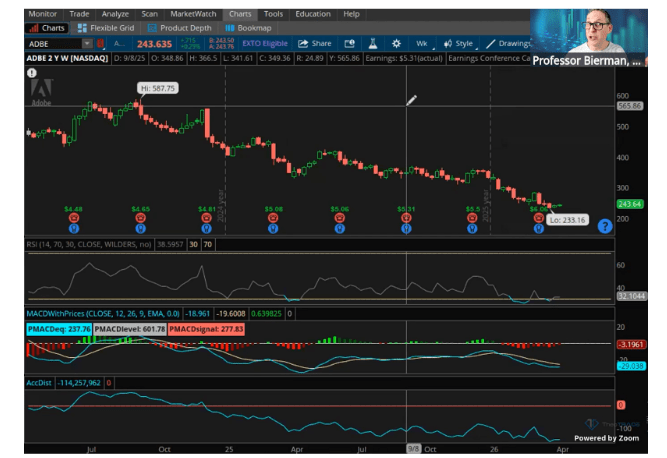
Valuation is the other hedge. I own Adobe at a P/E of about 14. I got in around 237 to 238.
I have a put option underneath it as a floor with strikes at 235 and 240. All this stock has to do is trade sideways for four weeks and I make money. I do not even need it to go up.
That is a completely different way of thinking about risk.
The valuation itself protects the trade. When the P/E is 14, the downside is limited because the stock is already priced for bad news.
Compare that to Apple, where even Warren Buffett said this weekend it would have to go “measurably lower” before he would buy it again.
A stock with a P/E above 30 has no floor. A stock at 14 times earnings has gravity working in your favor.
Cash is a position. I am not being defensive with 50% cash. I am being strategic. At 6,900 on the S&P 500, I would sell everything again.
I am not shorting because I was taught by my mentors to never short a dull market.
But I am also not deploying capital into expensive names just to feel fully invested.
The market is rotating from expensive stocks to cheap stocks.
That process is healthy in the long run. But it will punish anyone still clinging to the growth playbook.
Buy cheap and you will become a millionaire.
Chase expensive and it will cost you eventually. That has never been more true than right now.
Professor Jeffrey Bierman
Creator of the Genesis COG System