
Hey trader,
A dead tape is where accounts quietly bleed out.
The screen looks full of setups. Every one of them takes a few dollars and hands you nothing back.
Thursday morning was exactly that. Gold stopped me out. Crude chopped sideways. The indexes ran higher without me on board.
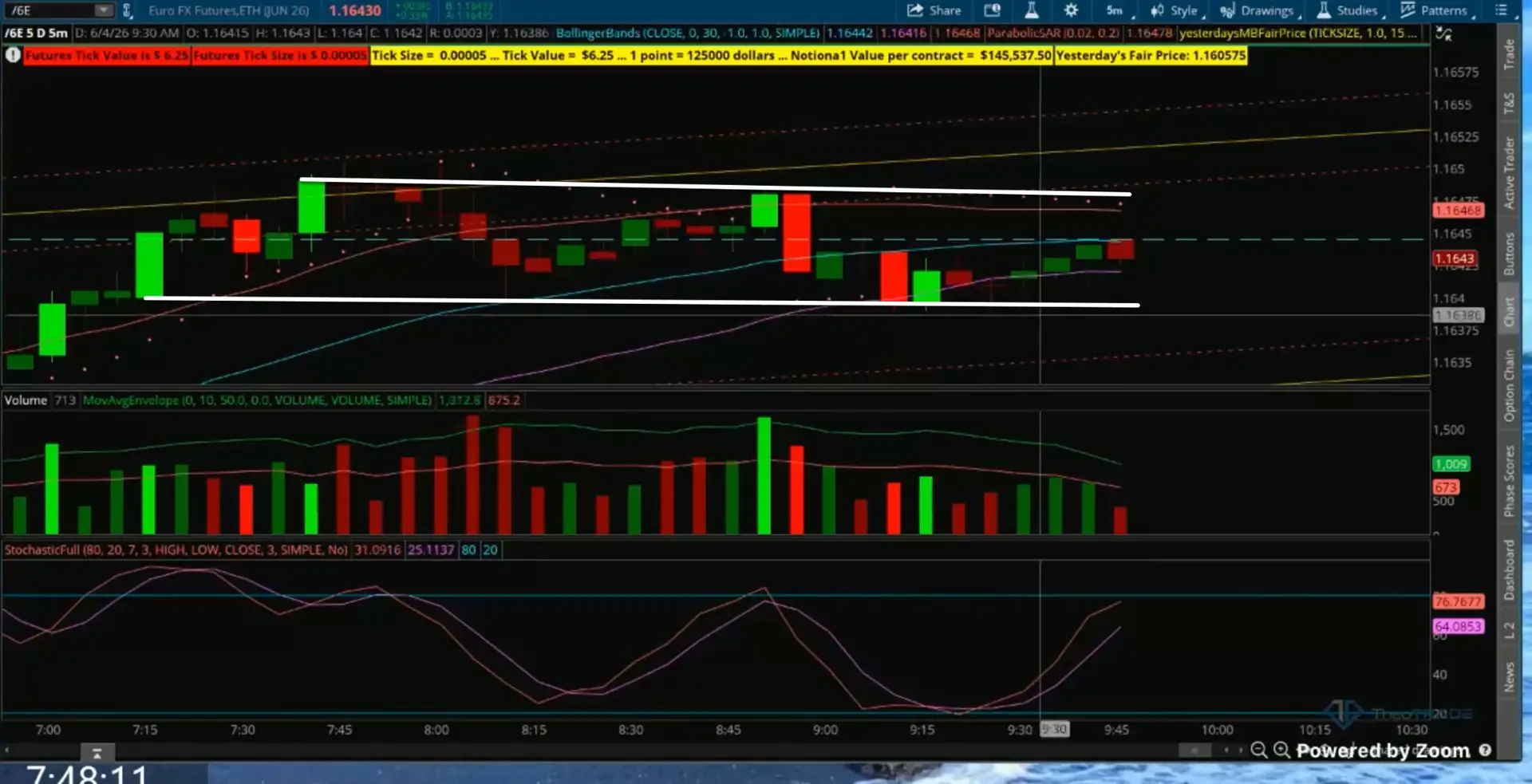
One chart was doing something different. The euro had wound itself into the tightest range on my screen. Six pips, top to bottom.
That squeeze was the only real signal of the morning. It paid $87.50 on a single contract while everything else gave money back.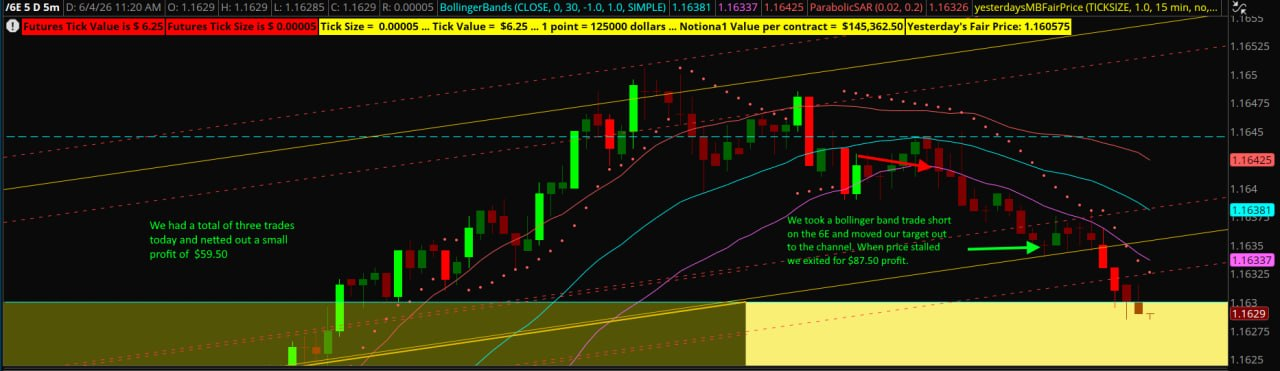
Here’s how I read the coil and traded the break on the 6E.
The Tape Going In
The morning opened slow and stayed slow.
Gold gave me a beacon breakout, ran a little, then reversed the whole move and tagged my stop before I could adjust a thing.
Crude kept poking at its level and refused to close inside it. The ES chopped through failed Bollinger Band breakouts on both sides.
Almost every instrument I trade off structure was pinned at fair price.
The Dow was up nearly 800 points. The action was happening everywhere except the charts I needed.
I called it a rough tape in the room – flat and squeezy.
Treasury Secretary Bessent was due to speak at the top of the hour, though I was not expecting much from it.
The One Chart That Was Coiling
The euro had already made its move overnight.
It broke out around 5:30 and ran the full distance of both the channel and the beacon, climbing from 1.1600 up to 1.1650.
Then it parked at fair price and held.
Here is the part that caught my eye. The one standard deviation band on the euro collapsed from 20 pips down to five or six pips.
That is a super squeeze. The range got so tight the chart looked like it had stopped breathing.
A coil that narrow is energy with nowhere to go yet. It has to resolve eventually. When it does, it usually moves with force.
Why Reviewing This Trade Helps You
Volatility runs in cycles. A market does not stay compressed forever. It winds up, then it releases.
The chart that is coiling is the one quietly building the next move while everything else burns your commissions. Spotting that compression is worth more to you than chasing whatever already ran.
A tight squeeze hands you something else most setups do not. It puts your stop close.
When the range is only five or six pips wide, you lean on a structural level that sits right above your entry. You risk very little to find out if you are right.
That is the takeaway I want you to keep. When the tape goes dead, look for the coil instead of the movers. The chart with the smallest range is often the one about to give you the cleanest signal on the board.
How I Landed on the Short
The squeeze finally broke. The euro closed down through the bottom of its Bollinger Band.
That is a bearish Bollinger Band breakout. It was the trigger I had been waiting on.
I run one filter before I take a breakout like this. I check the stochastic.
The bands were rolling over and the stochastic was crossing down without being overextended. That combination is a green light.
Gold gave me a breakout earlier that I would have skipped, because its stochastic was stretched too far. I know the difference when I see it side by side.
The tape was ugly. I took the trade anyway. The rules are the rules, and a rough morning is no reason to skip the one signal that qualifies.
Walking Through the Trade
I called the short at 1.1642. The stop went where the dot sat, up at 1.1647, because a Bollinger Band breakout stops at the dot.
That put five pips and about $62.50 of risk on a single contract.
The first target was 1.16355, measured dot-to-close on the breakout. That is better than $80 of reward against roughly $62 of risk before any management.
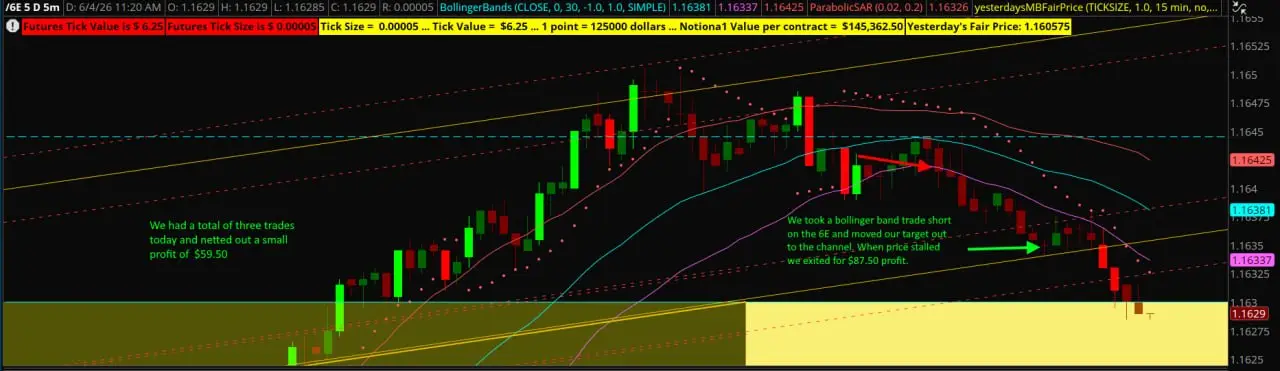
The candle closed outside the band and confirmed. Once lower highs and lower lows started stacking, I walked my stop down to break-even at the entry.
From that point the only thing I could lose was the commission.
Then came the move that turned a quick scalp into a real winner. I pushed the target out to the channel at 1.1634.
The breakout got me in. The channel structure told me there was more room underneath, so I extended into it.
As price drove through the zero and the 100 level, I kept walking the stop down behind it. First to 1.1640, then to 1.1639. Profit was locked the whole way down.
Booking It
The euro got within a single tick of the channel target.
The room was over and I had a meeting to get to. I closed it at 1.1635 for $87.50, a clean seven pips on one contract.
About ten minutes after the class ended, price tagged the full target at 1.1634 for $100. Then it kept going and pushed straight through the opposite beacon.
I reported the $87.50, not the $100. We always report the number that actually filled in the room. I would rather understate a result than ever pad one.
The euro was the full winner on a day that gave gold back to a stop and left crude scratching for a small gain. Three trades, and the account still netted a small profit of $59.50, because the one clean read carried the morning.
The Lesson Worth Keeping
On a flat tape, the coil is the signal.
The squeeze pointed me to the right chart. The stochastic filter graded the breakout. The break gave the entry, and the channel gave me room to extend the target once the move proved itself.
Draw your levels before the bell. Know your stop and your target before you click. Trust the squeeze over the noise on a tape that is trying to chop you to death.
Every trade I call inside the 10% Club follows this exact framework.
Entry, stop, target, and the structural reason behind every click. Every time, no exceptions.
👉 Click here to learn more and join us.
Blake Young
Senior Market Strategist, TheoTRADE