Hey trader,
Crude oil hasn’t been this volatile since the COVID crash.
The Strait of Hormuz is closed…headlines are changing by the hour…people are either frozen or chasing every spike.
Indecision has a cost.
Every session that passes without a plan is a session where crude hands money to someone else.
The moves are happening.
The only variable is whether you have a framework to capture them.
While I won’t give away all my secrets, I do want to illustrate how I do this.
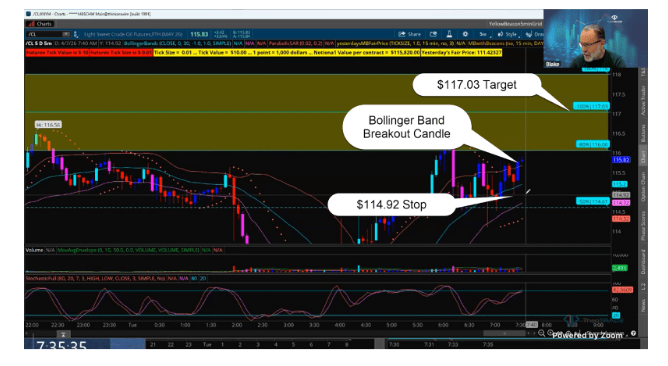
During this morning’s 10% Club session, I called a Bollinger Band breakout on crude oil futures:
- The entry was at 115.69.
- The stop was defined before the order went in, 114.72
- The target was 117.03.
It worked like a charm.
The entire trade followed a repeatable system that works whether the catalyst is Iran, OPEC, or a random Tuesday.
The Setup
Crude oil opened strong on Monday. The overnight session found a base near the zero level and broke higher before the bell.
By the time the session began, crude had already given a buy signal, then a sell, then another buy. The levels from Friday’s Monkey Bar distribution held despite the Iran news cycle. Price was respecting the structure.
The Bollinger Band breakout fired just after the open. The signal was a long entry with a target of 117.03, but I adjusted the exit to 117 even. Any time a Bollinger Band target has to break through the zero level to reach its full measurement, I treat that level as the exit.
The risk was $83 per micro contract. The reward was roughly $131. That gave us better than a 1.5:1 reward-to-risk ratio on the initial setup, and it improved significantly as the trade developed.
The Entry
I set the entry at 115.75 and waited for a pullback. Crude gave us one. Several members in the room picked up fills between 115.52 and 115.79.
I entered at 115.69 with a stop at 114.92. That stop was placed below the low of the third confirming candle, which gave the trade room to breathe without exposing the account to unnecessary drawdown.
One micro contract. That is all a $5,000 account can support at $83 of risk. Position sizing was locked before the order went in, not after.
The Selling Zone
The trade moved in our favor immediately, but crude hit resistance near 116.18. A large bearish candle appeared right in the middle of the move. Buyers pushed price up, and sellers hammered it back down in the same five-minute window.
That candle was the moment where most traders would have second-guessed the trade. It looked like the move was failing.
I told the room to hold. The stop was already in place at 115.05. The risk was managed. There was no reason to exit a trade that had not violated its structure.
The key level was 116.18. If crude closed above it, the path to 117 was open. If it failed there, the stop would protect us.
The Stop Progression
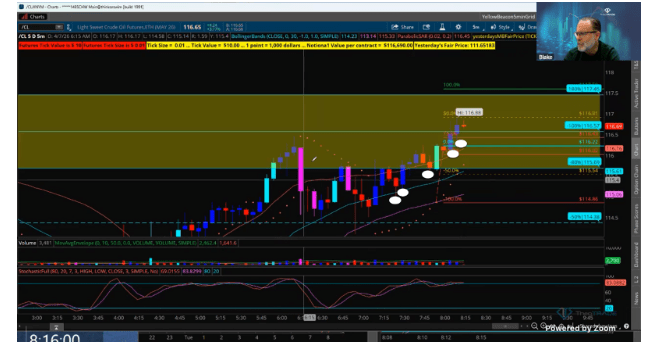
This is where the framework earns its money. Every stop adjustment followed the same rule. Three consecutive candles of higher highs and higher lows triggered the first move. After that, each one-candle reversal confirmation pushed the stop higher.
Here is how the stop moved through the life of the trade:
- 114.92 at entry, placed below the third confirming candle
- 115.05 after three candles confirmed higher highs and higher lows
- 115.50 as crude pushed toward the selling zone but held its structure
- 115.61 after crude closed above 116.18, bringing the stop to near breakeven
- 116.00 once the move cleared the halfway point, locking in profit
- 116.22 in the final stretch as crude approached the 117 target
By the time crude was within a dollar of the target, the worst-case outcome was already a profitable exit. That is the entire point of mechanical stop management. You remove the possibility of a winner turning into a loser before the trade resolves.
The white dots below show you the progression.
The Target Hit
Crude reached 117 roughly 45 minutes after the entry. The trade paid $131 per micro contract. Julie, one of the members in the room, ran a larger position and picked up $400 on the same setup.
The session finished with two winners and one loser across crude, gold, and the Russell. The Russell short triggered a stop for a small loss after a sharp reversal. The gold beacon short hit its full target of $170 per micro before I could type in the order.
Crude was the cleanest trade of the day. The signal was clear, the structure held, and the stop management turned a good entry into a locked-in winner.
Why This Matters Right Now
Crude oil is not going to calm down anytime soon.
The Strait of Hormuz remains effectively closed. President Trump’s deadline for Iran to reopen the strait expires tonight at 8:00 PM Eastern. Iran rejected the latest ceasefire proposal.
Analysts estimate nearly one billion barrels of supply will be lost by the end of April.
WTI is trading above $113 as of this writing. Brent is above $110. Gas prices at the pump are up 38% since late February.
This environment produces large, fast moves in crude futures every single session. The opportunity is real, but only if you have a system that tells you where to get in, where to get out, and how to manage the risk in between.
That is exactly what the 10% Club framework is built for. Defined entries. Mechanical stop management. Clear targets. No guessing. No chasing headlines.
What You Can Do Right Now
If you are trading crude oil futures without a rules-based framework, today’s session is a good example of what you are leaving on the table.
The trade was called in real time. The stop adjustments were announced as they happened. Every member in the room had the same levels, the same risk parameters, and the same target.
The six-week 10% Club mastermind begins tomorrow, April 8 at 1:00 PM Eastern.
I will be teaching the full methodology from the ground up. Bollinger Band signals, beacon trades, stop management, position sizing, and how to rotate across multiple markets without losing control.
If you have been through the course before, come back and sharpen the execution. If this is your first time, come ready to learn.
Click here to join the 10% Club and be in the room when the mastermind begins tomorrow.
Blake Young
Senior Market Strategist, TheoTRADE