
Hey trader,
0DTE options can be a lot of fun to trade…and profitable…but only if you know HOW to use them correctly.
It’s fine to treat them as lottery tickets. However, you need to be prepared to make adjustments to limit risk based on market conditions.
Let me give you an example.
Tuesday morning yielded a breakout trade setup.
I bought two 0DTE XSP calls Tuesday for 33 cents each once I got a buy signal…
…and then nothing. The tape just chopped.
That’s NOT what I wanted. Every minute that ticks by eats away at the value of my options.
I had two choices:
- Sit there and hold it, hoping like a doofus something would happen
- Adjust to the market conditions
I went with option #2.
By selling that higher strike, I cut my cost to $3 per contract, while still giving myself a chance to profit on a rally.
Naturally, you’re wondering what made me want to make that kind of change. After all, it’s not the first thing that comes to mind.
So, let me walk you through my logic and help you see why I did what I did.
Because at the end of the day, trading all comes down to risk management.
Why I Bought The Calls In The First Place
The ES opened Tuesday doing the thing I hate most. New low, poke at the high, back to the low, right back up again.
I said it out loud on the session. Gross.
Price was sitting on the VWAP and holding above the point of control, which is a polite way of saying nobody was in charge.
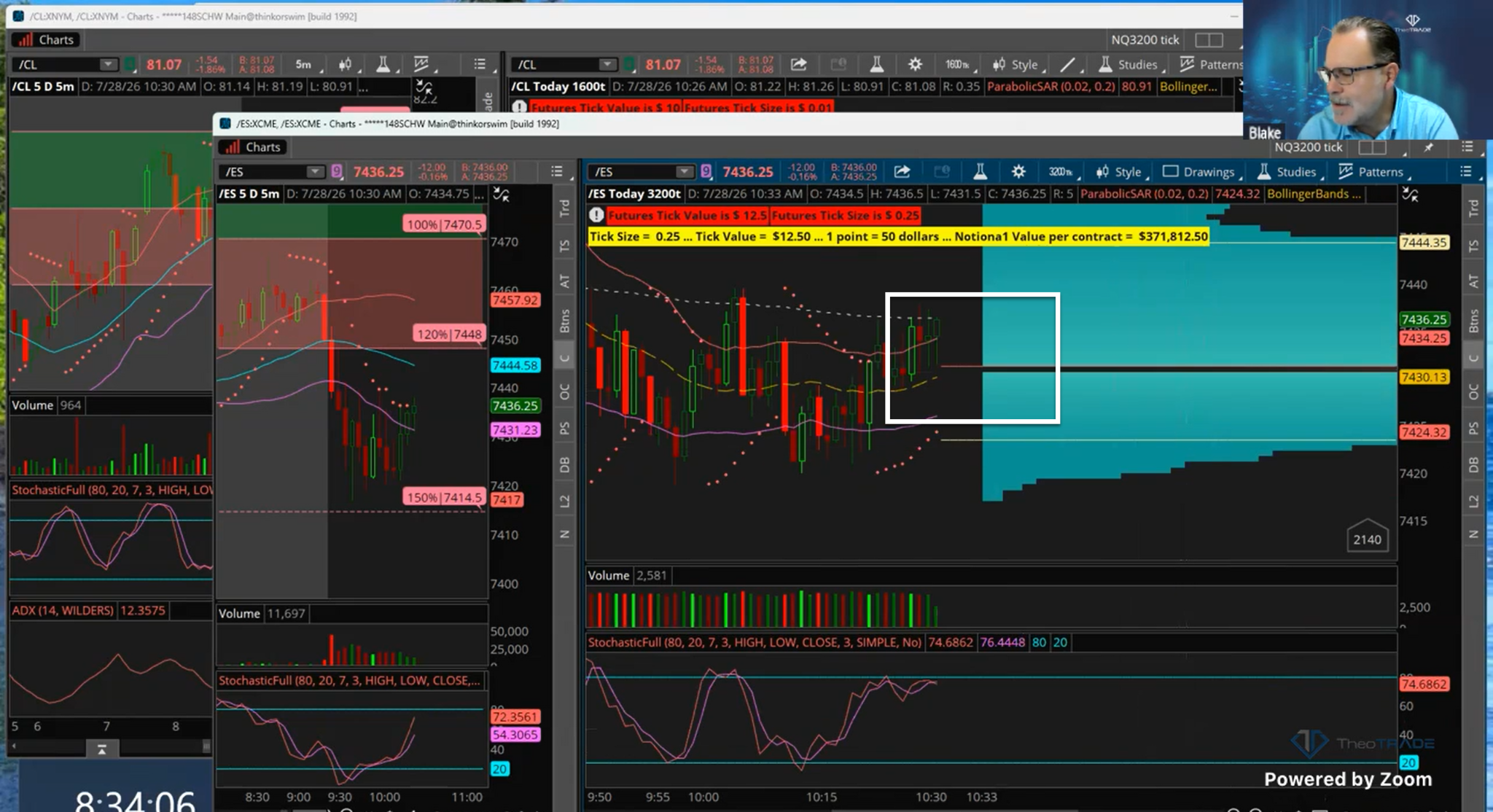
So I didn’t buy anything. I set a condition instead.
If price could break out either side, I’d take an XSP trade. The projected size on that break was 20 to 40 points.
That number mattered more than the direction. A 20 point run was enough to make the strike above mine worth real money, which is where my exit plan lived.
The trigger was a close above 7440, with 7460 as the target. When it printed, I wanted 45 to 50 cents for a long call.
Then Tasty locked up on me. By the time it woke up I was a few seconds behind, so I took the 744 for 33 cents instead of the 743 I wanted.
Two contracts. Total damage if I was dead wrong, $66.
What Changed
Here’s the thing about 0DTE. You can be right on direction and still lose, because you’re paying rent on the clock.
I got the breakout. What I didn’t get was follow-through.
My calls dropped to 26 cents, crawled back to 33, ran up to 41, then sagged again. At one point my whole position was up six bucks.
The Russell did the same thing. It spiked five points and handed every bit of it back inside a few minutes.
What really got my attention was the shape of the candles up at 7455. Same story over and over.
Buyers push, buyers hit something, buyers run.
Long upper shadow. Then another one.
Candles tell you buyers failed. They don’t tell you WHY.
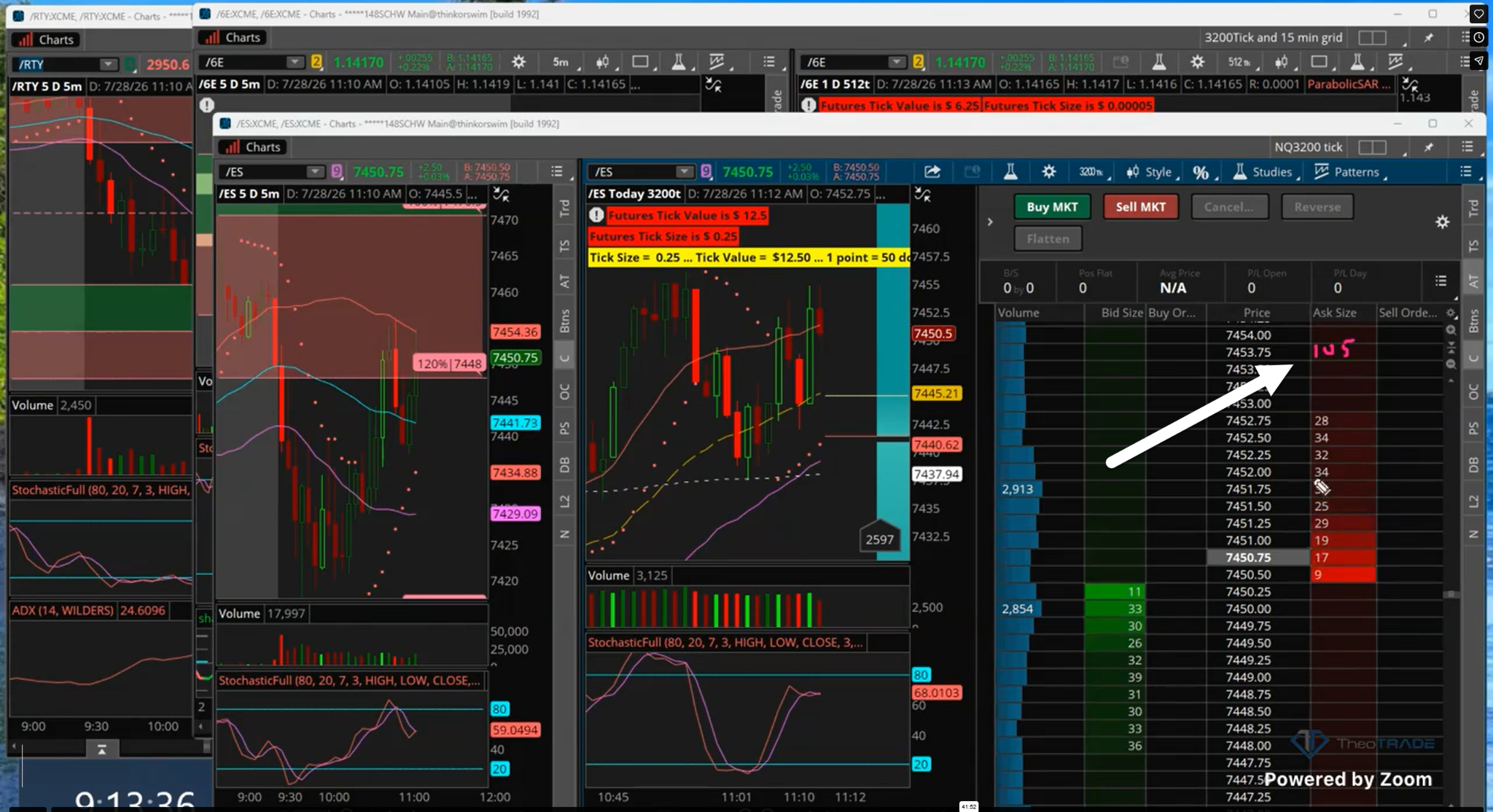
So I pulled up the ladder and there it was. 105 contracts resting at 7455, then 109, then 112, then 118.
Everywhere else on that ladder showed 20s, 30s, and 40s. Four times the supply parked in one spot.
Why This Adjustment Made Sense
My entire plan depended on price reaching 7460. At 7460, the 745 call should have been worth around 60 cents.
Sell that against 33 cents paid and I collect a credit. A credit on a one dollar wide spread means I flat out cannot lose.
That was the plan. The ladder told me the plan had a problem.
My target was sitting directly behind a wall of sellers. Waiting for the perfect 60 cent fill meant risking no fill at all.
Here’s the trade-off in plain English. A smaller credit I can actually collect beats a bigger credit that never shows up.
So I sold the 745 for 30 cents. Long the 744, short the 745, total cost $3 per contract.
Now look at what that does to the math. $3 of risk against $97 of upside means this thing breaks even if it works 3% of the time.
The platform said the odds of a full win were 17%. As price climbed, that number went to 24%, then 30%.
I need 3%. I was being handed six to ten times that.
Now the part I’m not proud of. Minutes after I sold, those sellers at 7455 cleared out and price ran through 7457 to the high of the day.
I was early. A fill at 45 or 46 cents would have locked in a guaranteed $13 per contract with the same $100 upside still live.
Later the 745 was bid near 66 cents, which is a 200% return on risk before the upside even counts.
I said it on air and I’ll say it here. I should have waited.
Notice what my bad timing did NOT do. It didn’t put my account at risk.
That’s the whole point of adjusting. The structure ate my mistake instead of billing me for it.
Members riding the plain long call did great on that push. BC closed his XSP at $1.03 for better than 200%, Dave picked up $93, and JG reported a 400% return.
Jay bought the 741 call for a dollar and sold it for two. That’s $100 per contract in a couple of minutes.
My spread never resolved before I handed the room over to Corey Rosenbloom. My standing order takes the whole thing off at 80 cents, which is $80 of profit against $3 of cost.
How To Analyze This Yourself
You don’t need my indicators to run this. You need one number in front of you the entire time you hold the trade.
That number is your credit. Write it down before you click.
Mine was 60 cents on the 745, because collecting that turns a 33 cent lottery ticket into a position that can’t lose.
Then you watch for the signs that your number is slipping out of reach:
- Repeated long upper shadows at the same price. Buyers are hitting supply, not running out of enthusiasm.
- Size clusters on the ladder at or just under your target. Triple digit orders against a background of 20s and 30s is your warning.
- Flat quotes on your option while the underlying moves. Decay is winning, and it does not stop to let you think.
- The clock. XSP gives you room to work an order all session, but that flexibility dies in the last ninety minutes.
When two of those show up together, stop waiting for your original number. Take the credit that’s actually available.
One more option worth knowing. If price is chopping instead of trending, you can leg in and out of the short strike repeatedly and let each sale pay down your cost, almost like a weird covered call.
What This Means For You
The lesson isn’t about XSP. It’s about refusing to sit still while conditions change.
Three moves you can run on your very next 0DTE trade:
- Write your conversion credit on paper before you enter. If you don’t know what makes the trade free, you’ll freeze when the moment shows up.
- Check the ladder at your target, not just your chart. Triple digit size sitting there is the market telling you your target is expensive.
- Set the exit at 80% of the spread width the second the spread exists. Mine sits at 80 cents on a one dollar spread, so the exit is math instead of a mood.
Do those three and your job shrinks down to picking the level. The structure handles everything after that.
Your Next Step
Pull up an XSP 0DTE chain tomorrow and walk this whole thing through with no money on it.
Buy one strike on a confirmed close through your level. Then just watch what the strike above it is worth as price moves.
You’ll see the credit build in real time. That number is the exact moment a lottery ticket turns into a position that can’t lose.
Do it once with the ladder open next to it and this stops being theory.
JOIN ME LIVE AND WATCH THE NEXT ADJUSTMENT HAPPEN
Take the credit that’s there, not the one you wanted.
Blake Young
Senior Market Strategist, TheoTRADE