Hey trader,
Some days the market simply won’t move far enough to reach your profit target.
Trade those days like any other and you take on the risk without a real shot at the reward.
The options market tells you how far price is expected to travel today. It takes seconds to check, and it can save you from a string of dead trades.
On Tuesday, that number said the S&P 500 futures would move only about 12 points for the rest of the day.
A normal day at that hour allows about 18 points, and the days around last week’s Fed allowed closer to 40.
My usual setups needed more room than Tuesday was offering, so I passed on them.
Below I’ll show you how to read this number and use it to decide whether a day is worth trading.
Plus, I’ll give you the low-cost trade I priced out in case the market surprised everyone.
What The Expected Move Tells You
Every option has a price. That price depends on how far traders think the market will move.
Big expected moves make options expensive, and quiet ones make them cheap.
The expected move turns those prices into a simple range. It tells you how far price is likely to travel, up or down, from where it sits right now.
I watch it on XSP, which is a smaller version of the S&P 500 index.
XSP runs about one-tenth the size of the index, so a $1.20 expected move lines up with roughly 12 points on the S&P 500 futures.
Think of it as the market makers’ best guess for the rest of the day. They’re the ones selling those options, so they back that guess with their own money.
Your profit target has to fit inside that guess.
If your trade needs 10 points and the whole day is priced for 12, you need nearly the entire move to go your way. That’s a long shot, even on a good setup.
How I Read It On Tuesday
I check the number more than once, because it tends to shrink as the day goes on.
Tuesday it started low and kept falling.
Early in my futures session, XSP showed an expected move of $1.40. About half an hour later it read $1.28, and a few minutes after that it hit $1.20.
I always compare the reading to a normal day.
At that hour a normal day prices about $1.80, and around last week’s Fed meeting the same reading ran as high as $4.
Tuesday’s $1.20 sat about a third below normal.
The chart told the same story.
The S&P 500 futures sat in roughly the same spot for about an hour and went nowhere.
Then I held my setups up against that range.
One tick-chart signal pointed price back toward the level where the most trading had happened that day, and that level was only four points away.
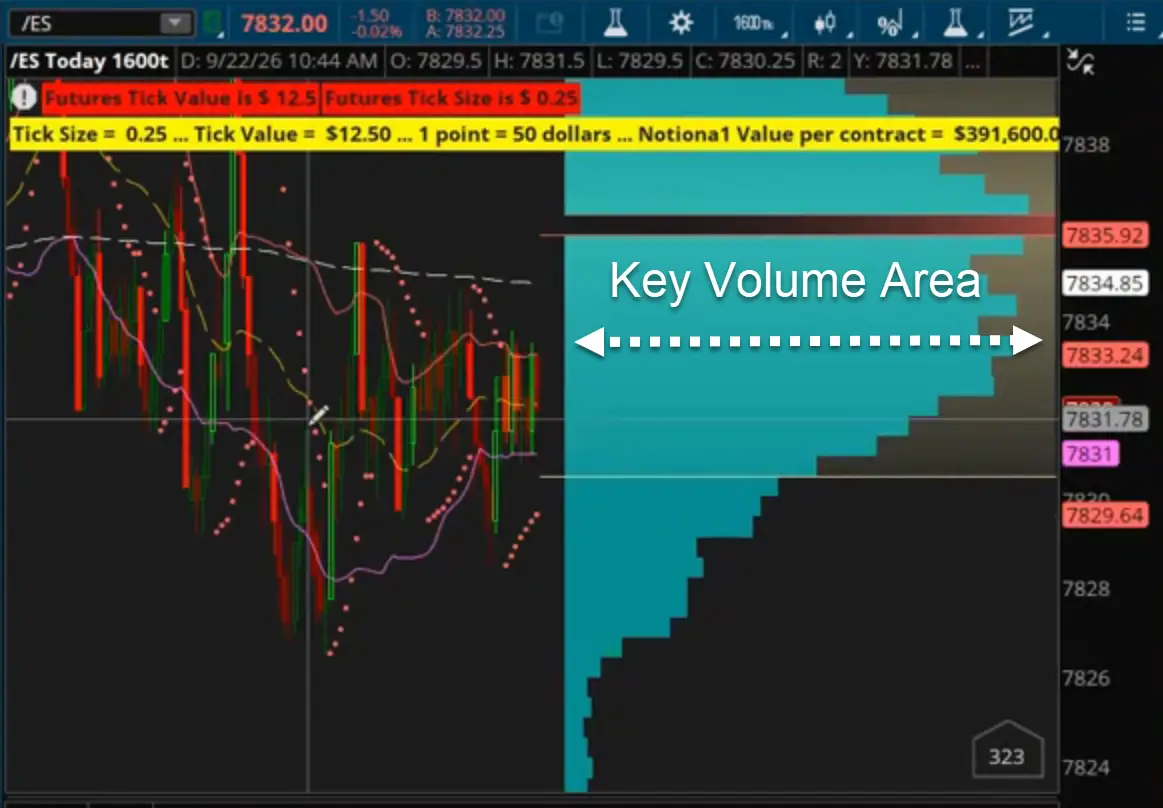
I want at least 10 points out of an S&P 500 futures trade. Four points isn’t worth the risk to me, so I passed.
That’s my line, and it doesn’t have to be yours.

Corey Rosenbloom’s approach handles moves that small, and plenty of you trade them well.
Quiet days don’t change my rules. A setup that shows up later in the day with enough room still gets my attention.
The Cheap Trade For A Surprise
A small expected move comes with one upside, because it makes options cheap.
The market makers were pricing Tuesday as a dud for the rest of the day, and I wasn’t so sure.
My read was that price would fake up and fake down, then eventually break toward 7845 or 7815.
Trump was speaking at the UN, and a single headline could move this market.
When you think a big move is coming but can’t tell which way, you can buy both sides. You buy one call above the market and one put below it, and that pair is called a strangle.
Tuesday the 778 call cost 30 cents and the 775 put cost 26 cents. Both sat outside the range the market expected, and together they came to 56 cents, or $56 for one of each.
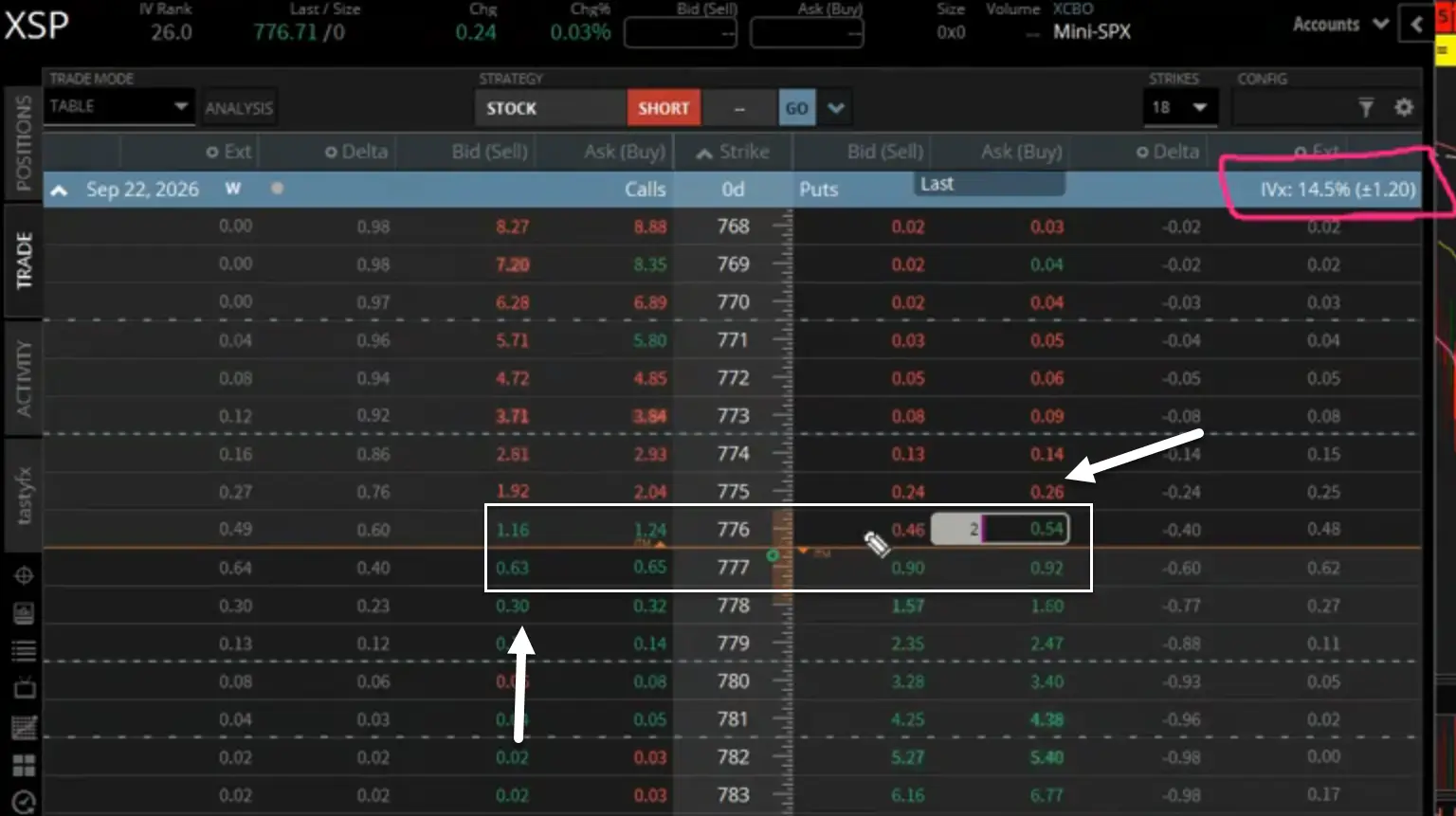
A 20-point rally could push the call to about $1.19, and a 20-point drop could push the put to about $1. Either one alone would be worth roughly double what the pair cost.
After price moves, you can sell the next strike beyond the side that’s working. That brings in money to cover what you paid, and it can turn the whole position risk-free.
A quiet market is the risk here.
Both options lose value if price stays put, and the 56 cents you paid becomes your loss.
I priced this trade out during Tuesday’s session and hadn’t placed it by the time I handed the room over to Corey Rosenbloom.
What This Means For You
You can run three moves on your next trading day.
- Check the XSP expected move before your first trade, then multiply it by 10 to see it in S&P 500 futures points.
- Compare that range to the target your setup needs, and pass when the target asks for most of the day’s expected move.
- Compare today’s reading to a normal day, because a number well below normal means options are cheap enough to buy both sides if you expect a surprise.
The second move saves you the most money. A target that doesn’t fit the day turns a good setup into a trade that stalls short of its number.
Your Next Step
Pull up the XSP option chain before your next session. Most options platforms show the expected move right on the chain.
Write that number down next to the target on your next setup, then check it again an hour later, because it tends to shrink as the day goes on.
If your target no longer fits, let the trade go and wait for a day that can pay you.
You can watch me read this number live in the 10% Club before I pick a trade. On Tuesday, I checked a $1.40 expected move in the room and used it to price a 60-cent XSP put.
Come sit in and see which setups make the cut and which ones I let go.
Check the range first, then pick your trade.
Blake Young
Senior Market Strategist, TheoTRADE