Hey trader,
Corporate bonds are sliding again.
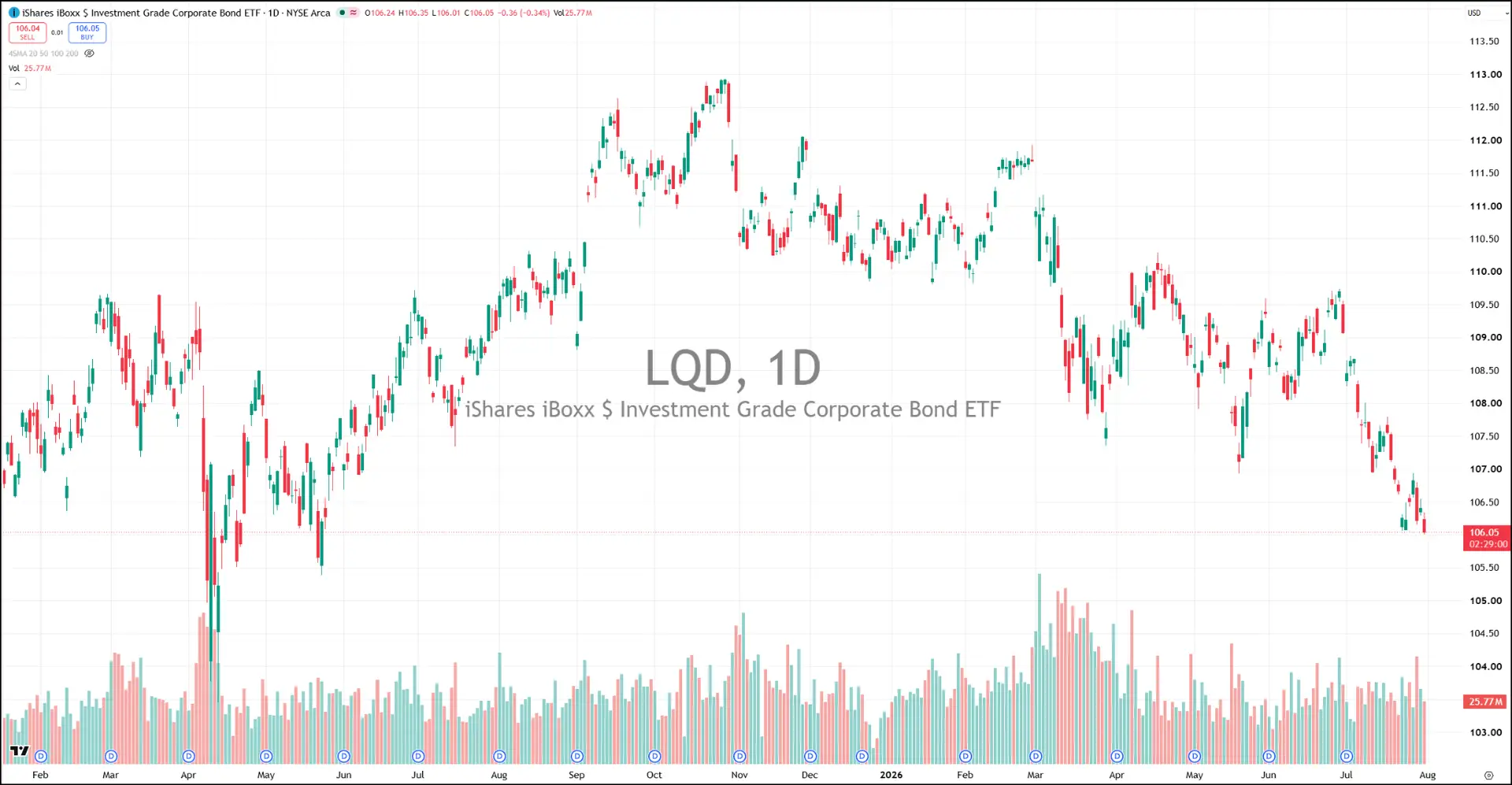
LQD, the junk bond ETF, sits at $106 with another 0.36% gone today.
Rising yields explain most of that.
Warsh spoke Wednesday. The bond market did not like what it heard.
Yet, then the Block Hunter Console lit up with something bigger than a one day reaction.
One institution bought 55,000 put spreads in LQD, the $104 strike against the $101, running out to September 18.

That is size with a calendar attached.
Nobody commits seven weeks of downside to investment-grade credit, the safest corporate debt on the board, over one press conference.
So what does that institution already see in corporate credit?
I’m going to put both strikes in front of you, because they mark the exact spot where this move gets faster.
What LQD Is And Why It Bleeds When Yields Rise
LQD holds investment-grade corporate debt.
Basically, it is a basket of bonds issued by companies solid enough to borrow cheaply.
Bond prices travel opposite to yields.
Yields have been climbing this week, which is why LQD keeps giving ground instead of defending $106.
A second pressure sits underneath that one. The spread between corporate bonds and treasury bonds is still pretty tight, meaning investors are barely paid extra to take company risk over government risk.
That leaves almost no cushion in the price.
Treasury yields keep pushing higher. Corporate bonds have to reprice with nothing built in to absorb it.
What A 55,000 Contract Print Actually Tells Me
The Console shows me size the moment it crosses.
Today it put up 55,000 contracts in LQD, buying the $104 put and selling the $101 put.

That structure is a long put vertical. Essentially, you buy one put and sell a lower one against it, which caps the upside in exchange for a much cheaper entry.
The strikes carry the real information.
A vertical only pays when price actually reaches the strikes, so the buyer has told me where they expect this to travel.
When something that big crosses, my first question is whether it is a roll or a standalone trade.
A roll is housekeeping on a position that already exists. A fresh standalone print is a brand new opinion.
The $104 Strike Is Where This Gets Faster
LQD trades at $106 right now. The short strike sits down at $101, which is a long way from here.
Three dollars separate the two legs. The $101 put carries about a one delta, so it barely reacts until price gets close, and it handed the buyer a little premium for holding that spot.
That leaves $104 as the accelerator. It is the level where this position starts earning in a hurry, and it is the target I am watching.
The clock runs to September 18.
Seven weeks is the window this institution gave itself to be right.
Why I May Take This In LQD Instead Of HYG
My usual vehicle for a bearish credit read is HYG, the high yield fund. It gives me more volatility. It also reacts less to whatever treasuries are doing.
Today the strain shows up in the other one. LQD is down 0.36%. HYG is down 0.12%.
There is a reason for that gap.
LQD runs a tighter spread against treasuries, and money hiding from rising rates may rotate down into lower quality credit for a bit of insulation.
So I may go LQD on this one. What follows is the framework the print lays out rather than a specific call with my own entry price.
- Setup: Long the $104 put, short the $101 put in LQD
- Target: $104 first, with $101 sitting at the far edge of the spread
- Time frame: September 18 expiration
- Edge:Tthe strikes name the level where the move accelerates, and 55,000 contracts are already positioned for it
The bond market is steering bearish across the board today. If the selling really picks up from here, HYG should produce the larger move of the two.
That print never showed up on a price chart first.
It showed up on the Block Hunter surveillance Console, the tool I use to catch a block the moment it crosses and read whether it is a roll, a fresh buy, or size sliding closer to the money.
This is the work I do inside Block Hunter every session.
I take the prints as they cross, translate them into gamma exposure and levels, then walk them into real trades.
Click Here to Learn More About How You Can Join Block Hunter
Brandon Chapman, CMT
Creator of Ghost Prints