Hey trader,
Did you miss the trade but the entry still looks good?
Sure you could try an entry here, but you’ve halved your profit potential while doubling your risk. Not a good idea.
So pullback to the original entry should work then…right?
Not so fast padawan.
Once price runs halfway, that trade is done…at least the way I do things.
And it all has to do with the way I manage my risk, something we’re going to dig into today.
This isn’t just some hypothetical.
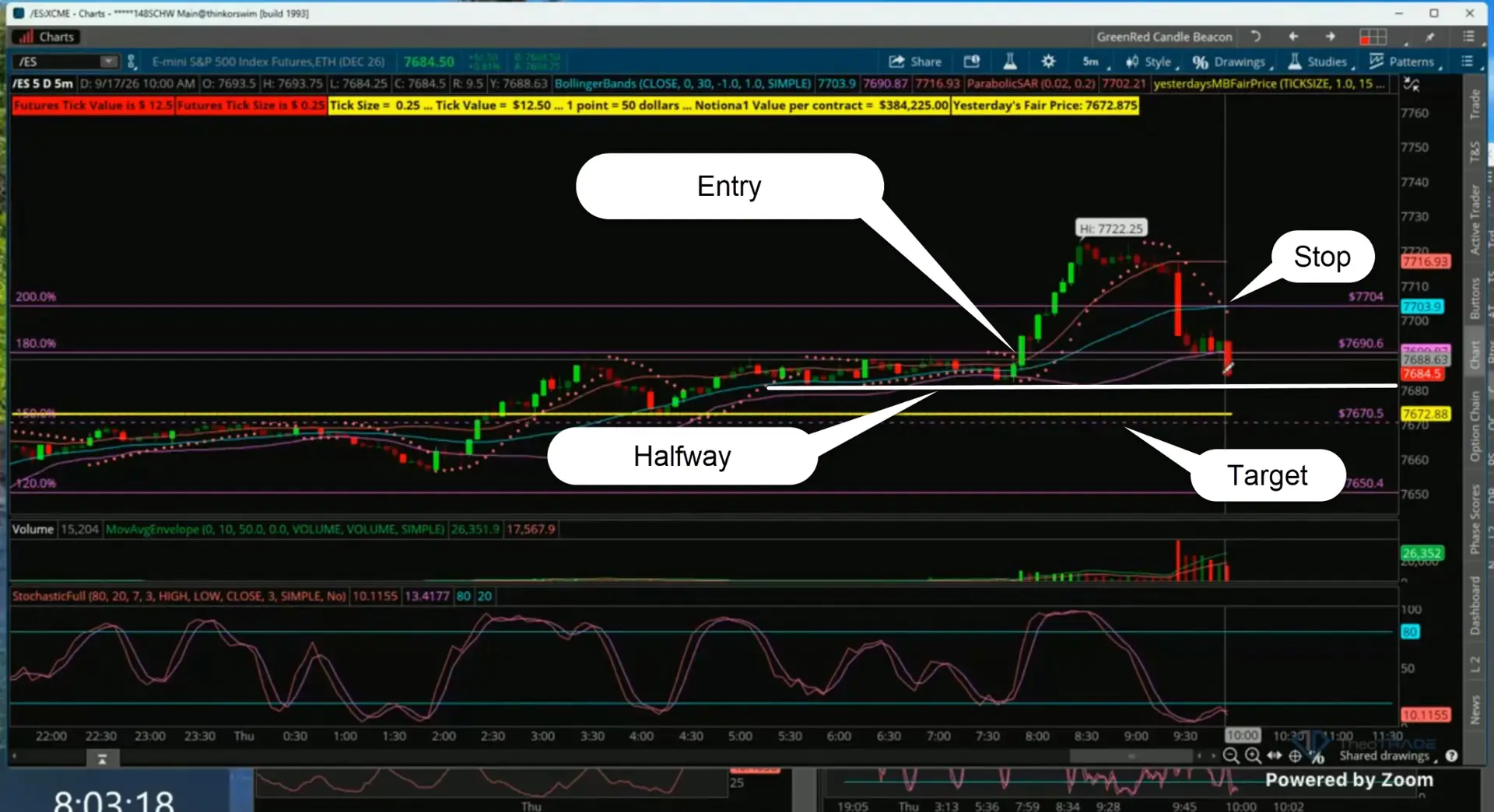
Thursday morning I watched it happen live. My ES short sat at 7690.50 against a 7670.50 target.
Price covered half the distance without me.
I canceled my standing entry order.
Getting in down there meant sitting right next to where I’d already decided to be wrong…
…because it had nothing to do with the entry or my profit target, but the adjustments I made to my stop loss.
What most folks don’t realize is risk management can have nothing to do with whether you’re in the trade or not. It often depends entirely upon price movement.
Allow me to explain.
Two Numbers, Four Seconds
Grab your entry. Subtract your target. That’s your distance.
Thursday morning that was 7690.50 minus 7670.50. Twenty points.
Now divide it twice.
Distance divided by three is 6.67. Subtract from entry and you land on 7683.83.
Call that your warning line.
Distance divided by two is 10. Subtract from entry and you land on 7680.50.
Call that your cancel line.
Two divisions. Four seconds. Mark them both before the order ever goes out.
What Each Line Is Telling You
The warning line is where the math quits working for you.
A beacon setup starts around three to two. Reward above risk, which is the only reason to click.
Price eating a third of the distance before you fill drops you under one to one.
You’re now risking a dollar to make a dollar on a setup that was built to pay you more.
The cancel line is worse than that.
Past halfway, three to two flips into two to three. Same stop, same target, pointed the wrong direction.
Here’s what gets me though. Neither number moved.
Your stop is exactly where you put it. Your target is exactly where you put it.
Price did all of this to you while you sat there doing nothing at all.
Thursday’s Short That Never Existed
Let me walk you through what actually happened.
The ES set up a clean beacon short. I typed it out and got it into the announcements before the candle finished.
Here’s what went out to the room:
- Short entry at 7690.50, sell limit resting, no market order
- Stop at 7704 to start, which put $67.50 at risk on one micro
- Target at 7670.50, twenty points of room
I tightened that stop to 7699 before the order went live. My ceiling is around $50 on a single contract, so 7704 was a little rich for my taste.
Then I did the boring part. I waited for the close.
I wrote it in the announcements three separate times. Wait for the close.
The candle closed down. The signal was real, the trade was legitimate, everything checked out.
My limit never got touched. Not once.
The Stop Moves Whether You Own It Or Not
Now here’s the part most folks never think about.
I don’t park a stop and walk away from it. That stop moves as price hands me reasons to move it.
Three things move mine:
- A one candle reversal with follow through, meaning a lower high, a lower low, and a lower close in the direction I’m short
- Price clearing the halfway mark, which pulls the stop down to the beacon level
- The structure itself, whatever high or low the chart just printed, plus a few ticks of breathing room
Read that middle one again.
Nothing in there asks whether I got filled. Price clears halfway, the stop belongs at the beacon level, end of story.
The chart prints the level. I just follow it.
So Thursday morning price ran through 7680.50 and my stop belonged at the beacon.
The beacon level was 7690.50.
That was my entry price.
Sitting Next To Where You’re Already Wrong
Think about what taking that fill would have meant.
I get short at 7690.50. My stop, by my own rule, also sits at 7690.50.
Zero distance between them. I’d be entering a trade that was already stopped out.
There’s nothing to manage there. No room to be wrong, no room to be right.
I canceled the order. Took about two seconds.
Then I pulled the alert out of the announcements entirely, because a setup I don’t own is not a trade I’m going to talk about later.
About That Pullback
I know what you’re thinking, because I thought it too.
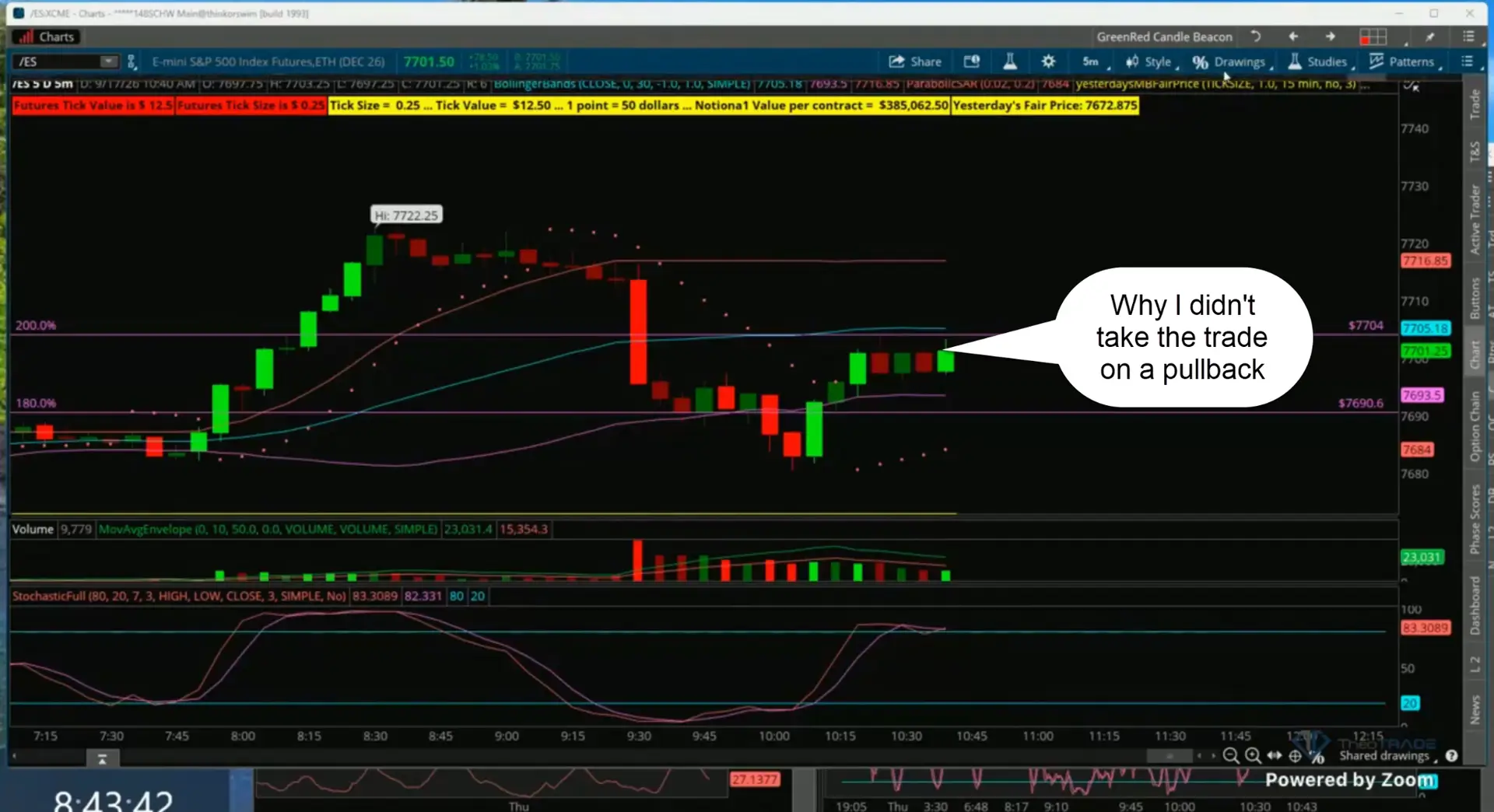
Just wait for price to come back to 7690.50 and take the original entry.
That works, and it happens less than you want it to. Thursday the ES drifted back up toward the zero and chopped sideways for the rest of the hour.
The setup that was worth taking at 9:55 was not the same setup at 10:40. Volume had died, the tape went flat, and I had no interest in forcing it.
Miss the fill and you’re not owed a second one. Some mornings the trade just belongs to somebody else.
What This Means For You
Three moves you can run before your next order goes out.
- Do the two divisions first. Distance over three is your warning line, distance over two is your cancel line, and both get marked on the chart before you place anything.
- Ask where your stop belongs right now, not where you set it twenty minutes ago. If your own rule puts that stop at or past your entry, the trade is gone.
- Cancel the working order and clear your platform. A resting limit you forgot about turns into a live position at the worst price on the move.
Run those three and this stops being a willpower problem. It turns into arithmetic you finish before the candle closes.
Your Next Step
Pull your last ten trades tonight.
Find the ones where price had already moved your way before you got filled. Measure how far it went.
Then ask what your stop rule would have said at that exact moment.
I’d bet you find a few where you got in below your own cancel line and never noticed. That’s the leak.
I make these calls out loud every morning, including the ones that end with me deleting an alert I sent fifteen minutes earlier.
Come sit in the room and watch a trade get canceled in real time.
Right level, wrong price.
Blake Young
Senior Market Strategist, TheoTRADE