Hey trader,
The tape looks calm. Stocks bounced back this week. The surface says relax.
My screen says something different.
Skew spiked to 154 over the last two sessions.
That number only climbs when big money starts paying up for downside protection.
That is the tell. The players with the most information are quietly buying insurance while everyone else enjoys the rally.
I put on my red and navy for the 250th today. It felt fitting. The signal on my screen is the old warning ride. The British are coming.
If these gauges are right, this calm does not last. I will walk you through what my screen is seeing.
Then I will show you the small, defined-risk trade I put on to get paid if the selling arrives.
What Skew Is Telling Me Right Now
Skew measures how much more the market will pay for downside protection than for upside bets. It just spiked to 154 over the last two sessions.
That number does not jump on its own. It climbs when the firms with real size start hedging.
Here is the mechanic in plain terms. To protect a large book, a big player buys puts for downside insurance and sells calls to help pay for it, usually about 30 days out.
That buying of puts and selling of calls is exactly what pushes skew higher. It is the footprint of protection being purchased.
This is not zero-day noise. Hedges live about 30 days out. That is where I saw the move.
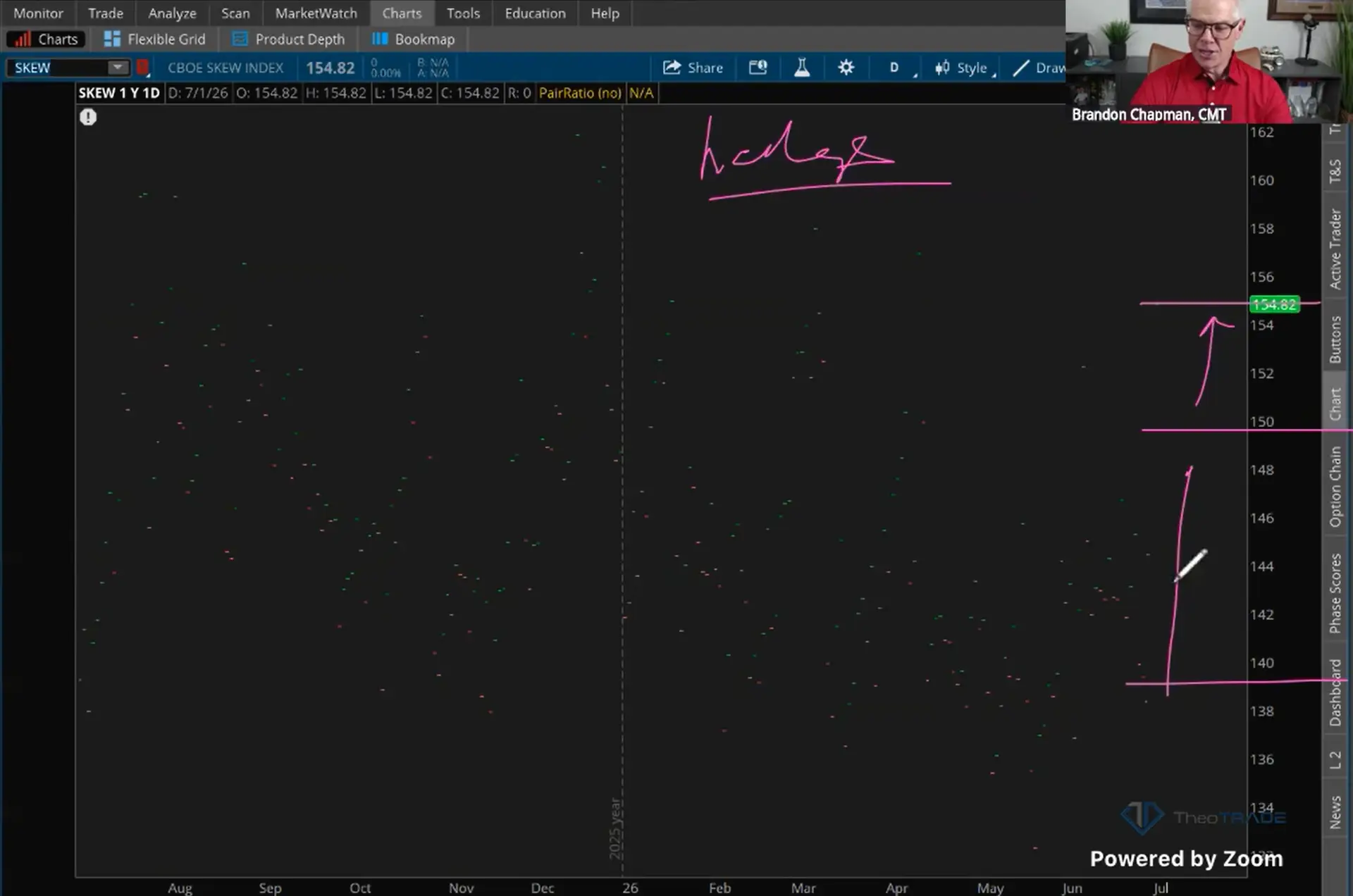
The part that matters is the timing. This protection is getting bought while stocks are still climbing.
That is the warning ride. On my screen, the British are coming.
The Backup Alarms Agree
Skew is one gauge. I do not lean on a single reading. I check it against two others.
The first is a volatility ratio, the three-month VIX against the spot VIX. It sits at 1.15 right now.
In plain terms, the market is pricing volatility 15 to 16 percent higher a few months out than it is today. My trigger on that gauge is 1.20. We tagged it recently.
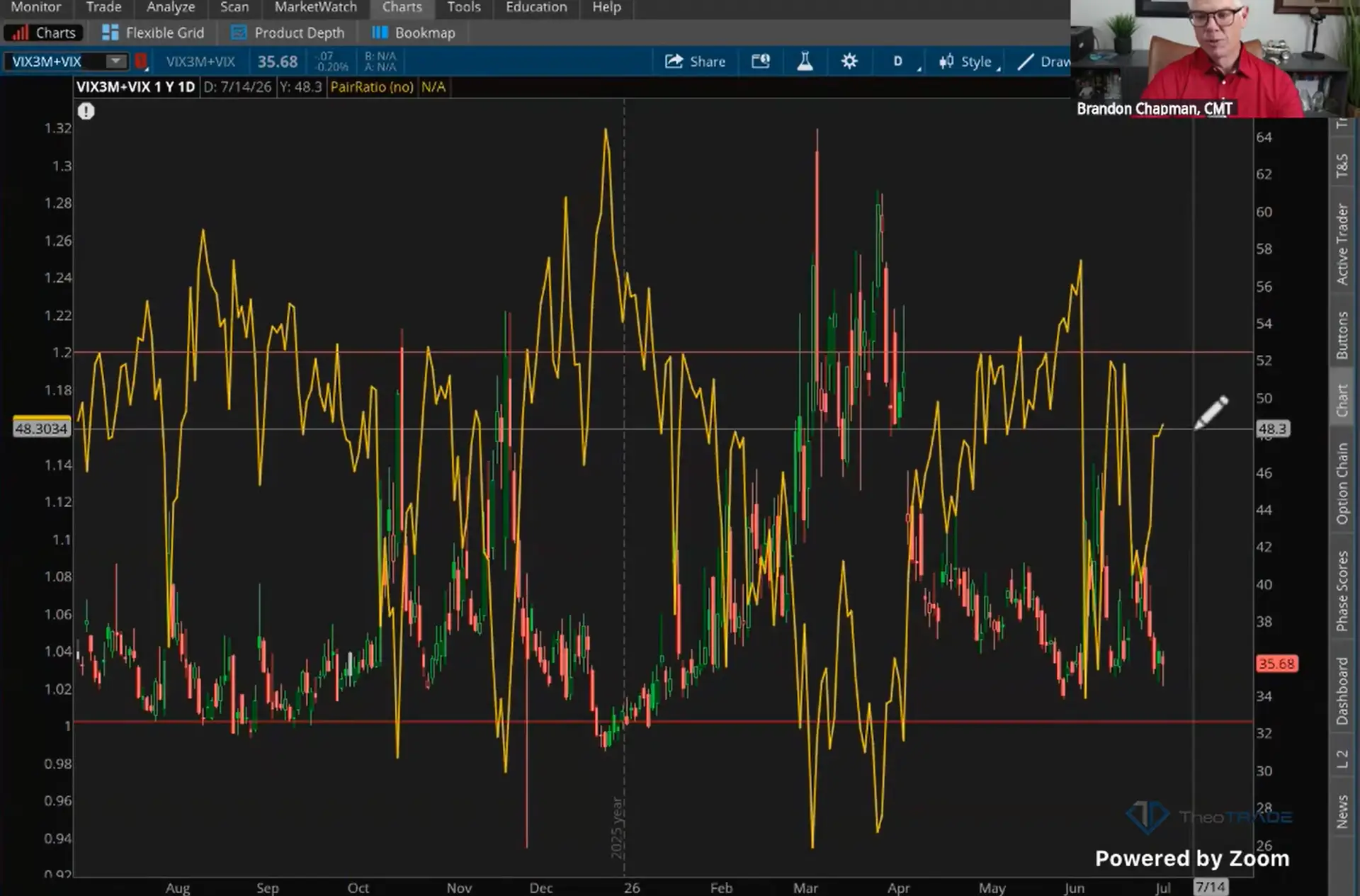
The second gauge is dispersion, and it just hit a 52-week high. The plain version is that individual stocks are priced for far bigger swings than the index itself.
That gap is my canary in the coal mine. It points straight at the chip names. Nvidia is the one I watch first.
Nvidia is already down about 18 percent from its peak. Past drops under this same signal ran 17 and 20 percent. This one may not be finished.
Put the three gauges together and they say the same thing. The correction is not done.
I still read this as a regime that expects a 5 to 10 percent pullback. A 5 percent slide from the peak carries the S&P 500 toward 7,150 to 7,200.
That level matters for a reason. It sits below the June 9th low.
The calendar backs it up. The third week of July is often a seasonal high. July runs weak to begin with.
How I’m Leaning Into It
I am not just sitting in cash waiting. I already have a small position built for exactly this kind of move.
It is a bet against the chips through SOXS, a fund built to rise, and rise fast, when semiconductors fall. I bought the 4 call and sold the 6 call as a spread.
The spread cost me 52 cents. That price is the most I can lose.
Right now the trade sits at break even. Any real selling next week should push SOXS toward 5 to 5.50, where I can sell the spread for about a dollar.
- Setup: skew at 154, a three-month-over-spot VIX ratio at 1.15, and dispersion at a 52-week high, all while stocks still climb
- Structure: a SOXS call spread, long the 4 and short the 6, bought for 52 cents
- Trigger: real selling in semiconductors, the move SOXS is built to amplify
- Target: SOXS toward 5 to 5.50, selling the spread near a dollar for roughly a 100 percent return, with 6 the level I am ultimately looking for
- Invalidation: the rally holding and volatility fading into the holiday, leaving the trade stuck near break even
- Cost and max risk: the 52-cent debit, known going in
- Edge: three separate volatility gauges leaning the same way, paired with a defined-risk vehicle that pays if the selling arrives
What I’m Watching
None of this has fired yet. Stocks are still green. The calm is still holding.
That is the whole point of reading skew. It marks the lean before the chart shows a thing.
Big money is paying up for protection right now, into a rising market, 30 days out. That is the order of events I want you to carry.
The signal came first. The selling, if it shows up, comes second.
I built my lean while it still felt unnecessary. That is exactly when it should be built.
Brandon Chapman, CMT
Creator of Ghost Prints