
Hey trader,
A breakout that fails is where good accounts quietly bleed out.
The entry looks clean. The target sits right there. Then price stalls, rolls over, and a loose stop hands back money you never had to lose.
This morning was built for that mistake. The clean winners got away early, and the pull to force something into a stalling gold breakout was strong.
I did not force it. Gold handed me a textbook failed breakout, and because my stop was trailed tight to structure, the reversal cost me nothing.
Let me walk you through where the stop went and why a break even counted as a win today.
The Breakout That Would Not Hold
Gold broke out of its consolidation. I went long at 3999.
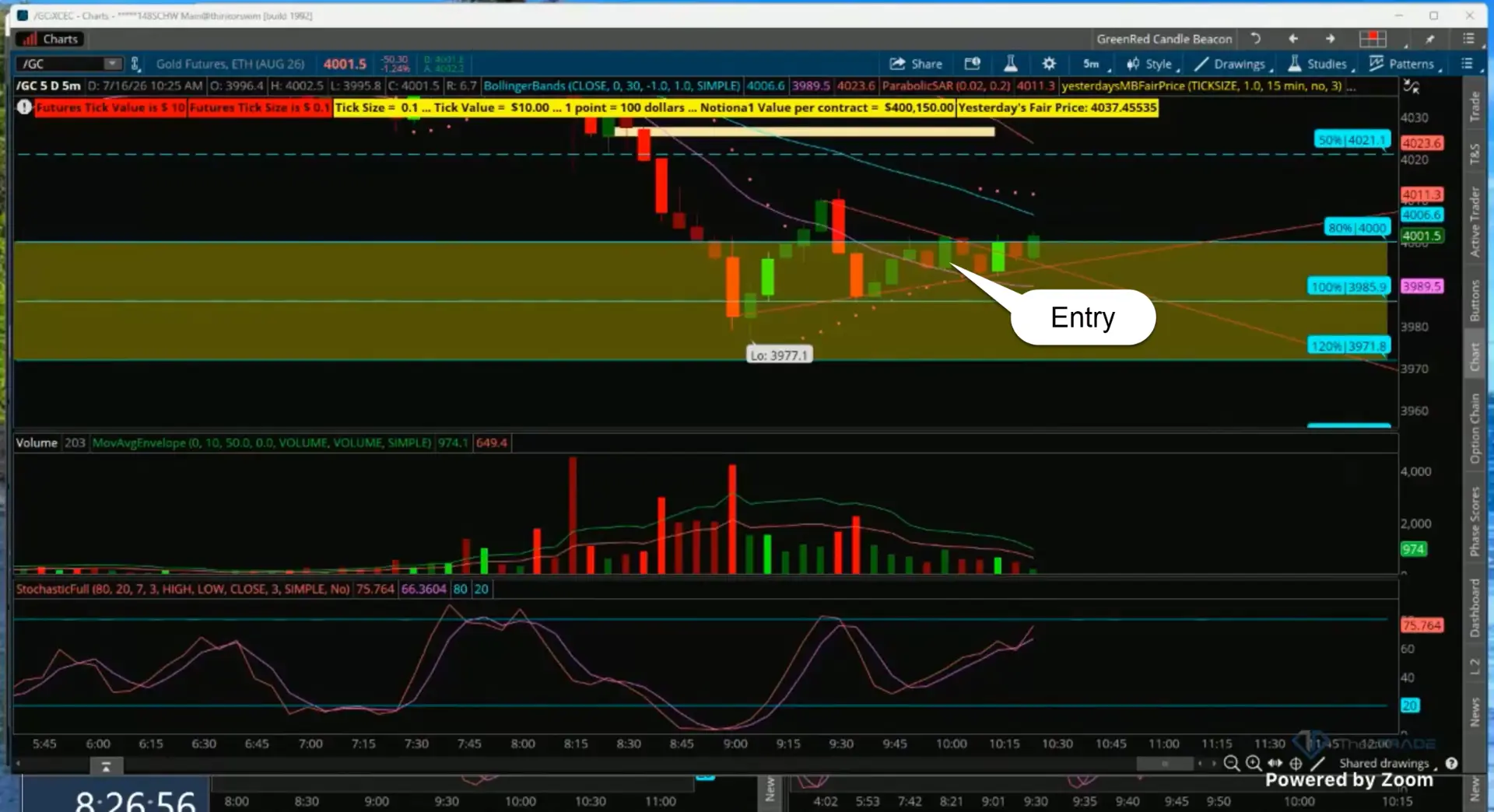
The signal fired at 4001. By the time it posted, price had ticked back to 3999, so the fill came in at 3999 or better. Nobody got a worse price than that.
The stop started at 3990. That gave me nine points of risk against a target up at 4021.1, worth about $218 on a single micro.
Then the trouble showed up. Gold pushed at the highs, got rejected, pushed again, and got rejected again.
Sellers were stacked overhead the whole way. As I put it at the close, gold broke out, broke out, broke out, and could not get through those sellers.
The Question Every Breakout Trader Should Ask
Bertram asked me a sharp question mid-session. He saw sellers sitting right off the opening candle and wanted to know whether a breakout into that supply is still worth taking, or whether it calls for a tighter stop.
That is the right instinct.
My answer was yes on both counts. You can take the breakout when the beacon still has priority. You have to get aggressive moving your stop the moment price pushes into that seller block.
A breakout into overhead supply is a lower-odds breakout. The answer is not to avoid these setups. Tighten your risk instead, so a rejection costs you a scratch rather than a stop-out down at the lows.
Where the Stop Actually Goes
This next piece saved the trade.
I did not leave the stop parked at 3990 and hope. Every time gold made a higher high and a higher low, I walked the stop up behind the structure.
- The first lift went to 3994.50 once we had a higher-low follow-through.
- The next lift went to 3995.50 on the following higher close.
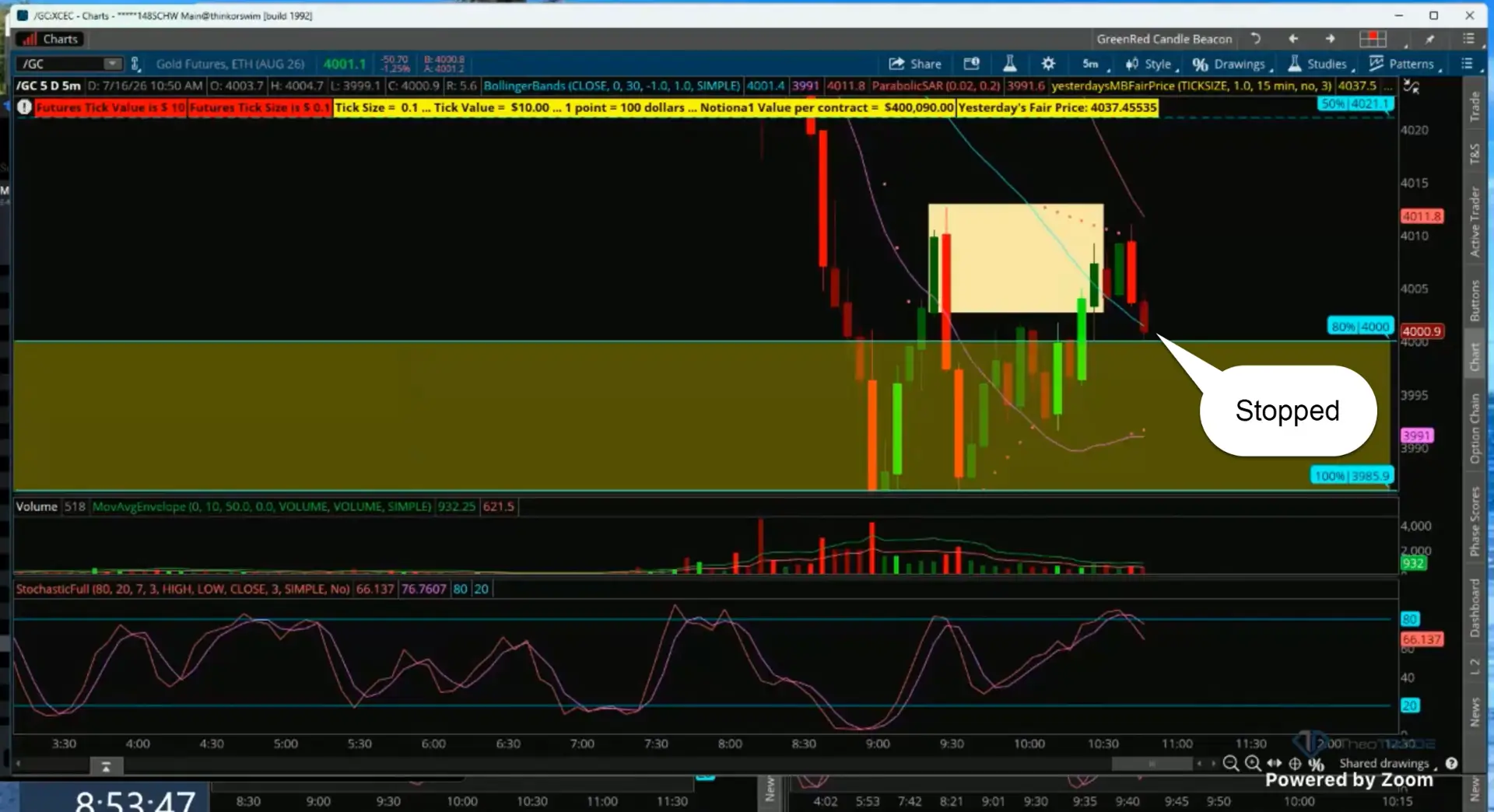
- The final lift went to 4000 even after price tagged a new high at 4003.
By that last move, the trade sat at break even. The worst case had already been removed. Gold could reverse as hard as it wanted, and my downside was gone.
There is no guessing in this. You follow price up and drag your risk out of the trade as it proves itself.
Why a Break Even Was a Win Today
Gold finally rolled over on a pirate flag and came back to my level. I flattened at 4000. It was a big break even.
On another morning that might sting. Today it was a genuine win.
The two clean winners on the board were the ES beacon and the Russell beacon. Both broke out and both hit their targets. I missed them both while I was managing four other charts.
On a day where the good trades got away, the gap between a break even and a full stop-out is the gap between a flat day and a red one. The trailed stop kept a failed breakout from turning into a loss I never needed to take.
The called trade left everyone in the same spot. Stop at break even, flat on the exit, no damage done.
How to Run This on Your Own Breakouts
Take this to your next breakout, especially one pushing into overhead supply.
- Set the initial stop below the structure that triggered the entry, not at some random round number.
- Move it up only on confirmation. A higher high with a higher low and a higher close earns the next lift.
- Get to break even fast once price tags a new high. Removing the worst case matters more than chasing the final few points.
- Let a rejection take you out flat. A breakout that cannot clear the sellers is telling you something, and a tight stop lets you listen without paying for it.
A number placed before the reversal turns a stalling breakout into a math problem instead of a gut call. You quit reacting to the candle in front of you. Instead you trust the level you set before the pressure showed up.
That is the entire framework inside The 10% Club. Every trade gets a level, a stop, and a target before the click, and every stop trails the same disciplined way this gold trade did.
I call these live every morning inside The 10AM Bell. Entry, stop, target, and the reason behind every move. Every session, no exceptions.
Click here to join us and watch the next one called in real time.
Blake Young
Senior Market Strategist, TheoTRADE