Hey trader,
About 25 years ago, I shorted 100 shares of Google after hours. It was up 45 points. I felt smart.
Scott Sheridan closed my account right in front of me.
I was down $4,600 with a margin call.
He looked at me and asked what I was thinking. I had no honest answer.
Tom Sosnoff sat 20 feet from me. Scott Sheridan sat right to my left.
I had never defined my risk.
That loss became my baptism into the one rule I trade by today.
Define the risk first. Then make the trade.
You can watch my setups fire live in the Genesis Cog Scanner.
Yet, a signal only marks the entry point.
The rest of this lesson covers the harder half: How I decide whether to take the trade at all.
Why the risk comes before the trade
I have been in this business 40 years. I made a lot. I lost a lot.
The greatest rule I ever learned came from Don. Define the risk first. Then make the trade.
Losses rarely come from a bad entry.
They come from a trader who never decided where the pain stops.
I am a risk management trader. I am not a momentum trader.
I love Gianni Di Poce. I cannot trade the way he does.
He is right most of the time. Momentum is his game. When I am wrong, there is no turning back for me.
Map the volatility before you pick a side
Here is how I size up a trade. I refuse to walk in and pick a direction.
I do not claim it goes higher. I do not claim it goes lower.
Pull up nine months on the stock. Strip off every indicator that carries a bias.
A little bias hides inside the MACD. Clear it off. Keep the chart clean.
Then drop a standard deviation channel on the chart. A linear regression fulcrum runs right through the middle.
That channel shows me one thing. It shows me where death and destruction live if I am wrong.
Take AppLovin. The beta is 2.5.
That name moves 150% more than the market on an average day. High octane stocks open a trap door under your feet.
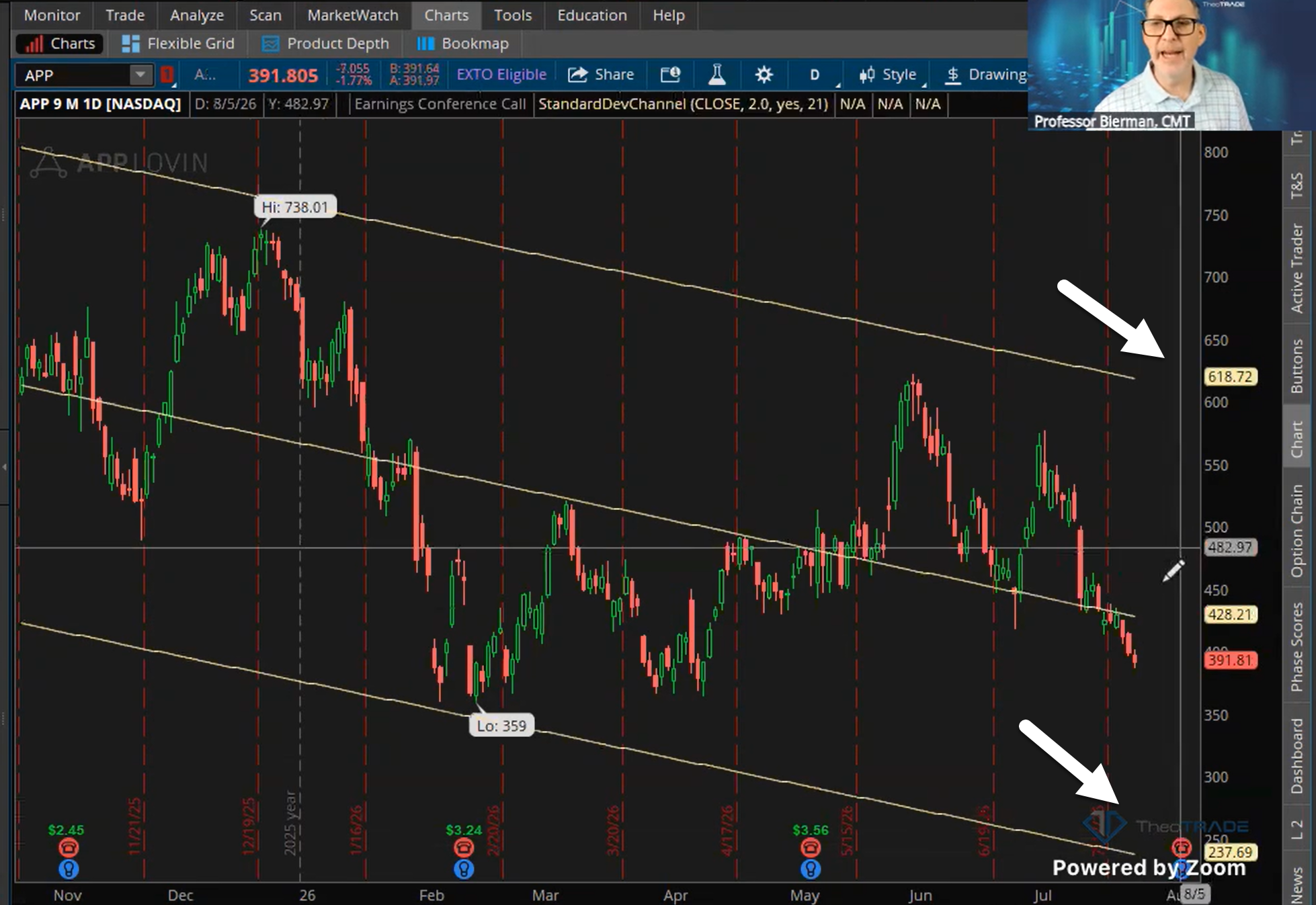
Say I short it. A black swan buyout hits. I already know my line sits at 618.
I have that number before I ever click the button. My downside target sits down at 237.
Weigh the pain against the gain
Every trade comes down to two numbers for me. I check them before I enter.
The first is the pain if I am wrong. The second is the gain if I am right.
When the pain outweighs the gain, I pass. That math ends the conversation.
Look at the same name through a Bollinger Band. A wrong short puts $80 at risk to the top of the channel.
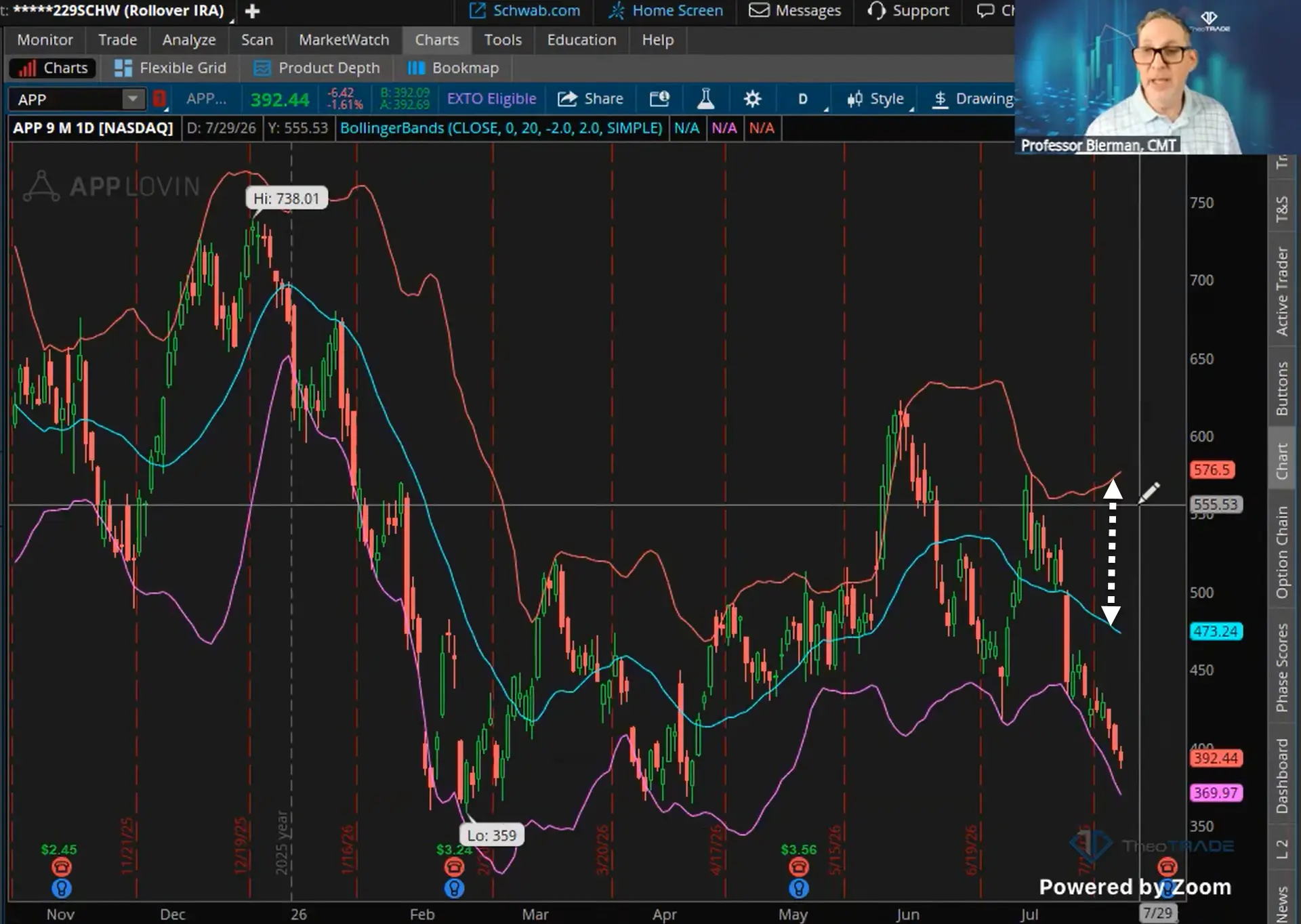
Double the standard deviation. You are down almost $200. That is the loss that puts a trader in therapy and on Prozac.
What this means for your next trade
Every time I take a trade, I put thousands of Genesis COG members at risk with me. I do not carry that lightly.
A signal only shows you the entry. The risk map keeps you alive.
Yesterday a close friend in Franklin, Tennessee texted me. He said he gave up and could not trade anymore.
The market had messed with his mind until he quit. I read that surrender as a sign we were near a bottom.
My own account had been down the day before. It came all the way back on a flat day.
The market breaks traders who enter with no defined exit. It pays the ones who map the damage first.
The full methodology lives inside the Genesis COG System. It teaches you to map volatility and define the loss before you enter.
Define the risk first. Then make the trade. Do it in that order every single time.
Professor Jeffrey Bierman
Creator of the Genesis COG System