
Hey trader,
Thursday morning handed us one of the ugliest tapes I have seen in months.
The ATR was running near 70. Gold had slipped under $4,000 before the bell.
The Korean market opened limit down at almost minus 8 percent. Dollar strength was dragging on everything that tried to find a bid.
I sat on my hands through most of it. Setups kept printing, and I let almost all of them go.
Then one short 77 set up.
I took it without a second of hesitation.
It paid the full 25 and put us 35 handles to the good on the session.
Here is the part that should get your attention. It was the same level I had skipped a few times earlier that morning.
Same red line. Same chart. To anyone watching the level by itself, the trade I took looked identical to the ones I passed on.
What made it a real trade was the way price arrived at the level. That single detail is what I want to walk you through today.
The Trade That Looked Like All the Others
Earlier in the session, I had a handful of 77s and 26s that looked clean on paper.
Price chopped its way up toward each level. It stalled, poked through, then came back at me.
Those trades got me a quick plus five at best. A few scratched even, and one or two ran me over before I could blink.
The short that paid the 25 behaved nothing like those. Price ran straight up into the 77 in one clean push.
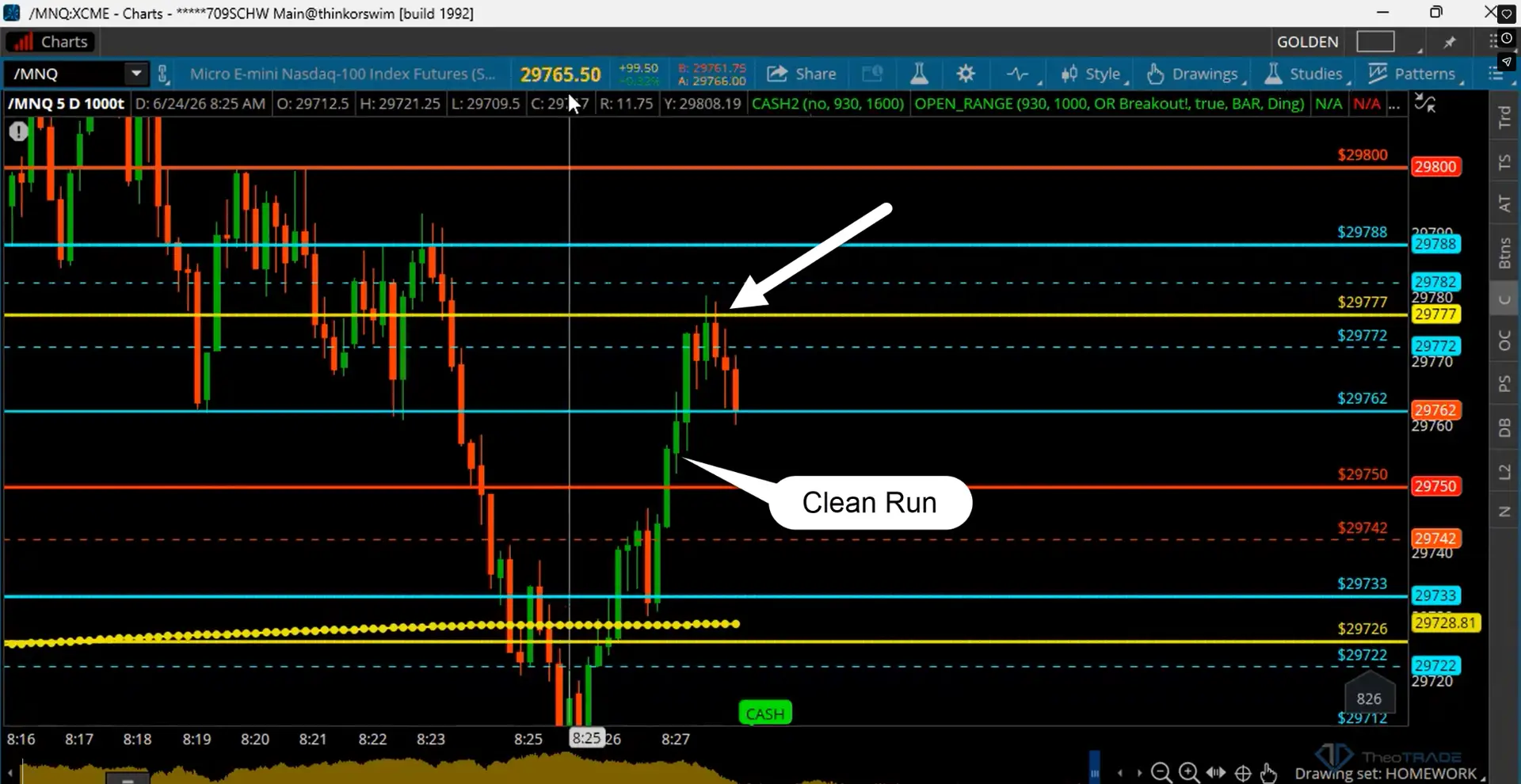
It showed no pullback on the way. It gave nobody a chance to get comfortable along the route.
That is the entire tell. I said it to the room the moment I booked it.
“The reason I liked it on a test from below is because of where it came from without any kind of retracement. Any kind of retracement. It’s just like a straight bar, straight up into it.”
Why the Straight Shot Works
There is real logic underneath this. It comes down to who is sitting in the trade when price hits the level.
When price grinds into a level with little pushes and pullbacks, a lot of traders caught a decent entry on the way up.
They are sitting in profit. They are willing to defend that move.
The level has to chew through all of them before it can reject. That is why the grind so often produces a weak plus five and not much else.
A straight bar into the level is a different animal. Price covered the whole distance in one move.
Nobody got a better seat along the way. The buyers who chased it in are stretched, late, and sitting with no cushion underneath them.
When the level rejects, they have nowhere to hide. The snap back comes fast, and it comes clean.
This is also why the setup is so easy to walk away from when it does not show. If the clean run is not there, the edge is not there.
That is exactly how the short played out. I called the backtest live as it worked.
“Give us our plus 20. Here comes a 62. One more 62 and we should get it.”
Price scooped down, tagged the 62, and gave it up. “Boom, we got it.”
The runner paid the full 25 with no stress attached.
The Setup That Made Me Sweat
Compare that to the trade I took right before it. I wanted a long 77 off a back-through.
Price was moving so fast that I could not just rest an order at the level and wait. I had to let price tag through the number first, then buy the reclaim.
I sat there talking to my own screen the whole time. “Seventy-two needs to hold here. Come on. One more push.”
I squeezed a nervous plus five out of it and was happy to be done.
I told the room the truth about that one. “That’s a little stressful, isn’t it? You’re just at the mercy of price.”
A back-through can work in the right hands. It asks you to time a fast reversal with your finger hovering over the mouse.
The clean test from below asks for none of that timing. You see the straight run into the level, you place your order, and you let the bracket do the work while you sit still.
How to Spot It Before You Click
Build one quick check into your routine before any short at a Golden Setup level. Look left at the last few bars and watch how price built its way up to the number.
That read sorts the trade into one of a few buckets:
- A stair-step climb with wicks and pullbacks stacking along the way tells you the move is balanced. The level has a fight on its hands, so you size down or skip it.
- A single clean run into the level from at least 10 points below, with no retracement worth mentioning, is the version I want every time. Place the order, target the backtest, let it pay.
- A straight drop from above into a 77 or a 26, with no bounce on the way down, is the same read in reverse. That is the long I trust.
- An open backtest sitting overhead stacks the odds even further. On Thursday the run from the 50 up to the 77 never tagged the 62, so that level was parked there waiting to get filled.
A clean test from below into a level that still owes a backtest is about as good as this methodology gets.
I run this same check in my homework every weekend. The straight shots are the trades that pay close to the math over and over.
Coming Into Monday
The tape is still wild. The headlines are still flying.
The mess overseas is not going to clear up overnight. None of that changes the read at your levels.
The level still tells you where to look. How price arrives is what tells you whether the trade is worth a click.
Skip the choppy grinds into the number. Wait for the clean run from below with no retracement behind it.
Take the backtest when it pays you. On a morning when almost nothing was tradable, that one read was the whole difference between a red session and 35 handles to the good.
Trade smart,
Tony Rago
Creator of the Golden Setup