Hey trader,
A 20,000-contract order hit QGEN this morning in one trade.
It filled right up near the ask.
A print that size in a name few people watch is easy to wave off as noise, a fund quietly shuffling a position it already had. That was my first instinct too.
The first thing I do with a print like this is ask whether it’s a roll.
So, I pulled it up on the Console and traced it back to the 40 and 45 strikes.

The read got more interesting the longer I sat with it.
The structure barely matters in the end.
Whatever the exact shape of this trade, the dealer on the other side is now short a stack of calls. That puts the desk in a corner.
What does that desk have to do now? Let me walk you through it and how you can turn it into a trade idea.
A 20,000-lot that filled at the ask
Size by itself never tells me enough. Where a print fills gives it away.
This one filled just below the ask and above the bid. Someone was paying up to get in.
When I see a single trade that big, my first question is always whether it’s a roll. A roll is when a trader closes one option position and reopens it somewhere else, further out in time or at a new strike. It looks huge on the tape. It can be housekeeping rather than a fresh bet.
I went to the Console and pulled the time and sales. The picture filled in from there. The size traced to two strikes, the 40 and the 45, at 10,000 and 20,000 contracts.
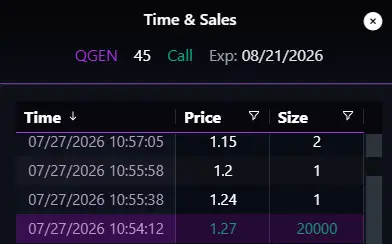
My first read was a clean roll, sliding out of the money to the 45 and bumping the size up to 20,000. The longer I looked, the less that fit.
This looked more like both strikes getting bought at once, 10,000 at the 40 in the money and 20,000 at the 45 out of the money, with 25 days on the clock.
Why the desk has to chase it higher
The exact label on the trade matters less than what it forces the other side to do. Someone had to sell those calls to fill that buyer.
That someone is the dealer.
A dealer who is short calls sits with negative delta. That is a plain way of saying the position bleeds as QGEN climbs.
The fix is to buy stock as a hedge. The higher the price goes, the more stock the desk has to buy.
That is negative gamma in plain terms. Every dollar higher digs the dealer deeper into the hedge, so the buying never really stops on the way up.
I could see the first hint of it already. Right around 8:54 my time, QGEN gave a small squeeze off the print.
The alternative reads don’t change the story. Maybe they sold the 40 and bought two 45s, a ratio backspread that leans hard long once price clears the strike. Either way, the desk ends up buying into a rising QGEN.
Where 45 becomes the magnet
I’m treating this as a framework rather than a fill-in-the-strikes trade. I’m giving you the mechanics and the levels that matter, not a specific spread or a cost, because that’s what the print supports right now.
The 45 strike is the magnet. A magnet is a strike carrying enough open interest that price tends to get pulled toward it as expiration nears.
The path there is simple to watch. A break above 42.50 opens the draw toward 45.
Then 45 itself becomes the line. Push through it, and the same forced hedging that started this can accelerate into a real squeeze higher on QGEN.
Here’s the framework I’m working from:
- Setup: Call, 25 days out, concentrated at the 40 and 45 strikes, leaving the dealer short calls and sitting in negative gamma.
- Trigger: A break above 42.50, which opens the draw toward the 45 magnet.
- Target: 45 first, then a further squeeze higher on a break through 45.
- Edge: The dealer’s forced buying as price rises, the negative-gamma hedge that reinforces the move instead of fading it.
What I’m watching from here
The print did its job. It pointed me at the pressure before the chart made it obvious.
Now the levels do the talking. 42.50 is the trigger to watch. At 45, the dealer’s hedging can turn a drift into a squeeze.
I want the break to show up before I lean on it. The setup is only as good as the level that confirms it.
That QGEN print never showed up on a chart first…
It showed up on the Block Hunter surveillance Console, the tool I use to catch a block the moment it crosses and decide whether it’s a roll, a fresh buy, or a backspread in disguise.
This is the work I do inside Block Hunter.
I take the prints as they cross, translate them into gamma exposure, then walk them into real trades, the same path I just took on QGEN.
If you want to learn to read the block before the move reaches the chart, that’s where I teach it.
Click Here to Learn More About How You Can Join Block Hunter
Brandon Chapman, CMT
Creator of Ghost Prints