
Hey trader,
Bond flow got loud today.
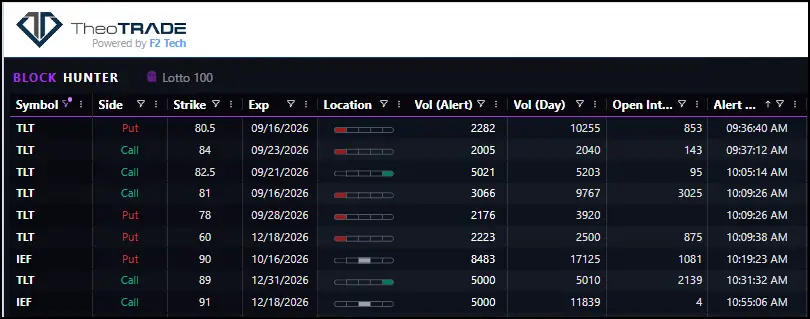
The Console pulled TLT and IEF into the same session, with calls filling at the ask and puts filling at the bid.
One IEF print ran 20,000 contracts on a December call spread. I checked it for a roll. It wasn’t one.
That buying leaves dealers short calls in Treasuries, which starts building an upside accelerator right in front of Wednesday’s Fed announcement.
So I went to build the trade. The spread I wanted priced at 36 cents. I threw it out.
One number on the short strike killed it. I run that same check before I sell any strike, in any name.
Then I built the version I actually want. That one is a single strike, and I’m bidding 35 cents for it.
It needs a pullback that hasn’t shown up yet.
Here’s the number that made me switch, and the order I’ve got working underneath it.
Institutions Spent Today Buying Treasury Calls
I went to the Console and pulled up block trades in rates. TLT and IEF both showed up.
The first TLT print was 5,000 contracts in the December 31 89-strike calls. A second one came through at 82.50 for the 9/21 expiration.
Then I reset every filter on TLT to see the whole day.
Calls filled at the ask. Puts filled at the bid.
The option statistics backed it up at two times the average volume. They’re buying calls and selling puts in Treasuries.
One exception showed up in there. The 81 strike for 9/16 was sold rather than bought.
IEF gave me the bigger number. Someone bought the 93 calls and sold the 96 calls for December 18, 20,000 contracts as a single spread.
That is real size in a product like IEF, so I checked it for a roll. It wasn’t one. The 20,000 filled a penny below the ask, which still counts as bought.
When institutions buy calls, the dealer on the other side is short those calls. Essentially, every move higher forces that dealer to buy more of the underlying to stay hedged.
That’s an upside accelerator, and it’s starting to build in the Treasury market.
Why This Week Gives the Trade a Reason
We have a Fed announcement Wednesday. We have a Bank of Japan announcement Friday.
Japanese government bond yields popped over the weekend because the Bank of Japan is expected to raise rates. Japan sits around 1.2% right now, and 1.5% is on the table.
My read is that the Fed raises to keep that yield spread from shrinking. A shrinking spread pulls money out of the carry trade, and an unwind there sends yields spiking.
The 10-year tested 5% today before backing off.
Here’s why the pace of that matters more than the level. You deposit a bond worth 102 as collateral. That price falls to 100, and now you have to put up more collateral.
The leverage game gets impaired at that point. Everything financed against Treasuries gets squeezed at once.
So the buyers in TLT and IEF are paying for the scenario where the Fed and the Treasury manage to calm the bond market this week.
The Number That Killed My First Spread
My instinct was to build a call spread and cut my cost. I pulled up the 81.50/83.50 for this week. It priced at 36 cents.
I threw it out.
The 83.50 has no value. Selling it brings in nothing worth having.
That’s my check on every short strike. If the strike I’m selling isn’t worth at least 10 cents, I have no business selling it.
All I’d be doing is capping my upside for free.
TLT trades at 81.24. Buying the 81.50 call outright puts my breakeven near 81.88, and that’s a lot of ground to cover in four days.
The Version I’m Actually Working
So I moved down a strike. The 81 call goes for 65 cents right now, and I don’t want to pay that.
I want it at 35 cents, which requires TLT to fade about 50 cents to 80.75 first. That drops my breakeven to roughly 81.30.
Here’s the setup as I have it working.
- Setup: Long the 81 call in TLT for this week’s expiration, with TLT at 81.24
- Trigger: A fade back to 80.75 that fills me at 35 cents
- Target: $1.20, roughly 60% of the width between 81 and 83, which puts TLT near 82.20
- Edge: Institutional call buying leaves dealers short, and both central bank announcements land inside the option’s life
- Cost: $0.35
I’ve got a first trigger sequence set on it. If the 35-cent order fills, the GTC order to sell at $1.20 goes live automatically.
I’m fading a sell-off here, which I do all the time intraday. It only works if the sell-off shows up.
If bonds break out before I get filled, I missed it. Any overnight selling tomorrow probably puts me in, and if it doesn’t, I put the order back in the next day.
Here’s How I Found This Before the Fed Meeting
None of this started with a chart. It started with a filter on the Block Hunter Console that showed me calls filling at the ask in TLT and a 20,000-contract spread in IEF inside the same session.
That’s the whole job. See where the size went, work out what the dealer has to do next, then decide whether the option prices you a good enough deal to bother.
I run that scan every morning before the open. The 90-Day Block Hunter Challenge is where I hand you the same tools I used today.
You get the Console scanning hundreds of names for hidden pressure. You get 2 to 3 block alerts a week, one high-upside setup every Friday, and the live Masterclass.
You also get 12 weeks of mastermind sessions with me, plus Ghost Hour from 11:30 to 12:30 EST every weekday. That’s the window when the market moves fastest and the prints tend to show themselves.
Recent Block Hunter reads include SILJ +392%, PLUG +222%, NKE +142% and GDX +72.5%.
Wednesday and Friday are both going to move this market. Your next 90 days start now, and your seat is protected by a full 30-day money-back window.
👉 Join the 90-Day Block Hunter Challenge
Brandon Chapman, CMT
Creator of Ghost Prints