Hey Trader,
Friday’s tape was dead.
We had chopped in a 20-point range for most of the morning, so I pulled up last week’s homework and walked the room through it bar by bar.
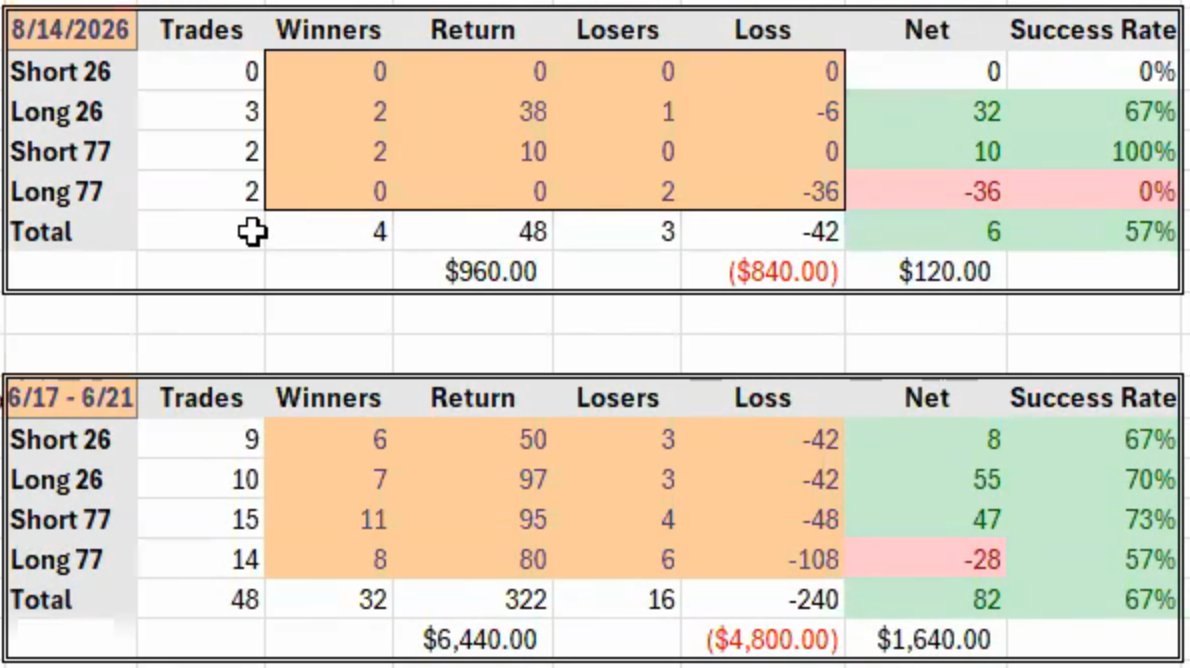
Here’s what the sheet said when I finished: Seven setups. Four winners. Three losers.
I said it out loud on air. “You churned your account. You didn’t get anything done there.”
That’s not the kind of number anyone wants to publish in a newsletter.
I published it anyway.
Logbooks are fundamental to successful trading. Without one, you’re hoping you remember everything correctly.
And that’s a recipe for disaster.
Here’s what I would suggest instead.
Build the Sheet Before You Need It
The setup takes about three minutes, and I walked the room through it live on Friday.
Save your first sheet as a template. Create a new sheet for the coming week and name it by the date range, which for us was 8.17 to 8.21.
Go back to the template, right-click and copy, then paste into the new sheet from the top left corner. Drag the tab to the end and you’re ready to log.
Then you fill it in setup by setup. Every trade the method offered, whether you took it or not.
Mark where you would have entered. Mark where your first target sat. Note whether price actually reached it, and where the escape hatch would have fired.
I told a trader exactly what to hunt for while he does this. “See how much that sets up. See how often that sets up.”
The counting matters more than any single result.
It Answers Questions You Can’t Answer Live
David came into Friday’s homework session with a problem. We had taken the same trade, and I got paid while he didn’t.
That question is impossible to solve during a session. Price is moving, orders are working, and you have no time to reconstruct anything.
On the sheet, it took thirty seconds.
I pulled up the fill and asked him one question about his bracket. The answer came right back.
“Are you using a plus seven? If you’re using a plus seven, you didn’t get paid.”
His first target sat too far away for that market. Mine didn’t.
Nothing was wrong with his read. Nothing was wrong with his entry. One number separated a winner from a scratch, and only the logbook could find it.
It Gives You Permission to Pass
Friday morning handed me setup after setup that looked tradeable. I didn’t take them.
A trader asked why, and I gave him the shortest answer I have.
“It doesn’t matter the day, the time, none of it matters. If I look left and see that, I’m just going to take a pass. And the reason I do that is because my homework tells me to.”
That’s the whole value proposition. I’m not passing because of a gut feeling or because I woke up cautious.
I’m passing because I’ve logged enough of these tapes to know what this price action does to an account.
I got a taste of it earlier that morning. I shorted the same area three separate times. All three came back on me, then it finally went where I wanted it to go after I gave up.
Here’s how I described it while it was happening. “I’m clicking three, four times into trades, and they’re not working. They’re not getting where I need it to go. Like, it’s just begging me to keep doing that so I can lose money.”
Without a logbook, that sequence feels like a personal failure. With one, it’s a pattern you’ve already seen.
You look around, recognize it, and stop feeding the machine.
It Forces You to Grade the Week Honestly
Let me show you what an honest review looks like, because I did this on air for August 14.
The first setup was a Golden Setup from the 50. A 26 that reached the 33, then came back and stopped us out even.
The next one was a long 77 that dropped to 66. That triggers the escape hatch, so you’re out. I called it what it was. “That’s a minus six. That’s a big swing and a miss right there, man.”
Then a 26 ran to 30 and stopped us out. Statistically the trade was correct, since it did achieve the 33. My bracket placement kept us from collecting on it, and I said so on air.
The one after that only reached 80.5 and never let us out. Straight loser.
One fat Golden Setup on the board paid properly. That was the best trade of the day by a wide margin.
Four wins, three losses, and commissions ate whatever was left.
Across the full week the sheet showed us still hovering around a 70% success rate on 48 setups. I called that tape exactly what it was. Broker appreciation.
You don’t get numbers like that from memory. You get them from counting.
What the Discipline Bought Us Friday
Sitting on my hands all morning kept the account intact for the part of the day that actually paid.
We got a short from the 77 that hit the first target for +5. Later, one clean Golden Setup came in and hit both targets for +31.
Paul finished with 57 points on the day. That’s $114 trading micros before commission, and roughly $1,100 on the full NQ.
Mary came back with 115 points, which puts her a little over $230 on micros and north of $2,200 on the NQ.
That’s the entire point of the exercise. As I told Paul, you want to master that number. Get that number done every single day and Bob’s your uncle.
PK signed off to go hang with his wife and dog. On a Friday when everyone else is still working, that’s what mastering the number gets you.
Your Weekend Assignment
Build next week’s tab before Monday. Then go back and log every setup from this past week.
Mark the ones that paid, the ones that scratched, and the ones you skipped that would have worked. Count them honestly.
Read the total when you’re done, even when the total is ugly like mine was.
That sheet turns a bad Friday into an informed Monday. It’s also the only thing that gives you real permission to sit out a tape that doesn’t deserve your capital.
The levels and the signals I logged all week live inside my Golden Setup.
Trade smart,
Tony Rago
Creator of the Golden Setup