Hey trader,
Someone in my session today pointed out that options cost more with the VIX above 14. Vertical spreads don’t work that way.
A vertical basically means buying one option and selling another at a different strike against it. Its price comes down to two things: the odds it pays off and skew.
Skew is essentially the gap in volatility the market prices into each strike. The bigger that gap, the better the price on the spread.
Today the gap was small.
A SPY spread I’d normally buy for about 40 cents was going for 52. I passed on it.
That extra 12 cents came from flat skew. The VIX level had nothing to do with it.
Once you can see which of those two things is moving, you’ll know a spread is overpriced before you pay for it.
Here’s how I priced it this morning.
Where the VIX Actually Shows Up
The VIX still matters to a spread trader. It just shows up somewhere other than the price.
With the VIX at 16 instead of 14, I might have to buy a long call or long put vertical a little further out of the money. If I’m selling a vertical, I can sell it a little further out too.
The VIX moves where my strikes land.
It doesn’t move what the spread costs. More volatility doesn’t create a higher price for a vertical, or for any other spread.
A spread gets priced off the volatility gap between the option I buy and the option I sell. That holds for calls and puts alike.
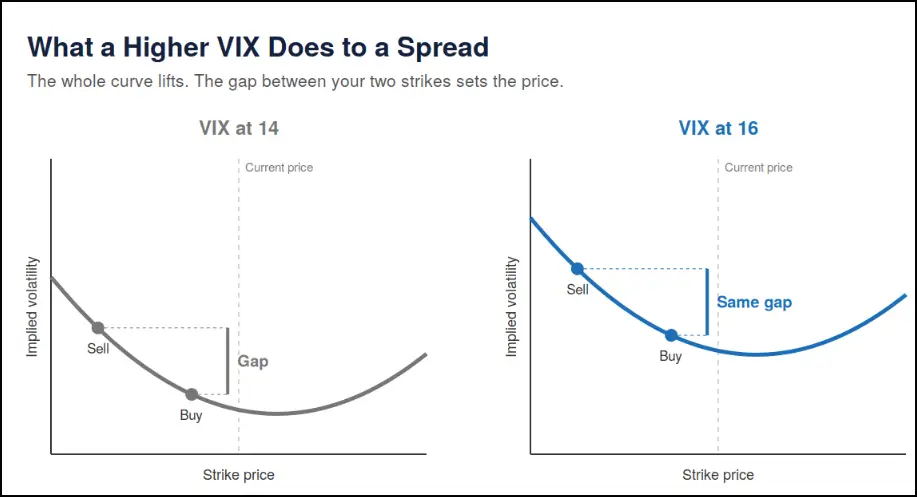
When skew works in my favor, it can more than offset any push further out of the money. For an intraday trade, the steepness of the volatility curve sets the price.
Why Today’s SPY Vertical Spreads Cost Too Much
The volatility curve shows how much volatility the market prices into each strike. On a chart it usually bends upward like a smile.
Today’s smile in SPY was flatter than normal.
The strikes I’d buy and sell were priced so close together that the gap between them was only about 1%. On a better day it runs 1.5% to 2%, and the bigger it gets, the cheaper my spread.
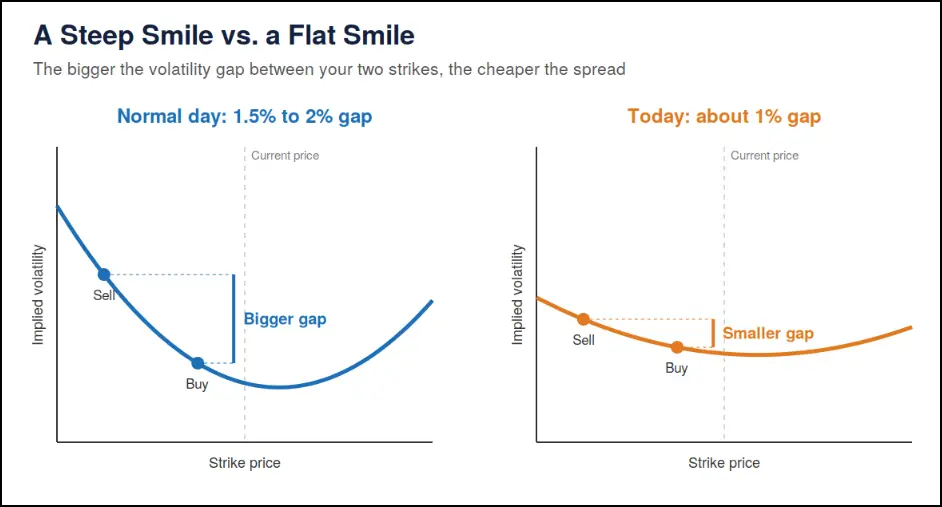
With SPY at 763.80, the 764/762 put vertical was going for about 52 cents. That means buying the 764 put and selling the 762 put against it.
I’d normally expect about 40 cents there.
A little later, with SPY at 763.24, a spread at the 762 strike was pricing at 44 cents while sitting $1.20 out of the money. I called that terrible.
The call side held up a bit better. The 764/766 call vertical cost 56 cents one strike out of the money.
Under 60 cents is okay for a call spread. It’s not great.
Overpaying hurts after the entry too. If price sits still near my strikes, I don’t want to watch 20 cents of decay come out of a spread I paid too much for.
Why I Wait for the Curve to Steepen
The same decay that punishes an overpriced spread can hand me a cheaper one. As the day runs down, out-of-the-money options head toward zero with less time left on them.
That pushes their volatility higher.
The curve steepens as a result, and the gap between my two strikes grows with it. A bigger gap means a cheaper spread.
The VIX doesn’t have to move for any of that to happen. For an intraday trade, the steepness of the curve sets the price.
If the pricing’s not there, I don’t make the trade. I’d rather wait for the curve to bend than pay up for a spread on a flat one.
Some days the pricing’s decent. Some days it’s amazing.
Today it’s awful. The VIX isn’t the reason.
Before you pay for a spread, check the volatility gap between your two strikes. That gap tells you more about the price than the VIX ever will.
Brandon Chapman, CMT
Creator of Ghost Prints