Hello trader,
Markets fall about 1.5x faster than they rise.
Bad news travels faster than good news, and fear runs stronger than greed.
One oversized position can erase months of gains in a single session. That is the math working against you every day.
The algorithms will not rescue you.
This market takes your money fast the moment you get careless.
That’s why I have one rule above every other: My job is not to lose money.
At the end of the day, it’s not about being a hero or who made the most money. It’s about making “enough” money.
Sure, it’s great to have extra cash in retirement. But, it’s more important to have a retirement than the largest accounts amongst your friends.
I know this advice is simple, common, and also quite hard to adhere to.
So, let me give you a clean example.
I’ll explain the exact way I held my loss to a fraction of a percent on a day the market dropped almost 2%.
You will see the cash, the positions, and the risk checks I use to contain the damage.
Then you can build the same discipline into your own account.
The Result on a 2% Down Day
The market fell almost 2% on the session. My account finished down 0.42%.
That gap did not come from a lucky trade.
It came from how the book was built before the day opened.
I don’t worry about any single trade wrecking my portfolio nor a down day blasting my portfolio.
Two habits do all the work.
- Buying with a cushion of safety.
- Balancing longs against shorts.
Together they keep a brutal day small and let you sleep at night like a baby.
Buy With a Cushion of Safety
I have never made money buying high. That is where I lose it.
The longs I own carry P/Es of five and six. The dividends run near 7%, so I am paid to wait.
That valuation is the cushion. The market can fall 1,000 points and it dings me without wiping me out.
A low multiple acts as a floor under the stock. There is little air beneath a name already priced for the worst.
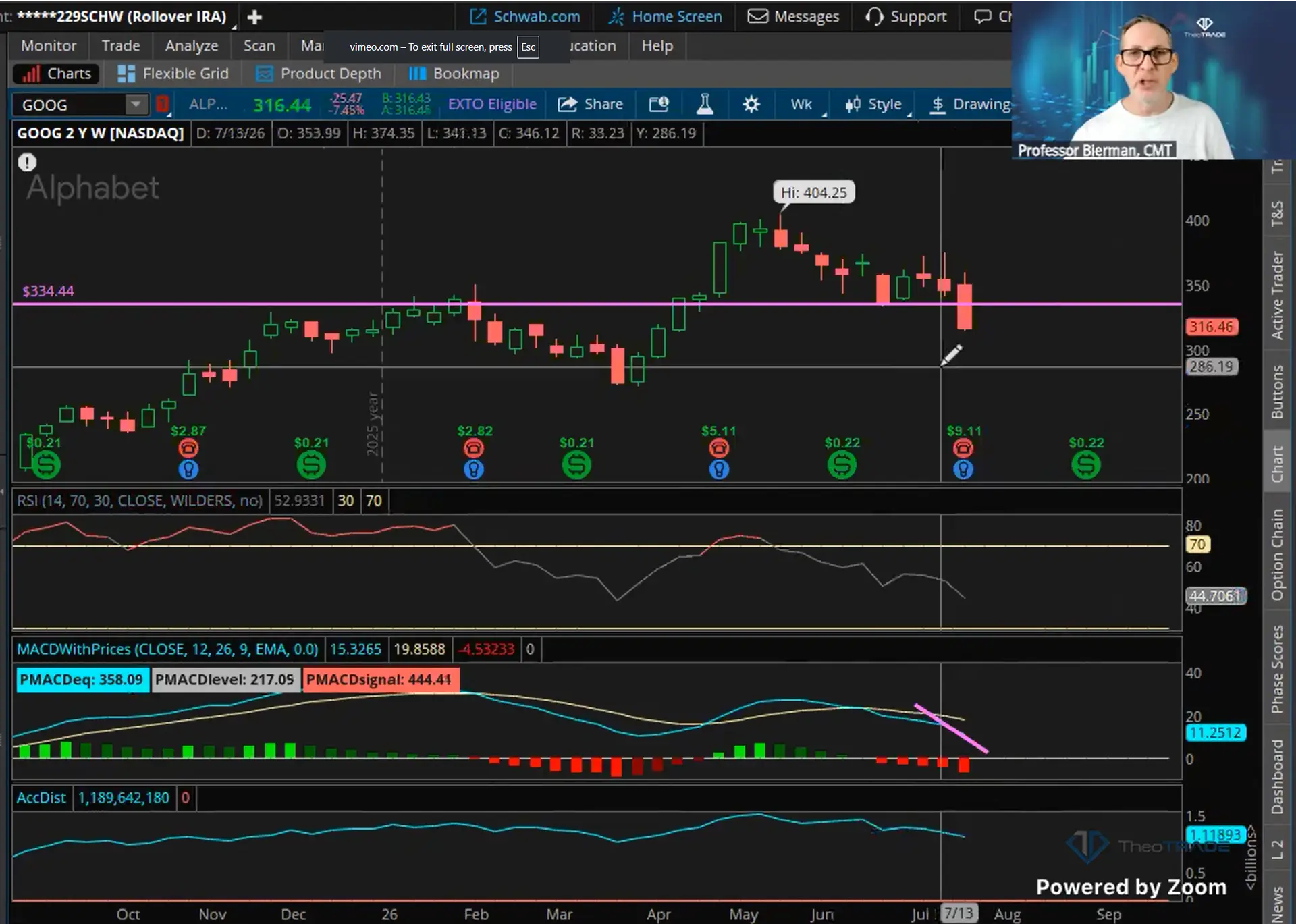
Stretched valuations have no floor at all. Google and Tesla proved it, each falling 10% to 20% in a single day.
I do not own either one. Those moves were telegraphed the moment the multiples ran to 30, 40, and 60.
Cheap by itself is not my reason to buy. I buy a monopoly, an oligopoly, or a business the world cannot stop using.
Balance Longs Against Shorts
A long-only book rises and falls with the market. That is pure directional risk.
I cut that risk by holding both sides. Right now I carry about seven short positions alongside 57% cash.
The shorts work for me when the tape drops. As my longs got tagged today, the short book pushed the other way.
I added a couple of shorts yesterday. I set them near cycle tops, so they carry little upside working against me.
I also manage that book actively. I covered my Airbnb short today for a quick gain and moved on.
The balance is why a 2% market drop was a fraction of a percent for me. The two sides absorbed each other.
Build the Same Discipline Into Your Account
You do not need a gift for this. You need two rules you refuse to break.
Buy value with room beneath it. Let the dividend pay you to hold.
Carry a short book so the market cannot move your account one for one. Hold cash for the days when nothing is worth owning.
Follow that and a savage session costs you a fraction of a percent. Skip it and a single day can undo a whole year.
Guard the capital first. The gains will still be waiting when the cycle turns.
When You Are Ready To Get On The Right Side Early
Protecting capital is step one. Catching the move before the crowd is how you grow it.
That is what the BURN SIGNAL is built to find. Every alert carries a ticker, the criteria that triggered, and both a stock play and an options play.
A signal is forming in my watchlist right now. The Burn Room caps at 200 traders. Once it fills, it closes.
Get inside the Burn Room before the next signal fires.
Professor Jeffrey Bierman
Creator of the Genesis COG System