
Hey trader,
A 50/50 trade with a 5-to-1 payout is one of the most rational bets you can find on a chart.
Skip enough of these and you bleed out slowly while never taking a single “bad” trade in your life.
Yesterday morning, I shorted the euro at 1.1645 with a 7.5-pip stop and a 33-pip target.
That put the trade at better than 4-to-1, and I was willing to be wrong on it more than half the time.
Here is the trade, the math behind why it got the click, and the rules I use to spot setups like this before they leave the screen.
A Coin Flip Is Not the Same as a Bad Trade
The phrase “coin flip” gets thrown around in trading rooms like it means reckless. It should not.
A coin flip is only a bad trade when the payoff matches the odds. 50/50 with a 1-to-1 payout is how an account dies slowly while paying commissions.
50/50 with a 5-to-1 payout is something else entirely.
Run ten of those. Five winners and five losers. The five losses cost 1x each. The five wins pay 5x each.
Net result is positive 20x, give or take slippage and commissions.
The break-even hit rate at 5-to-1 sits around 17%. One winner out of every six attempts covers the other five losses and still leaves money on the table.
The math does not care whether the trade feels uncertain at the moment of the click. The math just compounds.
Why These Trades Are Hard to Take
Two things make 5-to-1 setups hard to click, and neither one has to do with the chart itself.
The first is how a loss feels next to a win of the same size. Losing $100 stings more than making $100 feels good.
A setup with a real chance of losing money triggers the avoidance reflex even when the upside dwarfs the downside.
The second is the streaks. A trade that hits 25% of the time will hand you three or four losers in a row on a regular basis.
That is normal behavior for a 25% hit rate over a small sample. Nothing about it means the system is broken.
Knowing the math up front is what gets you through the streak. Bail on the system mid-losing-streak and you miss the winner that pays for the whole month.
What I Actually Took Friday Morning
The euro got steamrolled Wednesday and Thursday. Roughly 100 pips down in two sessions, which is two full average daily ranges stacked back to back.
Money was rotating into the dollar fast.
By Friday morning, the selloff paused. Price parked itself at the zero line at 1.1645 and started defending it.
It bounced off, retested, and bounced again. That gave me an entry I could lean on, with a stop sitting at a structural level instead of an arbitrary pip count.
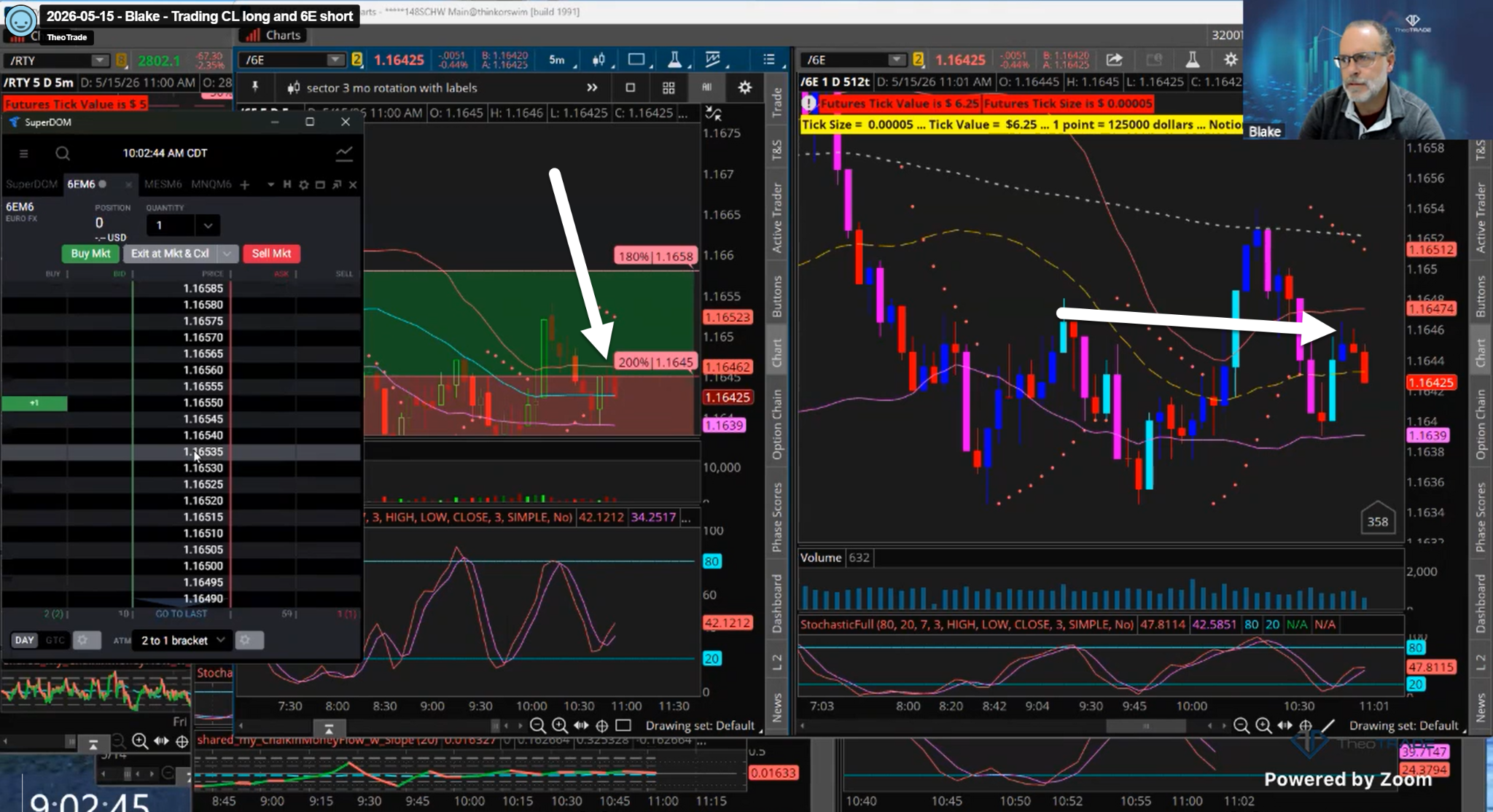
Here is the trade as I put it on:
- Short entry: 1.1645
- Initial stop: 1.1652.5 (7.5 pips, roughly $94 of risk on a full contract)
- Initial target: 1.1612 (33 pips, roughly $413 of potential reward)
The ratio came out better than 4-to-1 at the entry, and closer to 5-to-1 if the move ran clean through the initial target into the next level lower.
I knew when I clicked that the trade could just as easily bounce off the zero again, take me out, and resume the rally.
The number on the loss was small enough that getting wrong twice in a row still left me alive for the third attempt.
Managing the Trade in Real Time
The euro broke down through the zero, made a new low, and started moving.
I worked the stop down as the structure developed.
My first move was to 1.1647.5. Risk dropped to 2.5 pips.
The second was to 1.1645.5 after a one-candle reversal printed, which locked in a tick of profit no matter what came next.
The third was to 1.1644.5 as a second reversal stacked and the breakout kept going.
By the time my session ended, I was up roughly $100 unrealized with my stop tight enough that I was giving back almost nothing on a reversal.
The full target still sat about 24 pips lower.
The session closed before the trade resolved. I did not see whether it tagged 1612 or got faded back to a small winner.
What I do know is the structure played out the way an asymmetric setup is supposed to.
Three Rules I Use to Spot These
Not every coin flip on the screen is worth taking. The ones worth taking share three things.
Demand a real asymmetry. 3-to-1 is the floor. Below that, the math does not have enough cushion to absorb a normal losing streak.
5-to-1 is where these trades get interesting. 10-to-1 is rare and worth waiting for when the chart actually offers one.
Anchor the stop to something structural: a swing high, a Bollinger Band edge, the high of a one-candle reversal, or a round number with volume sitting on it.
A stop should not live 10 pips above entry just because that sounds about right.
Accept the loss before you click. If the stop is going to make you flinch when it fills, the trade is not really 5-to-1 in your hands. It is 5-to-1 right up until you panic and close it early.
Why This Setup Got the Click
The euro was not the cleanest chart on my screen Friday morning. The ES was tighter. The Russell had already moved. Crude was setting up its own breakout.
The euro got the click because the ratio was the best on the board.
That filter is the only one that matters when the math is asymmetric. A trade that pays 5-to-1 with a 30% hit rate compounds faster than a trade that pays 1-to-1 with a 70% hit rate.
The numbers back that up if you sit down and run them yourself.
Give me the coin flip with the right payoff every time. The “high probability” trade where the upside barely covers commission can stay on someone else’s screen.
Entry, stop, target, and the asymmetry behind why the trade is worth taking. Every time, no exceptions.
👉 Click here to learn more and join us.
Blake Young
Senior Market Strategist, TheoTRADE