
Hey Trader,
A short can be right on direction and still pay you nothing. It’s frustrating.
Traders take a valid breakdown, then watch it grind sideways until they walk away from the business.
The S&P 500 did that to people last week.
They shorted a real break underneath a bearish flag formation. The MACD slope behind that break measured nine degrees.
Those traders have lost 500 S&P 500 points. Their direction was fine. The angle behind it never paid them a dime.
It’s the angle of the slope that decides the size of your check!
In fact, I got an email this morning asking me about Nike. I won’t touch it, and the slope is my entire reason.
By the end of this article, you will know the exact angles I require before I risk a dollar on a short.
You’ll also learn why a flat MACD turns a correct call into months of grinding.
The concept is MACD slope.
And here’s how it works.
The Angle Decides How Much You Get Paid
Direction gets all the attention in this business. Which way is price moving?
Yet, the angle of the slope decides the size of the payout.
I have watched traders ignore slopes for years. They do not last very long in this business once they do it.
You see, machines run on slopes.
Institutions stay obsessed with moving averages, momentum, and crossovers, so I integrate both readings.
The MACD is my favorite indicator for the longer term. It shows me the exact point where momentum flattens out.
My read runs as a simple checkdown before I do anything.
I ask whether the MACD sits above the zero line, then whether the MACD line sits above the signal line.
Those two answers hand me trend and momentum. The slope then tells me whether the trade is worth my capital.
What The Slope Looks Like On Your Chart
Pull up a daily chart and put the MACD in the lower sub-study.
The angle sits in the data box in the banner right above it.
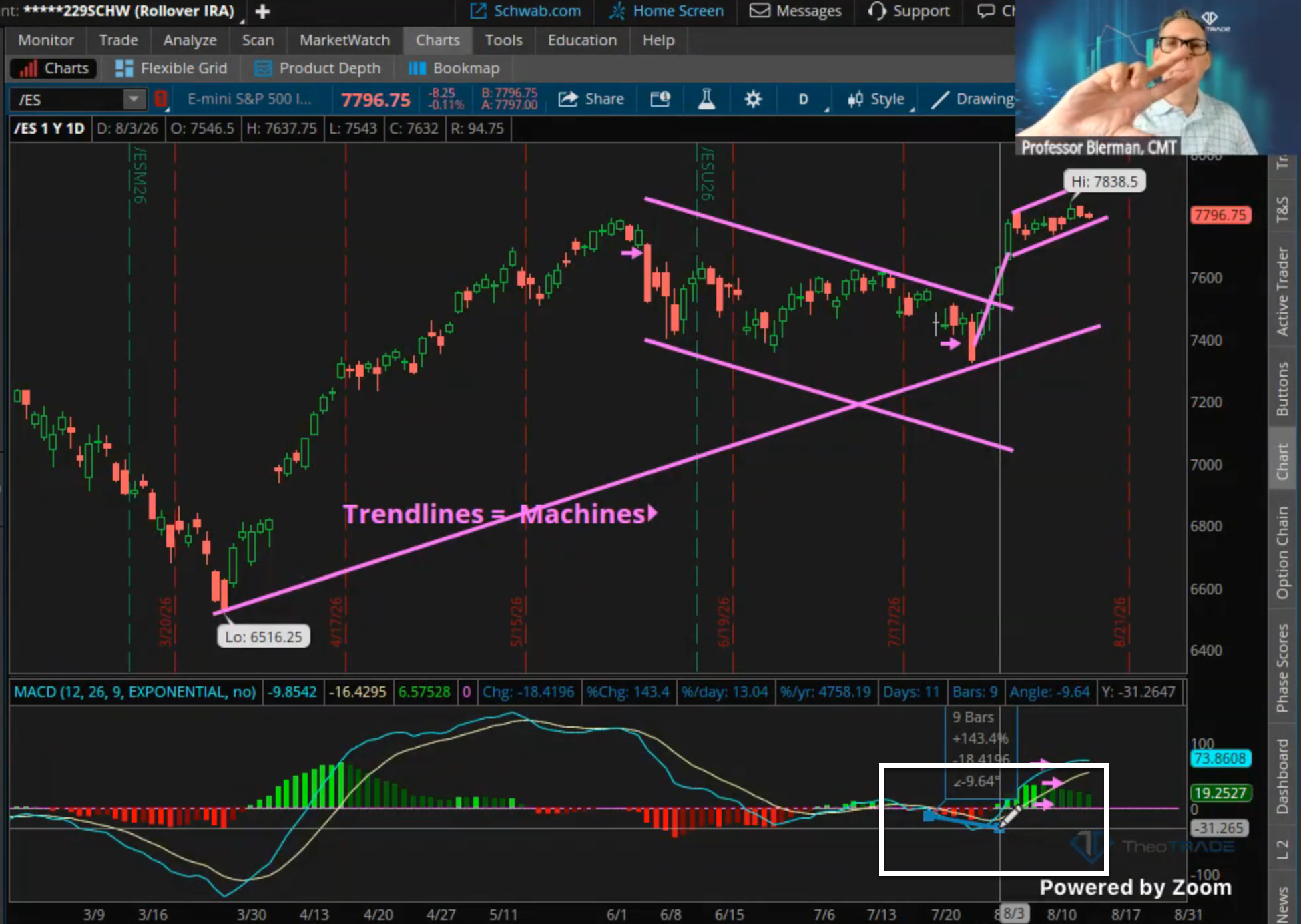
Then sort what you see into three readings:
- A vertical slope up makes a name totally unshortable.
- A waterfall slope down makes a name totally unbuyable, because you would be the only buyer in the crowd.
- A flattening slope opens a two way trade, so a dead cat bounce and a further meltdown both stay live.
Steeper angles pull in heavier participation. The steeper the angle down, the harder they sell it.
A steep angle up invites the gamma squeeze. I refuse to short on the way up for that reason alone.
One more piece of housekeeping matters here. Do not run the momentum SMA and the MACD at the same time, because their formulas clash and their triggers will disagree.
The S&P 500 Paid 300 Points At One Angle And Nothing At Another
The S&P 500 handed me three clean examples of this.
One short sat on a negative 29-degree angle on the daily, and that entry produced 300 points.
The next short looked identical in direction. The MACD slope behind it measured nine to ten degrees.
That entry came off a real break underneath a bearish flag formation. Traders who took it have lost 500 points on the S&P 500.
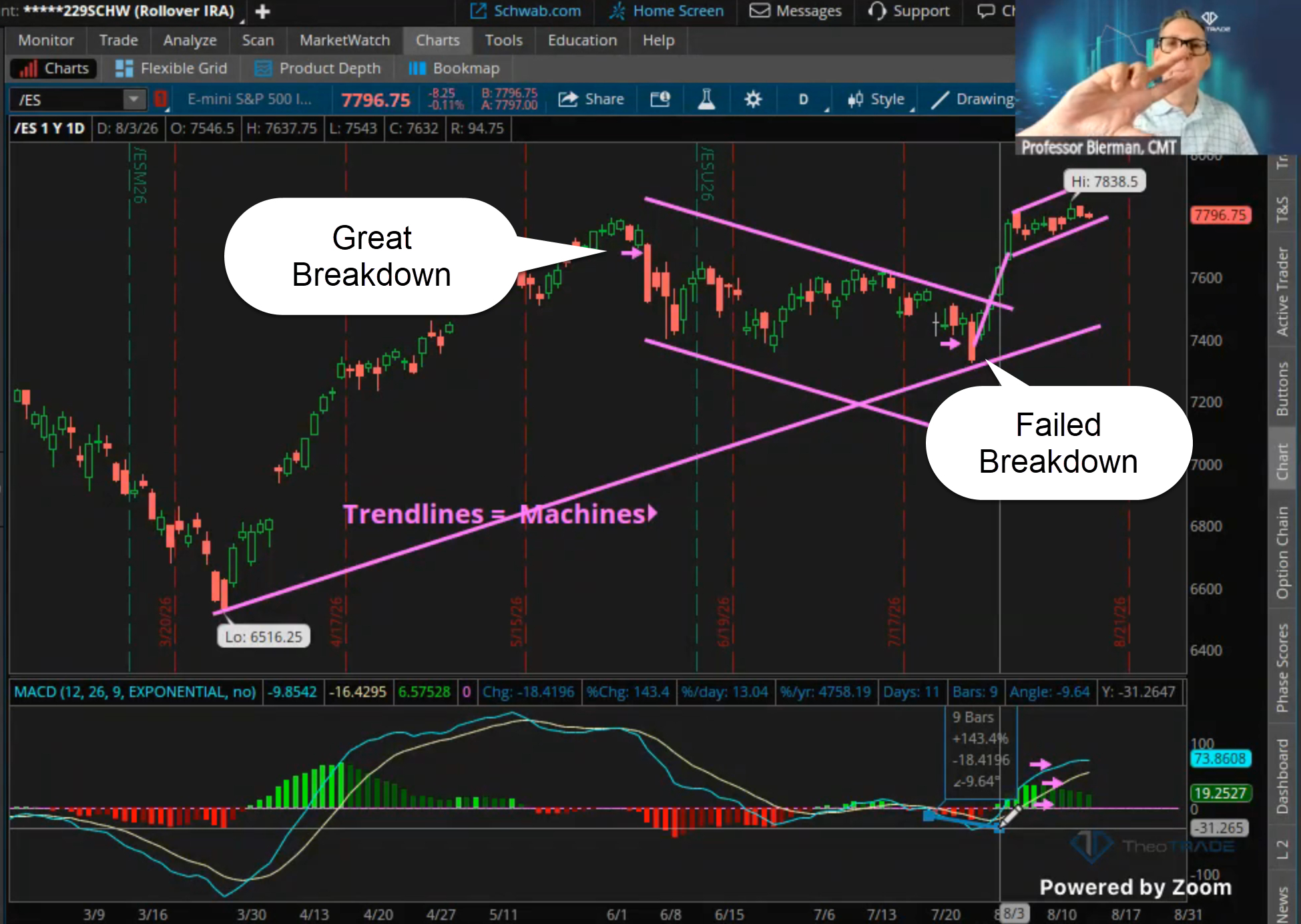
Then the slope flipped and ran back up to a 45 degree angle. Everybody still short got squeezed to death.
My argument sits with the angle rather than the direction. The break underneath the channel was real enough.
The slope never gave that trade room to pay. It ground them out day after day.
A fall from here runs into another problem. The algorithms defend 7442 because they are programmed to buy on the trendline.
A correct short on a flat slope will still grind you out of the business.
Nike Came Across My Desk This Morning
Somebody emailed me before the bell asking what I think about Nike. I will not touch it.
The slope is down. The stock sits below its MACD and below the zero line.
The business is not good and the price is not cheap enough. I read the technical picture first, and the technical picture is walking the stock lower.
Trade with the machines and trade with the institutions. Use the slopes to guide you into position.
How You Use This Tomorrow
Read the angle before you size the ambition. Work through it in this order:
- Pull the MACD angle out of the data box on a daily chart, because that number sets your ceiling.
- Pass on any short sitting inside a nine or ten degree angle, since it will grind instead of pay.
- Wait for the angle to turn down 30 degrees or more before you press a short position.
The S&P 500 carries a flat slope today. It sat at minus seven this morning, and I expect it there five hours from now.
A flat MACD works like a nail in a foot. The slope has to change before anything moves.
Stop prognosticating and stop guessing at direction. The angle will either pay you or bury you.
Running that checkdown by hand across every name you follow costs you the afternoon.
The Genesis COG System puts the whole sequence in front of you, from the zero line to the signal line to the slope that decides your payout.
Professor Jeffrey Bierman
Creator of the Genesis COG System