Hey Trader,
Short a rising stock in my room and I’d fire you on the spot.
I’d flunk you too. Ten years of teaching this hasn’t softened me on it.
Nobody gets rewarded for going first. You just get your head cut off.
Algorithms are programmed around slopes. They don’t wait for the top. They move BEFORE we ever get there.
So, why try to squeeze that last bit of juice from a lemon that’s already spoiled?
Obviously, you shouldn’t.
Instead, I want to show you how to think like the machines. That way, you know where to plan your exits and avoid stepping in front of a bulldozer to pick up pennies.
What A Bollinger Band Actually Shows You
I covered the moving average envelope and the Keltner Channel in the last two sessions. Today I’m on the Bollinger, and this read transfers to any of them.
A Bollinger Band has three components, all built off a given price. That price is usually the close.
- The upper band, measured as two standard deviations above the moving average
- The center line, which is the 20-period moving average
- The lower band, measured as two standard deviations below the moving average
Both outer bands get calculated off that center line. The center line drives them, and they never move on their own.
Now stop staring at where price sits between the lines. They don’t predict anything, and one headline can reverse them in a minute.
What they show is the path of least resistance right now. We read that off the slopes of the center line and the bands.
A candle can flip on you inside an hour. The center line can’t.
So the slope has to wait for old prices to roll off before it turns. That delay is what makes it worth trusting.
While the center line climbs, it drags both bands up behind it. The program reads that as a buy and keeps buying until the slope quits.
A flat band is permission, not a signal. The candle still has to print.
Now, let’s walk through an example/
Why A Bearish Candle Failed On Meta
A lot of people came in to short Meta on a red inverted hammer. They shorted it for one reason, which is that the candle printed red.
Look at why it was red.
Meta was up six points on the day, and it opened higher than where it was trading.
That’s a bookkeeping quirk, not selling pressure. The candle closed below its own open while the stock gained ground.
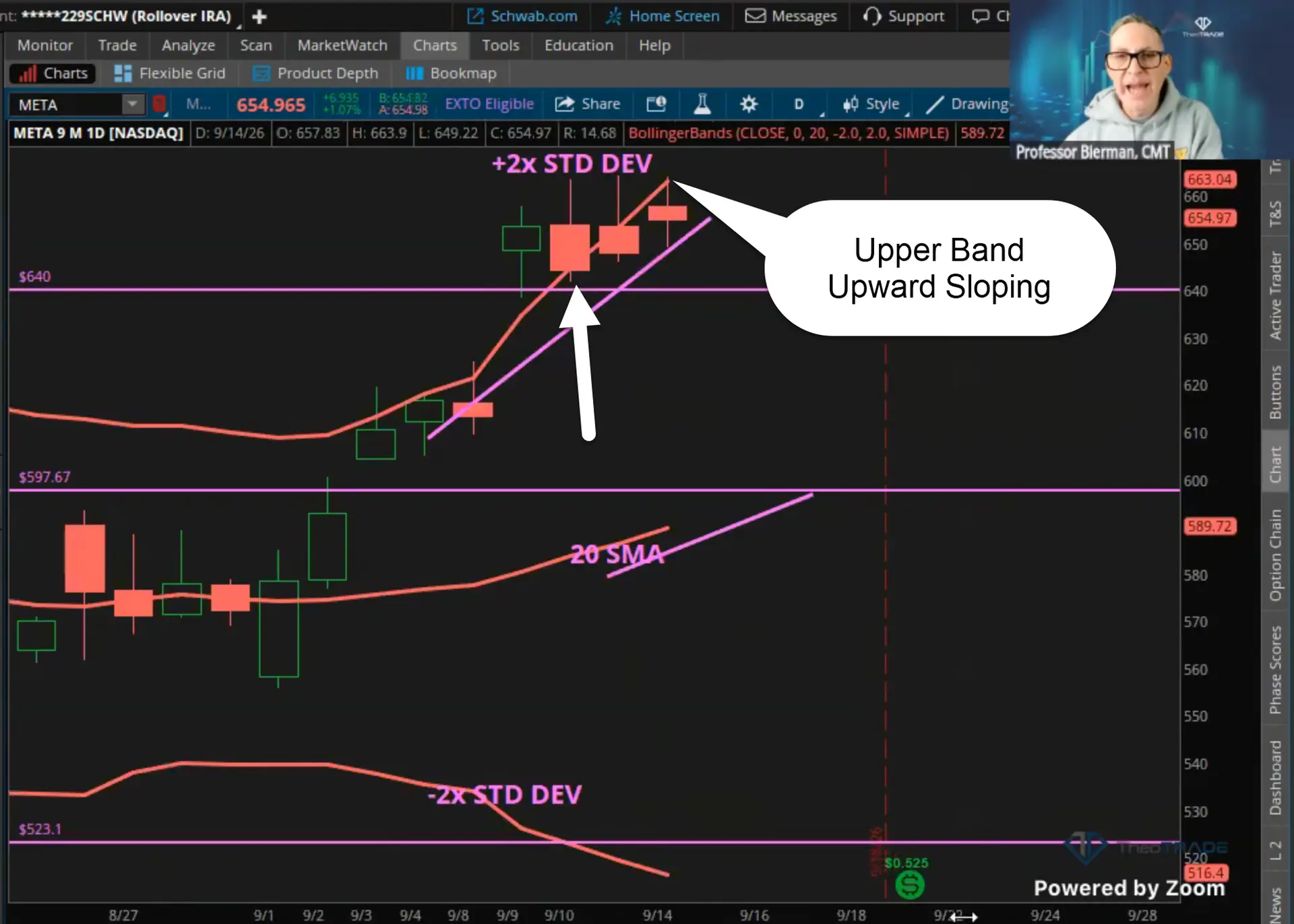
Now look above that candle. The upper band was still climbing, so no resistance existed there yet.
The program had one instruction and it kept executing. Those shorts went in against a buyer with no discretion left.
The real break came later, and it came in order. Support gave way at 598 to the dime, price dropped under the center line, then the band pivoted away behind it.
Three black crows printed on top of all of it. Every box got checked before the trade existed.
The machines walked it to 541 while I watched for 519.74. Then green candles showed up and none of them were a buy.
A key reversal candle gets confirmed on day two or three. At 629 the band flattened, the program went two-sided, and the stock broke back up.
How You Run This Tomorrow
Start with the slope and work toward the trigger. Three checks settle whether the trade exists at all:
- The center line has lost its slope
- The outer band has pivoted and flattened with it
- A definitive candle has printed against that flattening
Then stop hunting the top tick. I waited almost two months to take the short we released this morning.
I gave up two dollars of slippage on that entry. My timing came out optimal and I still missed the high by a mile.
Slopes and candles are inseparable. One without the other creates havoc and burns you.
That pairing is two of the five indicators I line up before I commit. When all five agree, I have a high-conviction trade instead of an opinion.
My reasons for shorting are never technical. They’re statistical and fundamental, and the technicals only tell me when to move.
The Genesis COG System hands you all five and the order I read them in. You get the valuation work, the slope rules, and the candle triggers that time the entry and the exit.
I released five short trades in the last 10 days off this exact read. Enrollment is open right now, and I’m running the model live every session.
Enroll in the Genesis COG System
Professor Jeffrey Bierman
Creator of the Genesis COG System