Hey trader,
On Thursday, I priced a General Motors trade built around selling a put, and it could pay me even if GM went nowhere.
It could also pay a lot more if GM ran to my target. The put that made both possible sat right at my stop.
Your stop is the price where you admit a trade is wrong. Usually, it only protects you.
A more advanced options approach puts that price to work.
You sell a put there. Selling a put pays you premium up front, and in exchange you agree to buy the stock at that strike if price falls there.
If the strike matches your stop, you’re getting paid at a level you’d already accepted. That premium can cover the cost of your upside bet.
On GM, the put paid for my entire call spread, which buys one call and sells a higher one to cut the cost.
Don’t reach for selling a put every time you want to finance a trade. It works under specific conditions, and only if you can handle owning the shares when price turns against you.
Here’s what had to line up on GM, and what happens if that put gets assigned.
Why I’m Selling A Put At My Stop
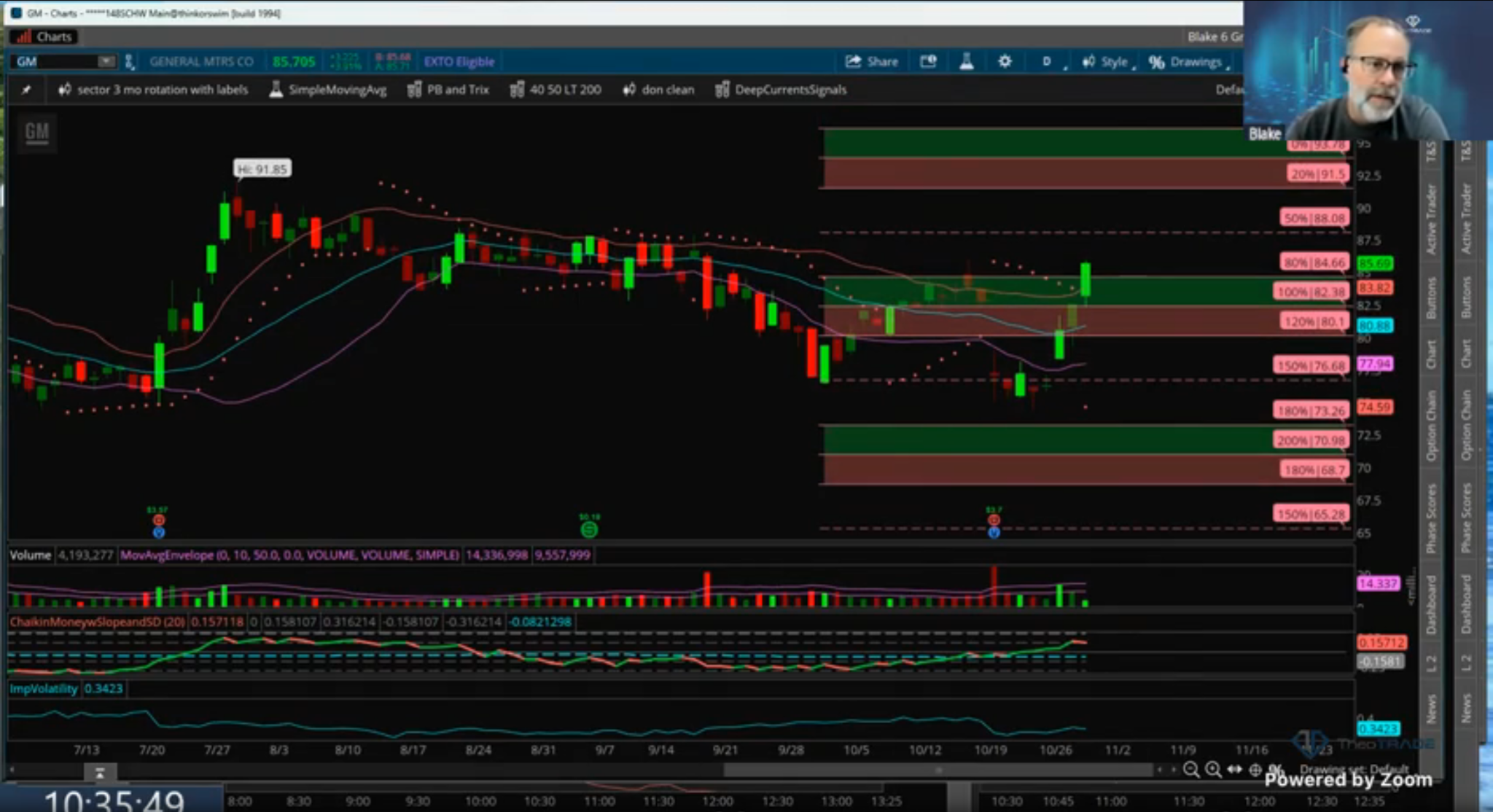
Every bullish trade I take has a level where I admit I’m wrong. On Thursday’s General Motors setup, that level sat at 82.
GM was trading about $3 below my first target at 88. I wanted out quickly if it dropped $3, which put my stop at 82.
Selling a put at that strike only makes sense if I’m okay owning GM at 82.
My plan already called for an exit there, so the put pays me at a level I’d marked in advance.
I told the room selling a put this way isn’t an infinite risk trade. By that logic, every stock you buy would carry infinite risk because it could gap down.
Put the short strike where your stop already sits.
The Conditions That Had To Line Up
Selling a put fit Thursday’s GM setup because three conditions lined up:
- Cheap options. GM’s implied volatility sat at the 27th percentile, and below 35 I want to start as a net buyer.
- A clear stop. I already knew where I’d exit, so the put strike wasn’t a guess.
- A target worth reaching through. Sellers stacked up at 88, and a V-type reversal could carry GM toward 97.
IV percentile shows where today’s option pricing sits against the past year. The year’s cheapest reading counts as 0, and the most expensive counts as 100.
A V-type reversal is a sharp drop followed by an equally sharp recovery. GM had broken out of a widening pattern, and I thought it could repeat its last swing.
Thursday’s General Motors Trade, Piece By Piece
I built the trade in three steps:
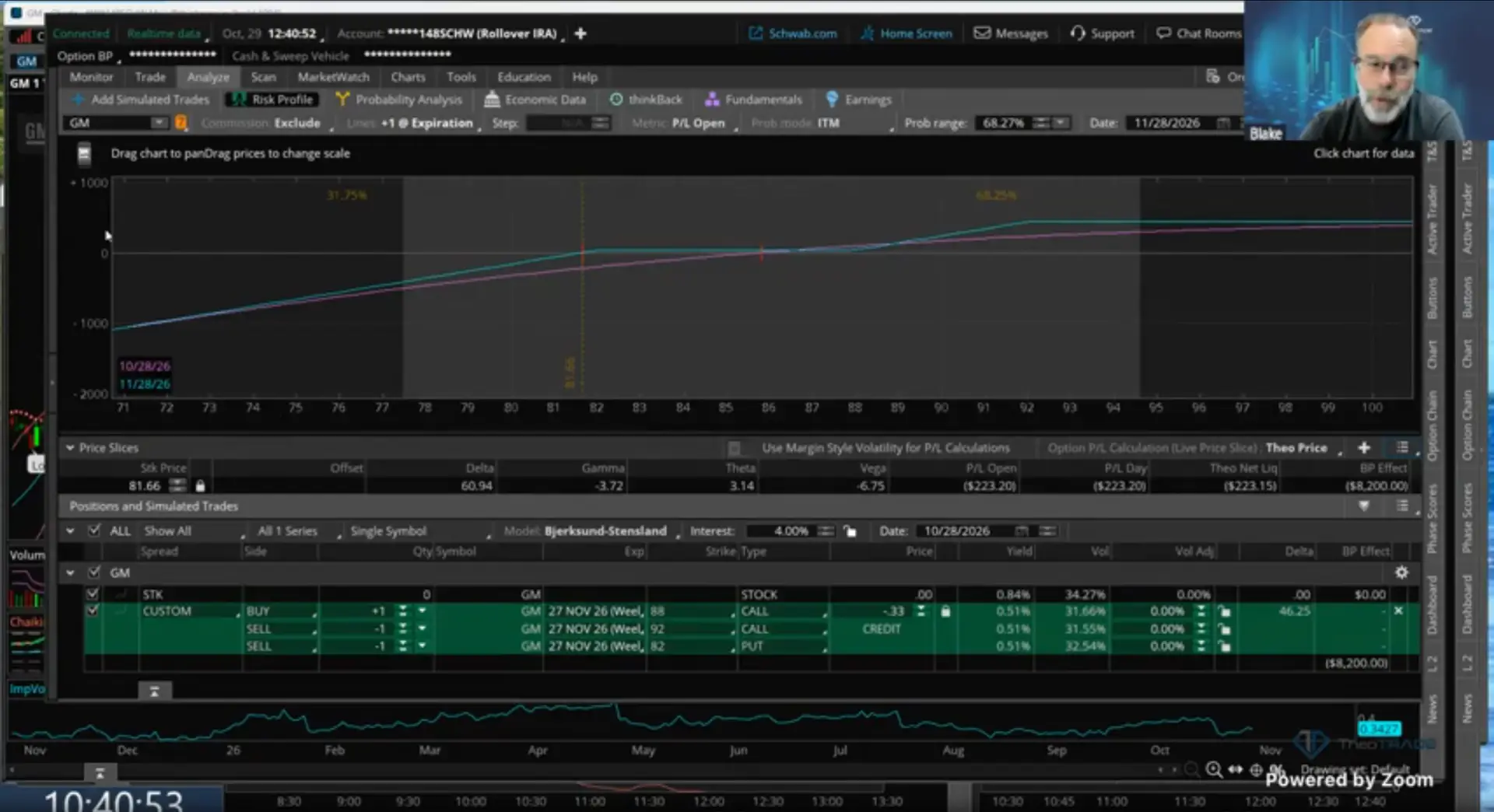
- Buy the first target. I bought the 88 call, since 88 marked the first wall of sellers.
- Sell the next target. Selling the 92 call made it a $4 wide spread that cost $1.20.
- Sell the put at the stop. Selling a put at 82 paid $1.40 to $1.50, more than the spread cost.
That flipped the whole trade to a credit.
Then I pulled up the risk graph, which plots what a trade makes or loses at each price. I set it to show breakeven slices, the points where the trade crosses from losing to making money.
In plain terms, the odds favored not losing, and the big payout needed GM to run.
The graph gave me a 68% probability of not losing. I told the room that doesn’t mean winning.
There was a 28% chance I’d keep only the small credit. There was also a 39% chance of making more, with up to $433 if GM hit my target.
I priced this trade live in the room but didn’t place it. I won’t claim a result on it.
What Selling A Put Means If You’re Assigned
Here’s the part you have to be ready for before selling a put.
If GM falls below 82, you can be assigned 100 shares per contract. At 82, that’s $8,200 of stock for every put you sold.
The credit lowers your cost.
I worked my breakeven out to 82 minus 32 cents, or 81.68.
GM could trade all the way down to my stop and I still wouldn’t lose anything. Below 81.68, the position behaves like owning GM from that price.
My stop doesn’t disappear after assignment. I told the room, “If it falls down, we can deal with it,” because 82 was where I’d planned to deal with it all along.
You can run the same build on your next bullish breakout:
- Check implied volatility first. Below the 35th percentile, start as a net buyer with a call spread.
- Let the chart pick the call strikes. Buy your first target and sell the next one.
- Sell the put only at your stop. Before selling a put, make sure your account can carry 100 shares per contract, and honor that stop if you’re assigned.
Let your stop pick the strike when selling a put, and let the premium help pay for your target.
That’s my line, and it doesn’t have to be yours.
I built Thursday’s GM trade live, with the risk graph on screen and the breakeven math out loud. I’d rather you watch me run those numbers in real time than read about them afterward.
Inside the 10% Club, every trade I call comes with an entry, a stop, and a target before I take it. You hear why I pick each strike while the market’s still open.
Set your stop first, then try selling a put at that level to help pay for your target.
Blake Young
Senior Market Strategist, TheoTRADE