Hey Trader,
G-Man dropped into the room at the end of my hour, and I told him it was his kind of day.
He agreed. Then I told him what we had just done.
“We bought the highs and we made money. How about that?”
He said that was music to his ears.
I want to be honest about what that trade was, because it was a chase.
I said so on air before I ever clicked the button:
“It’s got a setup, and it’s a chase. You’re absolutely chasing it here. There’s just no doubt about it.”
There is a version of chasing that empties accounts…
…but…there is another version that pays 80 handles.
Here’s how you can tell the difference.
The Difference Is Where in the Move You Get In
In one sentence…
Bad chasing means entering while price is still moving.
Your fill lands wherever the candle was when the urge peaked.
Good chasing means entering after the move stops. Price pauses, consolidates, and prints a close that confirms buyers are still there.
Same direction. Same market.
The stop sits in a completely different place, and that changes the entire trade.
Thursday handed me both versions. Here is each one.
The Two I Passed On
Early in the morning on Thursday, I flagged a 26 for the room and called it a horrible Golden Setup trade.
That was not a slip.
It was a clean first test of the 26 and it checked every box in terms of criteria.
Then look at how price got there.
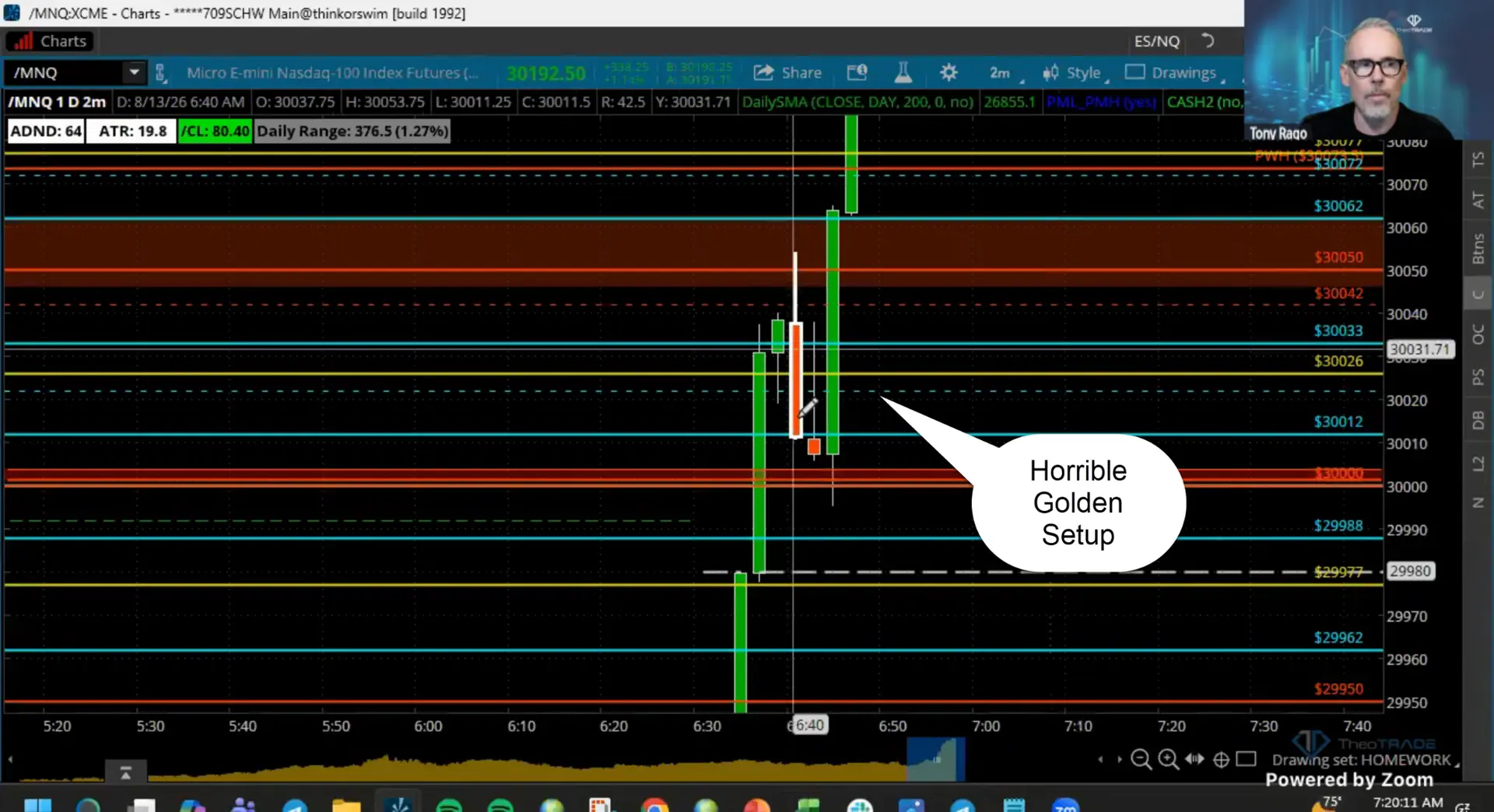
It ripped straight up, parabolic, no pullback, and stopped at the 50.
There was no pause to enter on. Buying it meant buying while it moved, with the stop parked below the whole vertical run.
Here is what I told the room. “When you see this kind of move, straight up without any kind of pullback, and then it rolls down from this 50 down to 26, I pass on those.”
A second one set up identically and happened to hold. I passed on that one too.
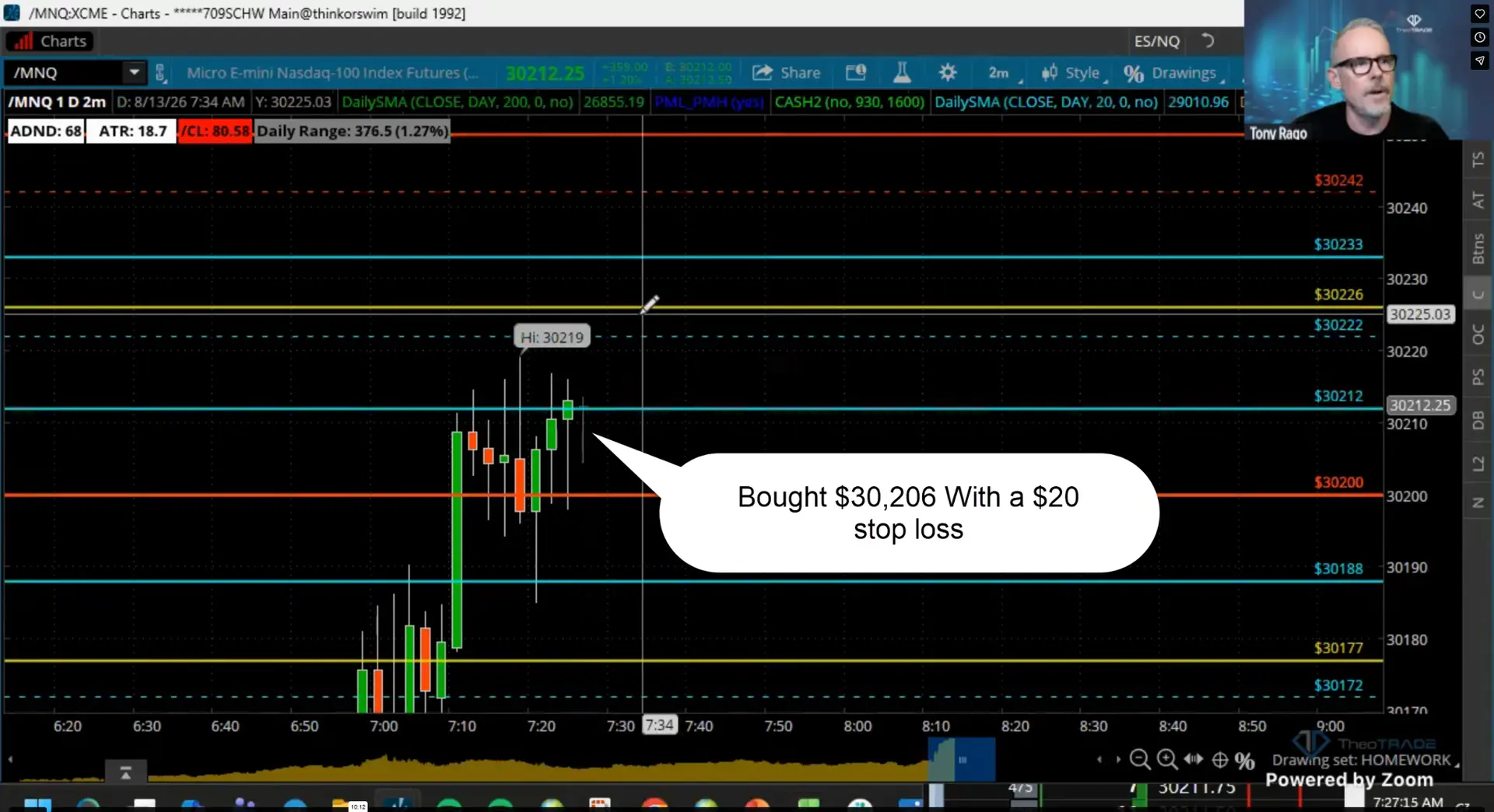
By the time I bought, price had stopped running.
We cleared the prior week high at 30,077. Then the tape went quiet and consolidated in a zone.
That consolidation is the whole thing. It gave me a pause to work with instead of a moving target.
I also had somewhere to go. I map the NQ in 100 points of price, and an hourly candle closed above 30,106.
That told me the 30,250 was live. The destination sat above my entry, not behind it.
Then I waited on the signal. From the round level, a close above the 12 seeks the 26 and the 33.
The candle struggled. It came back, tried again, and closed at 13.
I bought the 06 with a 20 handle stop underneath the structure. Both targets filled.
Chasing Changes Your Exit, Too
Buying a high also changes what you can reasonably ask for.
I had the 30,250 as my destination. I never waited for the tag.
I rolled the bracket up and offered at 46, which put me in front of the level instead of at it.
When the NQ runs hard and finally reaches a big round number, it very often pushes back. I have watched traders go from plus 50 to plus 15, hit flatten, then watch it continue without them.
We filled at 46. Two contracts, 80 handles.
Understand your instrument. Moving the S&P 500 takes a crowd coming along with you.
The NQ will flash up, grab a level, and reverse on no volume at all. On a chase, I take the money before the level gets tested.
Bringing It Into Next Week
Your homework takes twenty minutes. Pull up any strong trend day from the last month.
Mark where you felt the urge to get long. Then mark the first candle that actually closed above the level.
Measure the gap. That number is the honest picture of your entries.
Going forward, the NQ needs to defend the 30,077. I want a daily close above it to stack another bar on the weekly.
On the ES, the 7,850 is open for a test.
When price runs again, I will let it finish running. Then I will wait for the close above the 12 and go with it.
If you want the level map and the signals I traded off Thursday, they live inside my Golden Setup.
Trade smart,
Tony Rago
Creator of the Golden Setup