
Hey Trader,
A stock trading at a 5x earnings multiple sounds cheap. A stock at 10x sounds reasonable.
One at 20x sounds expensive. None of those numbers mean anything on their own.
That earnings multiple tells you what you pay for every $1 a company earns in a year. I’ve been a Wall Street analyst since I came out of my mommy’s womb.
I make my money finding inefficiencies in valuation. I’ve watched people get burned on this over and over.
They see a low number and assume they’ve found a bargain. Some stocks are cheap for a reason.
Others aren’t cheap at all once you compare them to the right group. I’ll show you how to tell the difference before you put a dollar in.
Bank of America is a perfect example. I nicknamed it Flat Bread today, because bread means money and its revenue came in flat.
Its earnings missed too. Next to BlackRock, its earnings multiple looks like a steal.
Measured against other banks, it still hasn’t hit its floor.
The numbers tell me what to buy. The chart tells me when.
We’ll start with what turns a low multiple into a trap. Then we’ll run Bank of America and BlackRock through the floors I use.
By the end, you’ll know why I’d bless one and won’t touch the other. You’ll also have a checklist for any financial stock.
What Turns A Low Earnings Multiple Into A Trap
A low earnings multiple tells you the price. You still have to check whether the company is growing.
Bank of America shows you why. The company still makes money.
Its revenue was flat. Its earnings missed.
That tells me the company has stopped growing. If there’s no growth, I see no reason to buy it.
It’s posting flat numbers while interest rates rise. That doesn’t bode well.
I’d call that chart a crash. Don’t buy it, and don’t short it either, because you already missed the move.
Growth changes the math. Look at ASML, a semiconductor name I covered today.
It’s still growing at a 30% clip. That’s why I don’t consider its valuation overbought.
A company with no growth tends to drift down toward its floor. A company that keeps growing can hold well above it.
Earnings Multiple Floors For Banks And Asset Managers
An earnings multiple only tells you something when you measure it against the right floor. Financials don’t share one floor.
Here’s the bottom multiple I use for each type:
- Banks: 8x to 10x earnings.
- Brokers and asset managers: 10x to 12x earnings.
They’re not the same. Price a bank like an asset manager, and you’ll call it cheap too early.
I’m a professor of finance, so I start with the valuation model. Then I use the technicals to spot my entries and exits.
An earnings multiple only means something once you know what kind of business you’re pricing.
Running Both Stocks Through The Floors
Finding an earnings multiple takes simple math. I add up the last four quarters of earnings, then divide that into the stock price.
Bank of America trades around $49 after this morning’s drop. That’s an earnings multiple of about 11x.
Next to BlackRock, 11x looks cheap. Against the 8x to 10x bank floor, it’s still above the line.
With flat numbers, I don’t see what holds it there. I won’t consider it until it trades at 8x to 10x.
For now, don’t touch it. It’s on the way down.
BlackRock earned about $55 a share over its last four quarters. At roughly $1,090, that’s close to 20x.
That’s well above the 10x to 12x floor for asset managers. I still call the valuation about fair value.
BlackRock is the largest asset manager in the world. Larry Fink runs it, and he’s brilliant.
It handles trading, bonds, equities and private equity, which makes it a one-stop shop. I read the earnings report, and the numbers were spectacular.
That kind of growth earns BlackRock a premium over its floor. Bank of America hasn’t shown the growth to earn one.
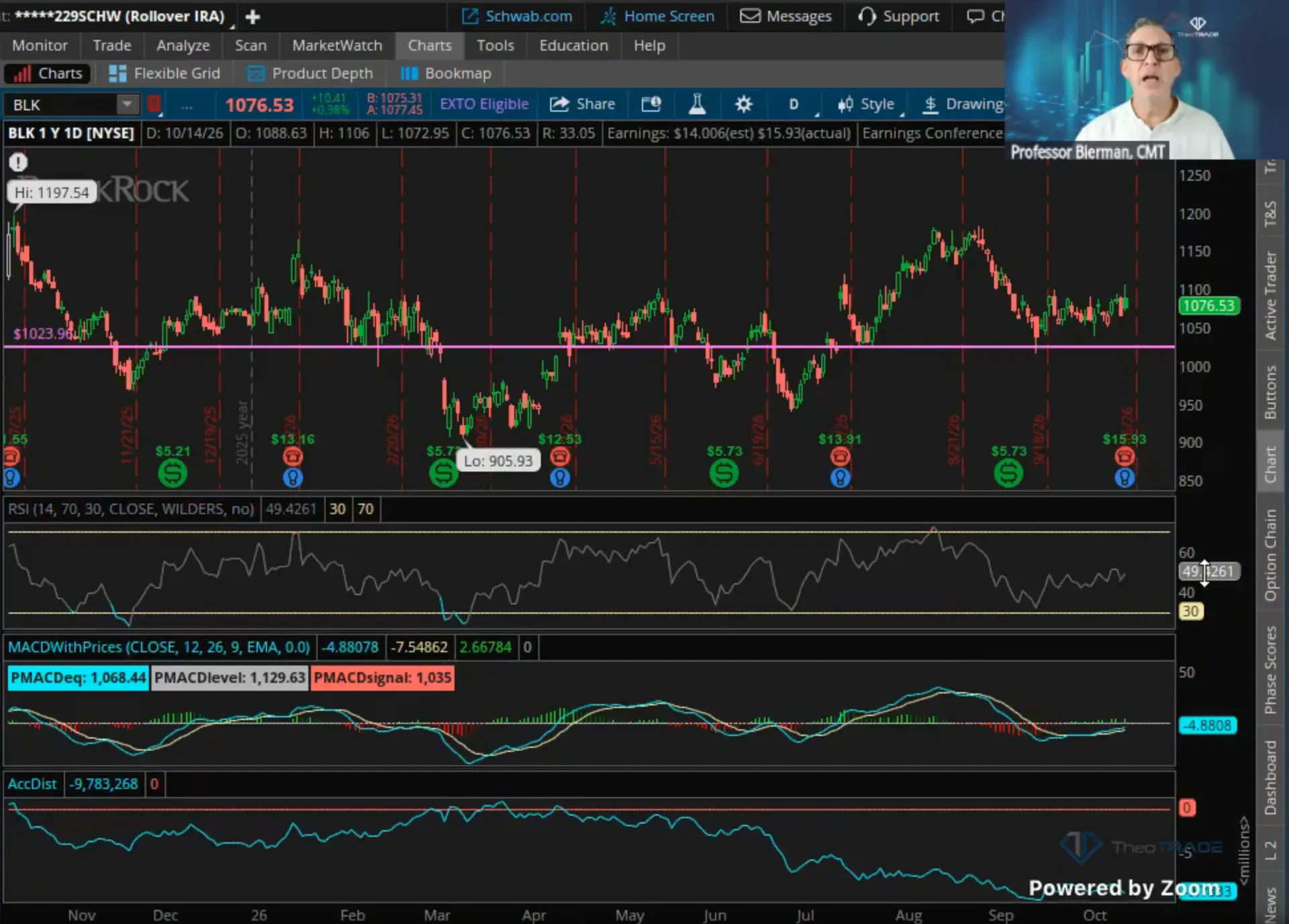
The chart has BlackRock in an upward flag channel. I’d draw a line in the sand at 1,023 to 1,025.
If it breaks through, cut loose and get out. My one concern is that not a lot of money is flowing into it right now.
How To Check Any Financial Stock
I rank financials ahead of tech. If they don’t rally, the market can’t move any higher.
Getting these stocks right helps you read the whole market. Run this check before you buy one:
- Find the earnings multiple. Add up the last four quarters of earnings and divide that into the price.
- Compare it to the right floor. Use 8x to 10x for banks. Use 10x to 12x for brokers and asset managers.
- Check the growth. Flat numbers pull a stock toward its floor. Real growth can earn it a premium.
- Set your exit on the chart. Draw your line in the sand before you put money in.
Do the math. Do the research.
That’s the order I work in every time. The numbers come first. The chart comes second.
I built the Genesis COG System around that process. It shows you how to judge an earnings multiple before you trust a chart.
Genesis COG has rules I never break. I never buy stocks that don’t make money.
I also never buy on the way down. That rule alone keeps you out of Bank of America right now.
The Genesis Cog Scanner adds real-time signals on top. Together, they help you tell a real bargain from a stock that’s still falling.
Join the Genesis COG System Today
Professor Jeffrey Bierman
Creator of the Genesis COG System