Hey trader,
Every time you take a trade, you have to pick your profit target and decide how greedy to be.
Hold out for the big one and you could watch a winner slip away, while grabbing the nearby level might leave money on the table.
There’s no way to know for sure which one price will reach. I’ve found that volume gives me a pretty good hint, though.
I run a quick volume check on my chart that takes a few minutes to set up. It tells me how much faith to put in a far target, and you can run the same check before you pick your profit target.
When I say volume, I mean the number of contracts changing hands. If plenty of traders are showing up, price has the fuel to push through levels, and when they leave, it tends to stall.
Gold showed me exactly that on Tuesday. I bought it with a target at 3982.60, and it drifted lower on thinner and thinner volume until it stopped me out at 3943.
When I checked later, gold was trading about 200 contracts every five minutes, down from about 2,000 near the open. I told the room I expected it to struggle at every barrier on the way up.
Gold wasn’t the only market running on fumes, either. Crude told a similar story, and the check I used works the same way on both.
Build A Volume Check To Pick Your Profit Target
You don’t need anything fancy for this. Before you pick your profit target, add one study to your volume and compare two numbers.
The study is an envelope, which draws a band around an average. You put the study on the volume itself, not the price graph.
Here’s how I set it up:
- Start with a 10-period average of volume. That’s the middle line, and it shows how busy the market has been lately.
- Set the upper band 50% above it. That’s the line that shows when volume runs higher.
- Color the lines so they’re easy to read. I use blue on top and red on the bottom, which helps anyone who’s red-green colorblind.
Next, I note where that average sat early in the day. That’s when the economic reports and the cash open bring in the crowd, so it gives me my baseline.
Then I compare it to where the average sits now. You’ll usually see more than half of the day’s volume on display by two to two and a half hours in.
When the current reading sits close to that baseline, traders are still showing up. When it shrinks to a fraction of it, they’ve walked away from the table.
What The Check Said About Gold
I went long gold on a beacon buy signal, one of the entry signals I call in the room. I priced the entry at 3953 to 3954, which put about $100 at risk on one micro contract.
If gold reached my target, the trade would have paid close to $290.
Volume didn’t cooperate. Before my order even filled, I pointed out that volume was sliding right along with price.
Gold chopped around for several minutes, filled me and then drifted into my stop. Even after I was out, it kept melting lower on lighter and lighter volume.
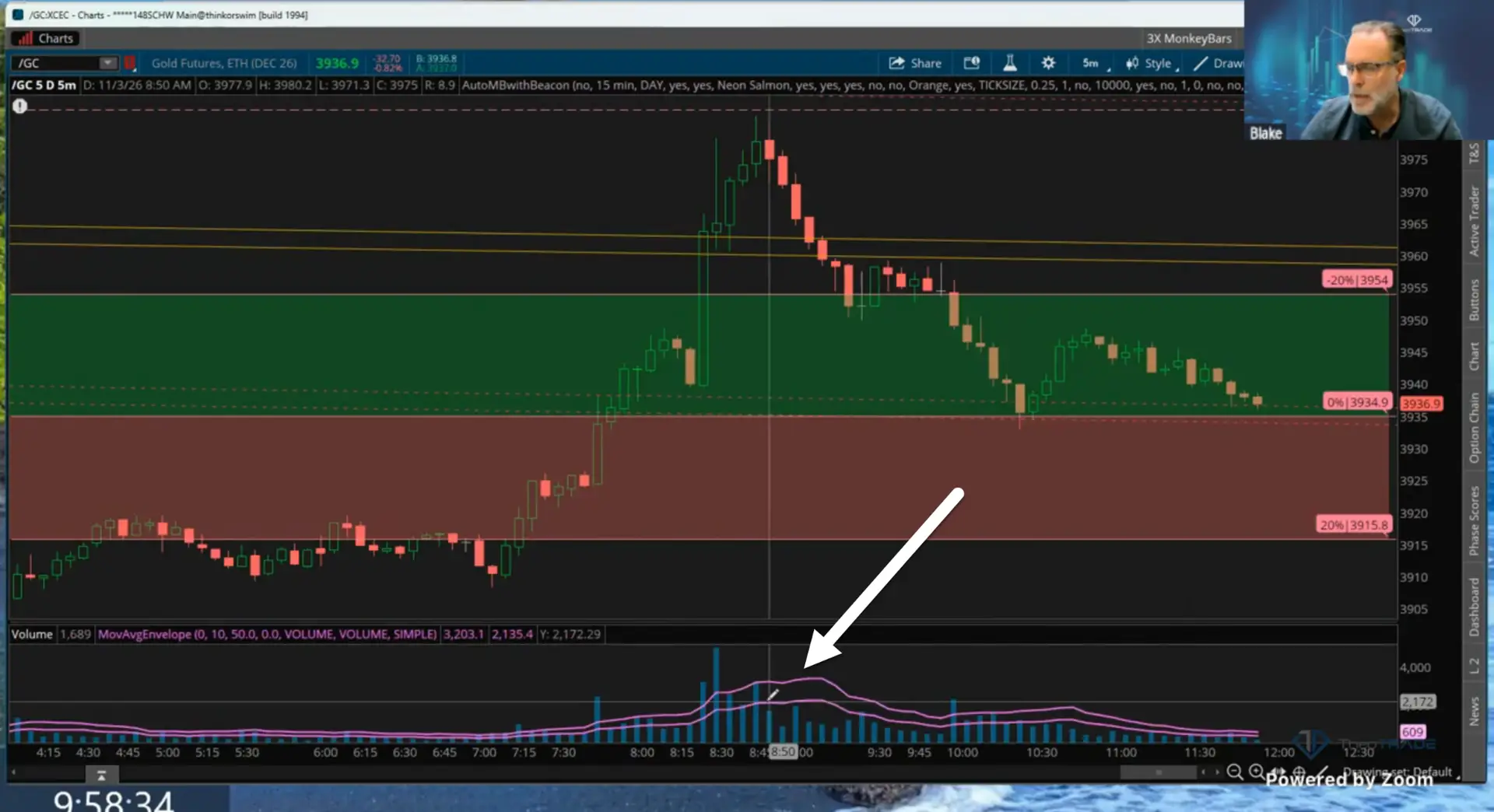
That one-tenth reading explains a lot. With so few traders around, I didn’t expect a big breakout, only a struggle at every level on the way up.
A target nearly 30 points away asked a lot from a market that empty. When you pick your profit target in a market that quiet, give the levels in between more respect.
Crude Ran On The Same Fumes
My crude long showed the same thing. Its volume averaged about 3,000 contracts every five minutes early in the session, and later it was down around 550.
Crude did push through the halfway mark of its move at 96.60. That let me move my stop up to 96.06, which protected the trade.
I still had my doubts about the full 97.14 target. A big group of sellers sat right between price and that level, and volume was thin.
That seller group mattered more on a quiet day, and it’s exactly what you weigh when you pick your profit target.
I never reported an exit on that crude long before the session ended, so I won’t claim a result on it.
How To Use Volume To Pick Your Profit Target
Use the check the same way on gold, crude or anything else before you pick your profit target. You’re asking whether enough traders are around to carry price as far as you want it to go.
If volume is holding near the morning baseline, a far target has the fuel to get there. When volume starts climbing again, I start watching for trades.
If volume has dried up to a fraction, I expect price to stall at each level along the way. A fade on no volume is where I start looking for bounces instead of breakouts.
A far target needs volume behind it, so respect the levels in between when the volume disappears.
Sometimes the read tells you to sit on your hands. A member named Thomas said it’s better to do nothing when you don’t know what to do, and I agreed with him.
I also told the room that runs against human nature. We’re always looking for a justification to do something.
None of this tells you for certain where price will go. It does tell you how much faith to put in a far target before you pick your profit target.
That’s my line, and it doesn’t have to be yours.
I measured gold’s volume live on Tuesday and showed members how to build the study on their own charts. You can watch me run that check every morning in the room.
Inside the 10% Club, every trade I call comes with an entry, a stop and a target in the alert. You also hear why I hold, tighten or pass while the market is still open.
Check the volume first, then pick your profit target.
Blake Young
Senior Market Strategist, TheoTRADE