Hey Trader,
What do you think markets care about more: earnings or sales?
I’ll give you the professor’s answer. Whether earnings or sales matter more depends on the company.
That answer matters more than it sounds. Look at the wrong number, and you can buy a stock that’s quietly falling apart.
Today I’ll show you how I pick between earnings or sales on any stock. It takes three quick checks you can run before you buy.
Take Angi, the company behind Angie’s List. Two years ago it traded at $20, and today it’s sitting around $6.
Its sales per share keep sliding, and I think it’s one step away from bankruptcy. Investors are watching the sales instead of the earnings, and I think they’re right.
Shopify is the opposite. It’s still growing, so I lean on its sales while the earnings catch up.
I still won’t pay any price for that growth. At nearly 100x earnings, one miss could gap it down to 80.
Then there’s Upwork, which doesn’t build anything at all. I go straight to its return on equity, the profit it earns on shareholders’ money.
Each of those stocks runs on a different number. Angi lives or dies on its sales.
Upwork runs on return on equity. Shopify needs its earnings to catch up fast enough to justify 100x.
Once you know which number matters, you can stop guessing. You’ll know whether a stock deserves your money or only looks cheap.
I’m a number-crunching geek. I ran a hedge fund, and I’m a professor.
Let’s start with Upwork.
When A Company Builds Nothing, Check Its ROE
Upwork connects businesses with freelance talent. It isn’t a car company or a technology manufacturer.
Earnings or sales alone won’t tell you enough about Upwork. It doesn’t create anything.
Return on assets judges how well a company uses what it owns. I push it aside here.
Return on equity drives a business like this one. Asset turnover is the other number I watch.
Asset turnover measures how much in sales a company generates from its assets. Transaction companies live and die by it.
Upwork’s asset turnover is declining. So is its return on equity.
Its earnings per share are in sequential decline. Its sales per share have stalled.
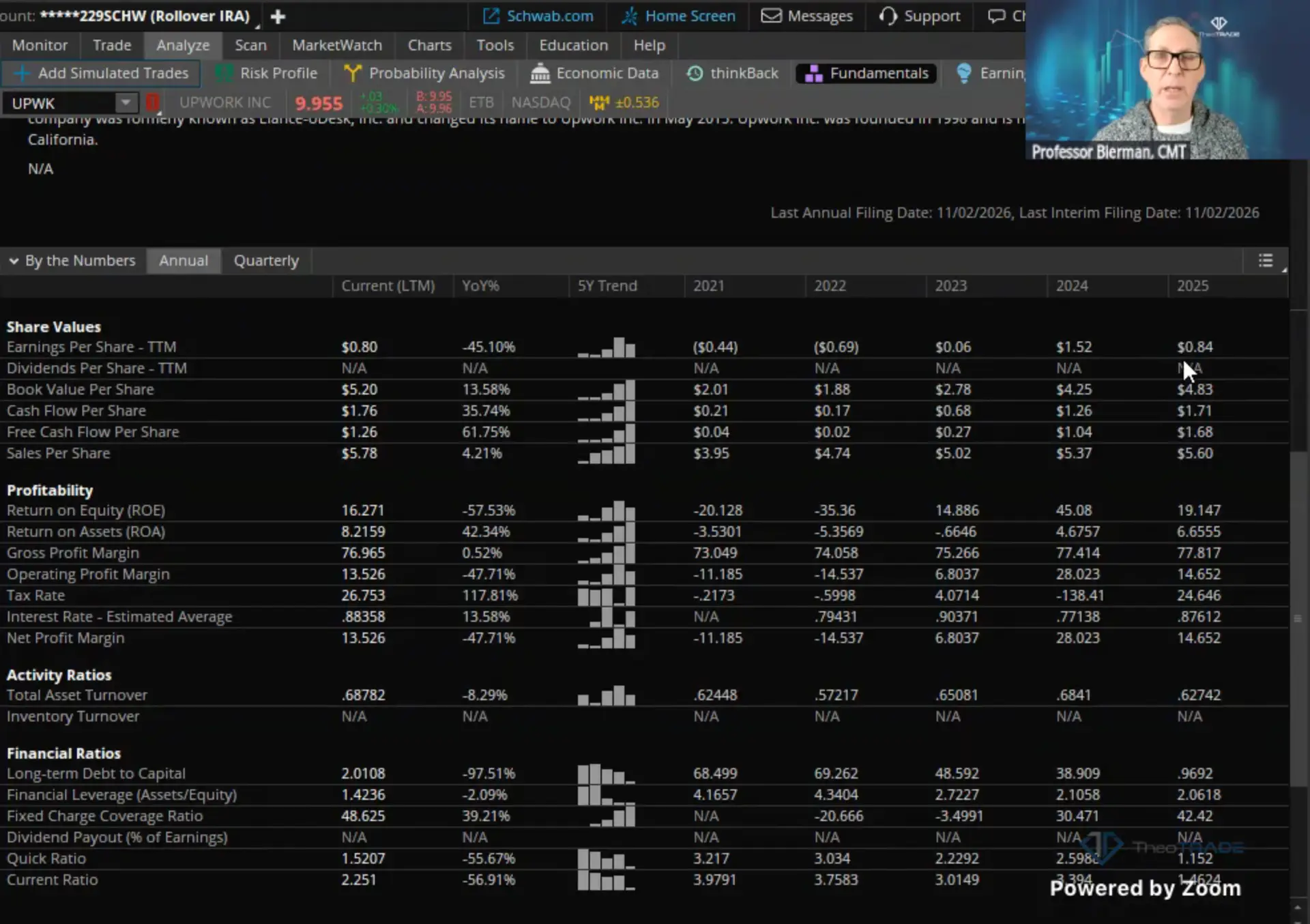
Upwork isn’t going out of business, though. It’s heavily liquid with virtually no debt.
Its book value sits around $5 a share. I see that as the floor.
Over the last four quarters, it earned about $1.35 a share. That puts its PE near 8.
The PE is the price you pay for every $1 a company earns. At 8, I don’t see this stock going to zero.
I’d rather own Upwork than Shopify. I just don’t have a catalyst to lift it.
I’m a trader. For now, I’m sitting and watching.
Growing Companies Get Graded On Sales
Shopify runs a different business. It gives merchants tools to manage inventory, process payments and ship orders.
Its earnings per share haven’t really been on the rise. Its sales per share have been really good.
When I weigh earnings or sales on a young, growing company, I lean on sales. The earnings come once sales reach scale.
I only give that slack so far. Shopify’s return on equity is declining, and I treat that as a red flag.
It tells me margins are shrinking as the business gets more competitive.
Then I check the price. Shopify earned about $1.50 a share, putting its PE near 100.
Paying 100x only makes sense if the company keeps growing near 100%. I think Shopify could.
Coke couldn’t do that. Neither could Chevron or Cisco.
Shopify beat last quarter by 16 cents. I want to see about 60 cents next quarter.
If it falls short, the multiple can compress fast. The stock could gap down to 80.
I don’t like the valuation. I’m not buying it.
Earnings Or Sales: Why Angi’s Sales Come First
Angi (ANGI) runs Angie’s List. It connects homeowners with plumbers, handymen and other local pros.
I heavily favor earnings over sales. With Angi, the earnings or sales question isn’t close.
Its sales per share keep declining. If the sales don’t keep up, the earnings won’t either.
Competition makes that worse. I don’t see why Home Depot and Lowe’s couldn’t build the same thing and squash Angi.
Companies like Angi don’t get a mulligan when sales slip. Its debt sits at 37%.
Its liquidity keeps dropping too. I wouldn’t buy this stock, and I think it could get delisted at some point.
I favor earnings over sales. A company’s life cycle, size and business model decide whether I trust earnings or sales.
How I Decide Between Earnings Or Sales
Before I buy any stock, I run three quick checks:
- Ask what the company creates. A platform that creates nothing runs on return on equity and asset turnover.
- Place it in its life cycle. A company’s stage tells you whether earnings or sales come first.
- Hold the price to the number. At 100x earnings, Shopify needs about 60 cents next quarter.
Skip these checks, and you’ll grade Shopify like Coke. You’ll also miss what Angi’s sales were telling you.
I never fall in love with a stock. I sell when it stops doing what it’s supposed to.
I also sell when the valuation turns obscene.
Do the research. I can’t do it for you.
The chart alone isn’t enough to make me buy. It isn’t enough to make me short either.
I blend the technicals with the fundamentals. That’s how I find a diamond in the rough.
Find the number the business runs on before you decide what the stock is worth.
The numbers tell me what a stock is worth. They don’t tell me when money starts moving into it.
My Burn Signal alerts handle that part. Every one starts with a lonely candle on a stock nobody’s talking about.
Then I check what’s building underneath it. One of my four signs, the Fuel Line, tracks money moving in or out before the price does.
At least one more sign has to line up behind the lonely candle. Only then does the alert go out.
Each alert gives you the ticker and the signs that triggered it. You also get a stock play and an options play.
Alerts come about twice a week. You decide how to trade each one.
You’re covered by a 30-day money-back guarantee. You also get a new 90-day, 10-trade guarantee.
Professor Jeffrey Bierman
Creator of the Genesis COG System