Hey trader,
Wednesday’s rebound in the Nasdaq felt sudden to a lot of traders. I wasn’t surprised, because I’d been watching for a market turning point.
I’d flagged the level where it turned with my members ahead of time. You’ve probably heard that nobody can time the market, and I know that’s not true.
A market turning point is the spot where a falling market changes direction. Few traders learn what one looks like while it’s still forming.
Traders who miss it get hurt twice. They sell near the low out of fear and buy back in once it feels safe.
Today I’ll show you the clue I watch for at a market turning point, using this week’s charts. Once you can spot it, you can stop guessing at bottoms and start waiting for the turn.
Before you grab your seat, here’s what Wednesday’s market turning point looked like before anyone believed it.
Where I Expected the Nasdaq to Find Support
I had marked one area on the Nasdaq’s weekly chart before the bounce. It was a fair value gap, which is a zone price raced through so fast that it left a gap in trading behind. Whenever you see a wide green or red candle body, there’s a good chance that created a fair value gap.
That zone used to be resistance. But, once price broke above it, the old ceiling became a ledge the market could land on.
Price came right down into it.
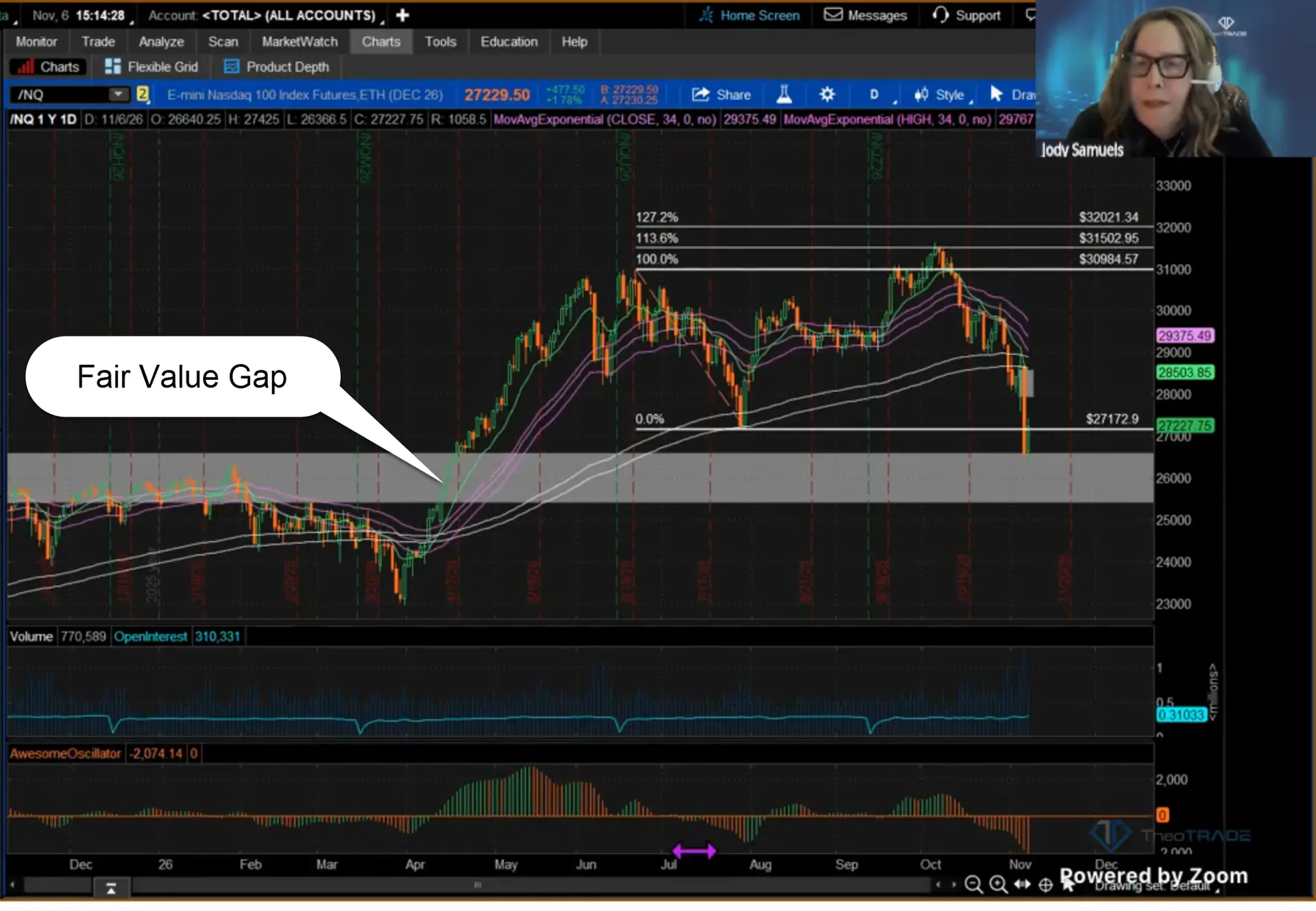
I didn’t know the Nasdaq would stop there. I did know it was a significant level for at least a bounce.
That level told me where to look. It couldn’t tell me when to buy.
Why Price Goes Quiet at a Market Turning Point
On the hourly chart, the move into the low turned choppy. Price drifted sideways and made slight new lows instead of falling cleanly.
The ES showed the same behavior. Cisco did too, making new lows before it slipped into its own area of indecision.
That chop is common at a market turning point. Traders at the lows are trying to figure out whether they’re looking at a quick bounce, a correction or another leg down.
Nobody wants to commit while that question is open. Traders tend to wait until price starts moving up, and you’ve probably traded that way yourself.
Institutions add fuel once the turn finally comes. Big players who hedged on the way down have to unwind those hedges, because nobody wants to miss the move.
That buying pushes prices higher in a hurry. By early Wednesday afternoon, the Nasdaq was up 2.61% and the ES was up 1.35%.
The Clue That Confirms a Market Turning Point
Chop on its own doesn’t give me a trade. I wait for price to break out of it with strong, impulsive candles that take out the recent highs.
That breakout confirms the market turning point. Traders who were sitting on their hands start jumping in.
Cisco gave me a clean example on the hourly chart. After its area of indecision, a run of strong green candles told me it might be turning around.
I also like to see divergence on the Awesome Oscillator, which is a momentum indicator. Divergence shows up when price makes a new low while the oscillator makes a higher low.
I treat that divergence as one more reason to trust a market turning point off the lows.
How to Spot a Market Turning Point on Your Own Charts
You can look for a market turning point the next time a market you follow starts to fall. Here’s the sequence I use:
- Mark your level ahead of time, so you know where a turn could start.
- Expect chop at the lows, and don’t treat every small bounce as the bottom.
- Wait for strong candles that take out the recent highs before you call it a turn.
- Look for Awesome Oscillator divergence as extra confirmation.
A real turn rarely moves in a straight line. After Wednesday’s run, I measured the Nasdaq’s bounce with Fibonacci levels from the swing high to the swing low.
The Nasdaq sits between the 38.2% and 50% retracement levels. The ES has already reached 61.8%.
I’d expect some kind of pullback from here. The next few days probably won’t be so straightforward, so I’ll follow price day to day.
This chop-then-break behavior shows up very often at a market turning point, though not every time. I let the market prove itself before I commit, and that patience keeps me out of a lot of false bottoms.
Jody Samuels
Queen of Quid